

.webp)

.svg)
Best digital marketing packages for small businesses

For most UK small businesses, Hook-digital’s growth retainer sits at the sweet spot: it combines local SEO, social media management, and Google Ads into a single managed package, typically ranging from £800 to £1,500 per month. If you are just starting out, a starter package (£400–£700/month) covering SEO foundations and social posting is a sensible first step. Businesses ready to scale with paid media and content should look at a full-service retainer (£1,500–£2,500+/month).
Hook-digital is an Oxford-based, full-service marketing agency — meaning you get branding, SEO, PPC, social, content, and website work from one team rather than juggling three separate suppliers. Every package is built around measurable outcomes: qualified leads, bookings, and sales, not vanity metrics like follower counts.
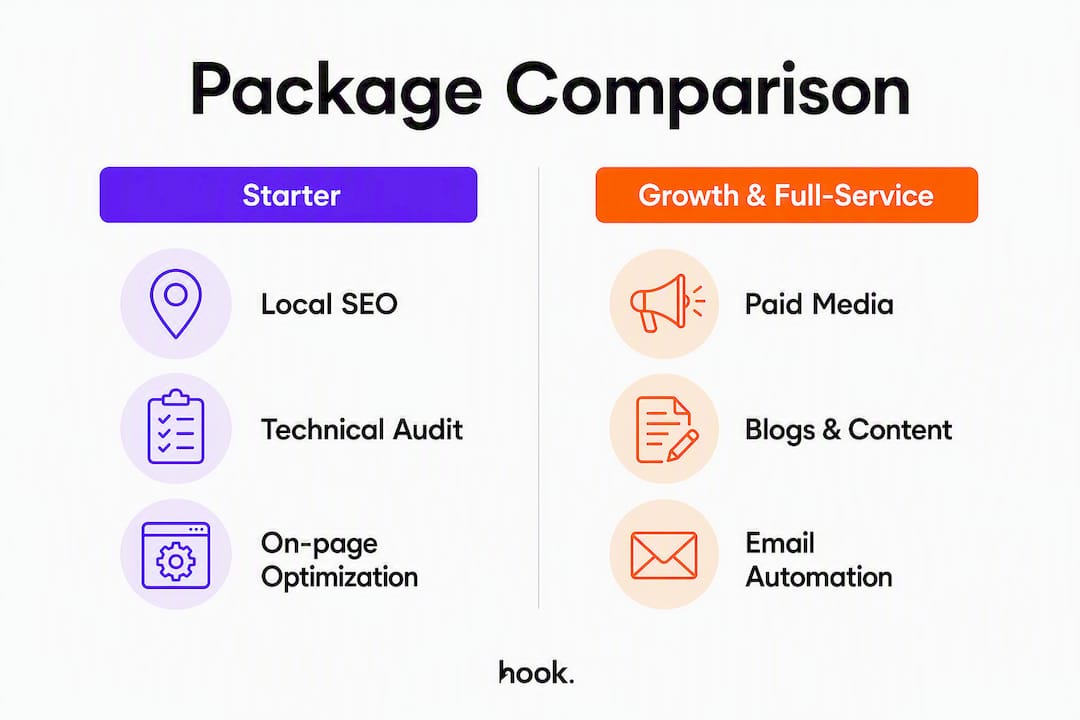
- Starter: £400–£700/month. SEO foundations, 8–12 social posts/month, monthly reporting. Best for new businesses building visibility.
- Growth retainer: £800–£1,500/month. SEO, Google Ads, social, content, and a dedicated account manager. Best for local service businesses and ecommerce looking for consistent lead flow.
- Full-service retainer: £1,500–£2,500+/month. All channels, bespoke website work, email/automation, CRO, and weekly reporting. Best for businesses ready to scale aggressively.
Table of Contents
- How do Hook-digital’s package tiers compare side by side?
- What does each package actually deliver for your business?
- How do you choose the right package for your small business?
- What should UK small businesses expect to pay?
- When should you expect to see results?
- How Hook-digital works with UK small businesses
- Key takeaways
- What most agencies get wrong about small business packages
- Ready to find the right package for your business?
- Useful sources and further reading
- FAQ
How do Hook-digital’s package tiers compare side by side?
| Starter | Growth Retainer | Full-Service Retainer | |
|---|---|---|---|
| Monthly cost (approx.) | £400–£700 | £800–£1,500 | £1,500–£2,500+ |
| Channels included | SEO, Social | SEO, PPC, Social, Content | SEO, PPC, Social, Content, Email, Website, CRO |
| Deliverables | 8–12 social posts, 3–5 target keywords, on-page SEO | 12–16 social posts, 1–2 blog posts, 5–10 keywords, Google Ads setup + optimisation | 16–20 social posts, 3–4 blog posts, 10+ keywords, full ad management, email flows, landing pages |
| Contract type | Rolling monthly or 3-month minimum | 3–6 month minimum | 6-month minimum |
| Reporting cadence | Monthly report, email support | Monthly report + mid-month check-in, dedicated account manager | Weekly updates, monthly deep-dive, named account manager |
| Best for | New businesses, tight budgets, local visibility | Local service businesses, ecommerce, consistent lead generation | Scaling businesses, multi-channel growth, high-competition markets |
Starter suits a business that needs to get found locally before spending on paid media. Growth retainer is where most UK small businesses will spend the majority of their agency relationship — it covers the channels that drive the fastest measurable return. Full-service retainer makes sense when you have proven a channel works and want to press harder across all of them simultaneously.
What does each package actually deliver for your business?
Understanding what you are paying for, channel by channel, is the fastest way to avoid a bad agency relationship.
SEO
A starter package typically covers a technical audit, on-page optimisation for 3–5 target keywords, and local citation building (Google Business Profile, Bing Places). Growth and full-service tiers extend this to 5–10+ keywords, monthly content targeting new search terms, and affordable SEO strategies that prioritise leads and bookings over raw traffic. The metric that matters here is not sessions — it is enquiries from priority search terms.

PPC and Google Ads
PPC is available from the growth retainer upwards. Expect campaign setup, keyword research, ad copy creation, and monthly bid optimisation. A well-run Google Ads campaign for a local service business can generate leads within days of launch. Hook-digital manages the full Google Ads process — from account structure to conversion tracking — so your budget is mapped to actual enquiries, not clicks.
Social media
- Starter: 8–12 posts per month across 1–2 platforms (typically Facebook and Instagram).
- Growth: 12–16 posts, platform-specific creative, story content, and basic community management.
- Full-service: 16–20 posts, video content, paid social integration, and performance reporting by post type.
Content and blog
Growth and full-service tiers include 1–4 blog posts per month, written to target specific search queries and support the sales funnel. Landing pages and service-page copy are included in full-service packages.

Email and automation
Full-service packages include email workflows — welcome sequences, re-engagement campaigns, and segment-driven newsletters. Marketing automation scales retention without proportionally scaling effort, which is why it tends to deliver strong repeat-purchase value for ecommerce and service businesses alike.
Reporting
Every tier includes monthly reporting. Growth and full-service clients receive a short KPI dashboard covering qualified leads, cost per lead, sessions from priority keywords, and conversion rate. The goal is a tight set of 3–5 metrics tied directly to revenue, not a 40-page report full of numbers that do not connect to your bottom line.
How do you choose the right package for your small business?
Match the package to your immediate revenue lever: local visibility, paid leads, or conversion improvement. That single rule resolves most decisions before you even open a proposal.
Diagnostic questions to ask before you commit:
- What is your primary goal right now — more enquiries, more online sales, or better brand recognition?
- What is your realistic monthly marketing budget, including any ad spend on top of agency fees?
- How long is your typical sales cycle? (A solicitor with a 3-month sales cycle needs different channels than a restaurant taking same-day bookings.)
- Do you have existing analytics access — GA4, Search Console, a CRM? If not, who sets it up?
- How much internal capacity do you have to review and approve content each month?
- Are you in a competitive local market where rivals are already running paid ads?
Red flags to watch for in any package:
- KPIs defined as “increased brand awareness” with no measurable metric attached.
- Minimum terms longer than 6 months with no break clause or performance review.
- Reporting delivered as a PDF with no live dashboard or account manager call.
- Setup fees that are not clearly itemised in the proposal.
- No mention of conversion tracking or GA4 setup in the onboarding plan.
Contractual checklist before signing:
- Setup fee (one-off vs. included in month one)
- Notice period for cancellation (30 days is standard; 90 days is a red flag)
- Deliverable cadence (what is delivered, by when, each month)
- Ad spend: is it included or billed separately?
- Ownership of ad accounts, website, and content assets on exit
Pro Tip: Ask any prospective agency to show you a real monthly report from a current client (anonymised). If they cannot, or if the report focuses on impressions rather than leads, that tells you everything you need to know about how they measure success.
The Digital Marketing Institute’s strategy checklist recommends defining SMART objectives before selecting any channel — a principle that applies equally when evaluating packages. Use Hook-digital’s agency evaluation checklist to score any provider against the criteria above.
What should UK small businesses expect to pay?
Pricing for small-business digital marketing packages in the UK varies by channel count, ad spend, and market complexity. Here is a realistic picture:
- Starter packages (£400–£700/month): SEO and social only. No paid media. Suited to businesses with a 6–12 month runway before they need paid leads.
- Growth retainers (£800–£1,500/month): The most common spend for UK SMEs running 2–3 channels. Ad spend is usually billed separately on top of the management fee.
- Full-service retainers (£1,500–£2,500+/month): Multi-channel, including website maintenance, email, and CRO. Typically includes a named account manager and weekly reporting.
What drives the cost up:
- Adding paid media channels (each requires setup, ongoing optimisation, and reporting).
- Bespoke website work or landing page builds.
- High-competition industries (legal, finance, property) where keyword costs are higher.
- Localisation across multiple geographic areas.
- Content volume — more blog posts and videos mean more production time.
Contract models to know:
- Retainer: Fixed monthly fee for an agreed scope. Predictable for budgeting; most common for ongoing SEO and social.
- Fixed project: One-off fee for a defined deliverable (website build, brand identity). No ongoing commitment.
- Performance-linked: Fee tied partly to leads or revenue. Less common for small businesses; requires robust tracking to be fair to both sides.
For a local tradesperson or independent retailer, a growth retainer at £800–£1,500/month covering SEO and Google Ads typically makes more sense than a large one-off website project with no ongoing promotion. A professional services firm (accountant, solicitor) often starts with SEO and content before adding PPC once organic rankings begin to generate enquiries.
When should you expect to see results?
Timing varies significantly by channel, and setting the right expectations at the start of an engagement prevents a lot of unnecessary anxiety at month two.
| Channel | Earliest measurable win | Typical time to business impact |
|---|---|---|
| Google Ads (PPC) | 3 days (first clicks and leads) | 2–4 weeks (optimised cost per lead) |
| Local SEO | 4–6 weeks (Google Business Profile improvements) | 8–12 weeks (local pack visibility) |
| Full SEO (organic rankings) | 6–8 weeks (technical fixes indexed) | 3–6 months (page-one rankings for target terms) |
| Content marketing | 4–8 weeks (pages indexed) | 3–6 months (traffic and lead contribution) |
| Social media | 2–4 weeks (engagement lift) | 1–3 months (community growth, referral traffic) |
| Email and automation | 1–2 weeks (first sends) | 4–8 weeks (measurable retention uplift) |
Early wins in the first 30–90 days that any good agency should deliver regardless of tier:
- Technical SEO fixes (page speed, broken links, meta titles) that improve crawlability immediately.
- Google Business Profile optimisation — one of the fastest ways to improve local visibility.
- A small PPC test (£200–£500 ad spend) to validate keyword demand before scaling.
- Conversion tracking set up correctly in GA4, so every subsequent decision is based on real data.
A hybrid approach — starter SEO combined with a small PPC test — is often the most efficient way for a UK small business to get early signals without a large upfront commitment. It lets you see which channel generates leads at an acceptable cost before doubling down.
How Hook-digital works with UK small businesses
Hook-digital’s process is built around a single principle: every activity should connect to a business outcome you can measure. Here is how a typical engagement runs:
- Discovery call: Understand your goals, current marketing, competitors, and budget. No jargon, no pressure.
- Audit and strategy: A review of your website, analytics, search visibility, and social presence. Produces a prioritised action plan.
- Setup and onboarding: GA4 and conversion tracking, ad account access, CRM integration, and content calendar agreed. This happens in week one — not week four.
- Execution: Campaigns go live, content is published, and SEO work begins. You receive a shared content calendar and approval workflow.
- Optimisation: Monthly (or weekly, on full-service) review of performance data. Budgets and tactics adjusted based on what is working.
- Reporting: A clear KPI dashboard covering leads, cost per lead, keyword rankings, and conversion rate. Delivered with a brief written commentary, not a wall of charts.
Onboarding checklist for new clients:
- GA4 and Search Console access confirmed
- Conversion goals set up (form fills, calls, purchases)
- Ad account ownership transferred to client (not agency)
- Target keywords and competitor set agreed
- Content approval process and turnaround times documented
- First review milestone set (typically 30 days)
Hook-digital covers the full range of services — branding, design, video, photography, websites, social, Google Ads, and SEO — so you work with one team rather than briefing four. Client reviews on Clutch consistently show that responsiveness and measurable outcomes are the two factors that determine whether a small business stays with an agency long-term. Hook-digital’s bespoke packages are built around both.
Key takeaways
The most effective digital marketing packages for small businesses match the package tier to the business’s immediate revenue lever — local visibility, paid leads, or conversion improvement — rather than buying channels for their own sake.
| Point | Details |
|---|---|
| Match tier to revenue lever | Choose starter for visibility, growth retainer for leads, full-service for scaling across all channels. |
| Pricing benchmarks | Starter: £400–£700/month; Growth: £800–£1,500/month; Full-service: £1,500–£2,500+/month. |
| Results take time by channel | PPC delivers leads in days; local SEO takes 8–12 weeks; full organic rankings take 3–6 months. |
| Insist on outcome-based KPIs | Report on qualified leads and cost per lead, not impressions or follower counts. |
| Hook-digital recommendation | Hook-digital’s growth retainer is the recommended starting point for most UK small businesses seeking measurable lead generation. |
What most agencies get wrong about small business packages
There is a tendency in this industry to sell channel activity as the product. You buy “12 social posts a month” and “weekly blog content” and the agency ticks those boxes faithfully — while your phone stays quiet. The deliverable is not the outcome.
The packages that actually work for small businesses are the ones where the agency starts with a revenue question: how many leads do you need this month, at what cost, to hit your target? Everything else — which channels, how many posts, what ad spend — flows from that answer. A business that needs 20 new enquiries a month from local search has a completely different package requirement than one trying to build a national ecommerce audience.
Hook-digital’s approach is to tie every pound of spend to a trackable business outcome. That means setting up conversion tracking properly on day one, agreeing a short KPI set before any creative work begins, and reviewing performance against those KPIs monthly rather than presenting a report full of metrics that sound impressive but do not connect to revenue. For small businesses in particular, where every £500 of monthly spend matters, that discipline is not a nice extra — it is the whole point.
Ready to find the right package for your business?
Hook-digital offers a free initial consultation for UK small businesses — no obligation, no hard sell. Before the call, it helps to have three things ready: your monthly marketing budget (including any ad spend), your top three business goals for the next 12 months, and access to your current analytics (GA4 or Google Search Console if you have them).
On the call, Hook-digital’s team will review your current online presence, identify the quickest wins, and recommend the package tier that fits your goals and budget. You will leave with a clear picture of what is possible and what it will cost — whether or not you decide to work together.
Hook-digital handles everything from branding and design to SEO, paid media, and social — all under one roof in Oxford. No coordinating between agencies, no briefing the same background three times.
Book your free consultation and find out which package is the right fit for your business.
Useful sources and further reading
- What is full-service digital marketing? | Hook-digital — explains the single-supplier model and typical deliverables across all channels.
- Bespoke marketing services for small businesses | Hook-digital — outlines Hook-digital’s outcome-focused approach and flexible engagement models.
- Marketing tools for small business owners: 2026 guide | Hook-digital — helps you decide which tasks to keep in-house and which to hand to an agency.
- 8 steps to a digital marketing strategy for small businesses | Digital Marketing Institute — a practical strategy checklist covering SMART objectives, channel selection, and budgeting.
- Affordable SEO strategies for small business growth | Depechecode — practical SEO tactics focused on measurable outcomes rather than vanity metrics.
- Marketing automation strategies for small business growth | TTOY Digital — covers email workflows and automation approaches that improve retention and repeat revenue.
- What is digital marketing? A guide for business owners | Hook-digital — foundational reading for business owners newer to digital channels.
FAQ
How much should a small business pay for digital marketing?
Most UK small businesses spend £400–£1,500 per month on a managed digital marketing package, depending on the number of channels and whether paid media is included. Ad spend is usually billed separately on top of the agency management fee.
Is digital marketing still worth it for small businesses?
Yes — particularly local SEO and Google Ads, which connect directly to purchase-ready buyers. The key is measuring results against qualified leads and cost per lead rather than traffic or impressions.
How do you choose the right digital marketing package?
Match the package to your immediate revenue lever: if you need local visibility quickly, start with SEO and Google Business Profile; if you need leads now, add PPC. Use the Digital Marketing Institute’s strategy checklist to set SMART objectives before committing to any package.
How do you market a small business online with a limited budget?
A starter package combining local SEO and a small PPC test (£200–£500 ad spend) gives you early data on which channel generates leads at an acceptable cost, without a large upfront commitment.
What does the 70/20/10 rule mean in digital marketing?
It is a budget allocation model allocating most spend on proven channels, some on emerging tactics, and a smaller portion on experimental tests. For small businesses, it is a useful framework for deciding how much to allocate to established channels like SEO versus newer ones like short-form video.
Recommended
- Marketing tools for small business owners: 2026 guide | Hook Digital - Oxford’s Premier Full-Service Marketing Agency
- Unlock Your Small Business’ Potential with Hook Digital’s Bespoke Marketing Services | Hook Digital - Oxford’s Premier Full-Service Marketing Agency
- How AI can revolutionise social media and marketing for small businesses | Hook Digital - Oxford’s Premier Full-Service Marketing Agency
- How Can Businesses Use Social Media for Marketing | Hook Digital - Oxford’s Premier Full-Service Marketing Agency
.png)


