


Brochure Sizes in the UK: A4, A5, A6 and DL Explained

Most UK brochures are A4 (210 × 297 mm) or A5 (148 × 210 mm). Leaflets and flyers more often use A5, A6 or DL (99 × 210 mm). The right choice depends on where the piece will be handed over, how much it has to say and how it will travel. The size should be settled before design starts, because layout, photography and copy all follow from it. We design brochures as part of a wider branding and design service, and the first question we ask is always how the piece will be used, not which size looks nicest.
TL;DR
- A4 (210 × 297 mm) suits catalogues, company brochures and reports. A5 (148 × 210 mm) is the all-round promotional size. A6 (105 × 148 mm) is pocket-sized for simple messages.
- DL (99 × 210 mm) is one third of an A4 sheet, which is why a tri-fold brochure or a rack leaflet is usually DL.
- Folded sizes are quoted as the open sheet. An A4 sheet folded once gives A5 with four panels, and folded in three gives DL with six.
- Add 3 mm of bleed on every edge of your artwork, so an A5 file is 154 × 216 mm.
- Size affects postage as well as print. Product photography for a brochure typically runs from £5 to £35 per packshot, or £400 to £675 for a full day.
Table of Contents
- The standard UK brochure sizes at a glance
- A4 or A5: which should your brochure be?
- DL: the size that is not an A size
- Leaflet sizes: A5, A6 and DL in practice
- How folds change the size
- Getting the file right: bleed and proofing
- Size, weight and postage
- What brochure photography costs
- What brochure design costs
- Choosing your size in five questions
- Promo: one team for the whole brochure
- Perspective
- FAQ
- Sources
The standard UK brochure sizes at a glance
UK print follows the ISO A series. Each size is half the one above it, with the same proportions. That is why an A5 design scales up to A4 or down to A6 without awkward cropping, though small text needs checking for readability at A6, as fPrint’s size guide points out.
The formats you will be offered by most UK printers, as listed in a UK booklet size guide, are these:
| Format | Size (width × height) | Typical use |
|---|---|---|
| A4 | 210 × 297 mm | Product catalogues, company brochures, reports, service guides |
| A5 | 148 × 210 mm | Event guides, promotional brochures, price lists, menus |
| A6 | 105 × 148 mm | Handouts, pocket reminders, simple messages |
| DL | 99 × 210 mm | Tri-fold brochures, rack leaflets, mailshots, menus |
| Medium square | 148 × 148 mm | Distinctive promotional pieces |
| Large square | 210 × 210 mm | Showpiece brochures and lookbooks |
A note on how sizes are written. Print people give width first, then height, for a portrait page. Some references list A4 as 297 × 210 mm, which is the same sheet turned on its side, so check the orientation before you brief anyone.
You may also see US sizes such as Letter (8.5 × 11 inches) quoted in guides written for other markets. For a UK audience, stick to the A series. UK printers, envelopes and display racks are all built around it.
A4 or A5: which should your brochure be?
This is the question most Oxfordshire business owners ask first, and the honest answer is that it depends on the job the brochure does.
When A4 earns its space
A4 is the largest standard brochure size. It suits company brochures, product catalogues, corporate reports and service guides, anything with a lot of information or large images. It also tends to be what an audience pictures when they hear the word brochure, which one printer’s format guide suggests helps engagement.
Choose A4 when:
- you have a range of products or services that need a page each
- your photography is strong enough to run large
- the brochure will be handed over in a meeting, sent as a PDF as well, or left in a reception area
- you are a professional services firm, developer or manufacturer whose buyers expect something substantial
When A5 is the better fit
A5 is half the sheet, compact and cost-effective. It works well for event guides, promotional brochures, price lists and menus. It is also cheaper to post, which matters more than most people expect (more on that below).
Choose A5 when:
- the brochure is mailed, dropped through letterboxes or handed out at events
- you have one clear message and a handful of services
- the reader should be able to hold it in one hand
- you want a booklet that feels designed rather than corporate
If you cannot decide, a common rule of thumb is to work back from the job: how much information must fit, how people will use it, where it will be seen, and whether the size suits your budget and quantity.
DL: the size that is not an A size
DL confuses people because it does not belong to the A series. It measures 99 × 210 mm, which is exactly one third of an A4 sheet (297 ÷ 3 = 99). Fold an A4 sheet in three and you get DL. It is the usual size for compliment slips, rack leaflets and tri-fold brochures.
One trap: a DL leaflet and a DL envelope are not the same size. A DL leaflet is 99 × 210 mm, while a DL envelope is 110 × 220 mm, a little larger so the leaflet slides in. A C5 envelope (162 × 229 mm) takes an A5 sheet or an A4 sheet folded once.
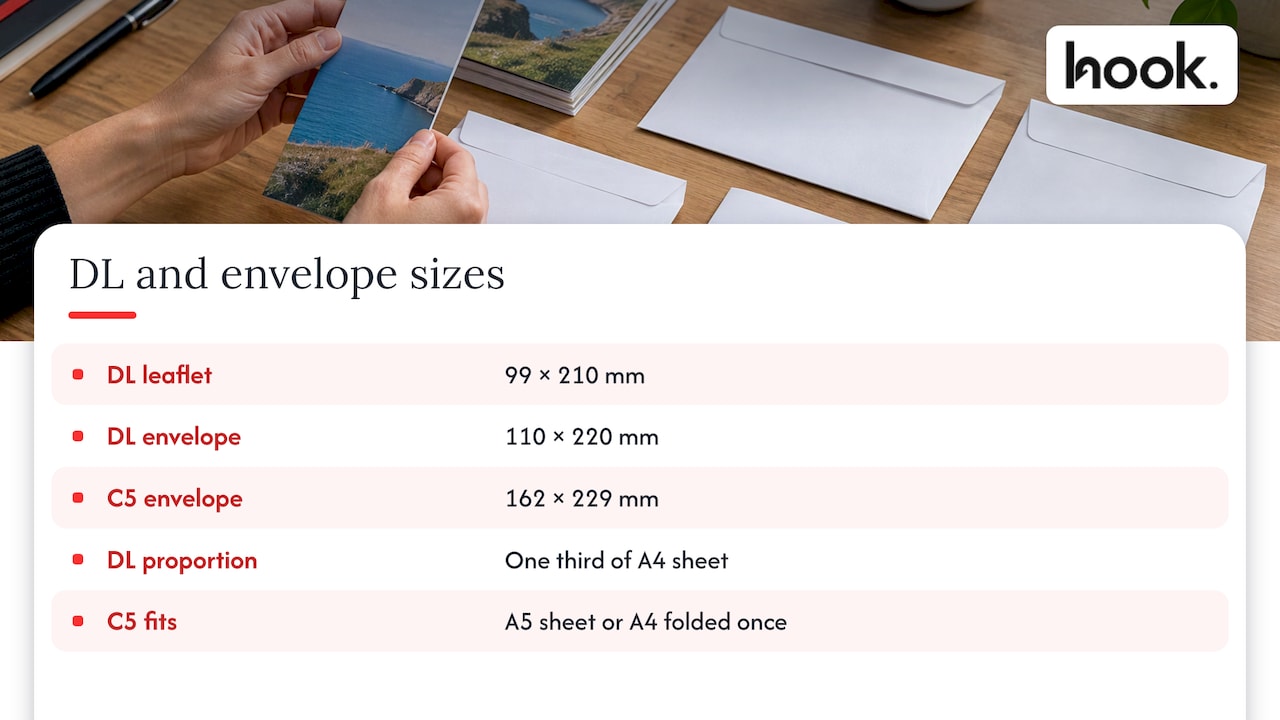
DL is a strong choice when the piece will sit in a leaflet rack, go out in a standard envelope or be tucked into a bag at an event. Its narrow shape also suits menus and price lists.
Leaflet sizes: A5, A6 and DL in practice
A lot of people searching for brochure sizes are really after leaflet sizes, and the formats are the same. What differs is the job.
According to a UK leaflet size guide:
- A5 is the usual choice for door drops, because it fits a letterbox without folding.
- A6 and DL suit counters, reception desks and leaflet racks.
- A4 and DL are common shapes for menus.
- A4 suits price lists and information sheets.
A5 is widely regarded as one of the most popular leaflet sizes in the UK, with A4, A6 and DL also in regular use. As a rough guide, A6 is for a simple message such as an offer or an event date, A5 for a promotional pitch with a call to action, and A4 when you need space for detail and photography.
A6 is the smallest standard size and works well as a physical reminder that bridges online and offline marketing, for example a card with a QR code that leads to your website.
How folds change the size
Folded brochures are listed by printers as the open sheet size, and the finished size depends on the fold. This catches people out when comparing quotes. As one catalogue explains, the useful question is what size you want in your hand and how many folds it needs, then you work back to the sheet.
| Open sheet | Fold | Closed size | Panels |
|---|---|---|---|
| A4 | Half fold | A5 | 4 |
| A4 | Roll or tri-fold | DL | 6 |
| A4 | Z-fold | DL | 6 |
| A5 | Half fold | A6 | 4 |
Folded leaflets typically start as an A4 sheet on 135gsm or 170gsm gloss, according to fPrint. Typical uses include A4 folded to A5 or DL for trade show handouts, pamphlets and price lists, and A5 folded to A6 for direct mail and street handouts.
Design tip: with a tri-fold, plan which panel the reader sees first when they open it, and keep your key message and contact details on separate panels. Folds also mean the panels are not always identical widths, so your designer needs the printer’s template before they start.
Getting the file right: bleed and proofing
Whatever size you choose, the artwork must extend past the trim line. This is called bleed, and it stops thin white edges appearing when the sheets are cut. The standard is 3 mm on every edge, so an A5 file is 154 × 216 mm and a DL file is 105 × 216 mm.
A short checklist before anything goes to print:
- Confirm the finished size and the fold type in writing.
- Set up the file with 3 mm bleed and keep text and logos clear of the trim edge.
- Print the design at its intended size and read it, to check the text is not cramped.
- Check images are high resolution for the size they will print at, and that colours are set up for print rather than screen.
- Agree the paper weight and finish, since this changes how the brochure feels as much as how it looks.
If your brochure is part of a wider brand refresh, it helps to have brand guidelines in place, so fonts, colours and logo spacing carry across every size you produce.
Size, weight and postage
If the brochure will be mailed, size is a budget decision as well as a design one. Most A5 brochures mailed on their own fall into the Royal Mail Large Letter band, while A4 brochures typically sit in Large Letter or, if thick, Small Parcel. The same source gives indicative 2026 Mailmark Large Letter rates of roughly 35p to 70p per item, depending on weight tier, presort level and volume.
At scale, postage can outweigh print. In that guide’s worked example, postage is about 60% of the budget for 2,000 A5 brochures, and moving the text stock from 150gsm to 130gsm saves 4 to 8 g across 16 pages. Postage rates change, so check Royal Mail’s current price guide before you commit to a mailing.
The practical lesson: decide the distribution method first, then the size and paper weight. A beautiful A4 brochure that tips every item into a higher postage band is an expensive way to find out.
What brochure photography costs
Photography is usually the biggest variable once the size is settled, and it is the part of a brochure readers remember. A study of 40 UK photographer price lists (August 2026) found:
| Item | Typical UK range |
|---|---|
| White-background packshot | £5 to £35 per image |
| Packshots at volume | £10 to £24 per image, with minimums of £125 to £150 |
| Product shoot, half day | £350 to £425 |
| Product shoot, full day | £400 to £675 |
| Styled or lifestyle shoot, full day | £600 to £845 |
The same study notes that prices move with usage rights, retouching (around £25 per image or £40 per hour extra), VAT treatment and location, with London at or above the top of each range. At the premium end, experienced specialists on elaborate advertising work may charge £750 to £1,100 or more per day, and large campaigns with crews, models and sets are priced individually.
The same guide makes a point worth remembering when you compare quotes: a £500 day rate that excludes studio hire, assistants and editing can end up costing more than a £750 package that includes them. Compare what each quote covers, not the headline figure.
Before you ask for any quote, count the images your brochure needs. An A4 catalogue with 40 products has a very different photography budget from an A5 services leaflet with six pictures. Our photos and videos service covers brand photography, product and commercial shoots and corporate and team portraits, and you can see more on our commercial photography page.
What brochure design costs
Design pricing varies too much to give an honest single number. It depends on page count, how much copy and photography you supply, whether the brochure needs a new identity behind it and how many rounds of changes you want. We do not publish a price list and we do not push forced packages: each project is scoped to what you actually need, so you pay for the pages, photography and copy that your brochure requires and nothing else.
To get a useful quote from any designer, bring:
- the finished size and fold
- the page count and quantity
- whether you have photography and copy ready
- where it will be distributed
- your deadline
Choosing your size in five questions
- Where will it be picked up? Racks and reception desks favour DL and A6. Meetings favour A4 and A5.
- How much do you need to say? One offer fits A6 or DL. A full range needs A4.
- Will it be posted? Lean towards A5 and lighter stock, and check the postage band first.
- How many will you print? A smaller sheet usually means a lower unit cost at volume, but confirm with your own quote.
- Does it sit alongside other materials? Stay within the A series where you can, so artwork can be scaled across formats.
Promo: one team for the whole brochure
A brochure rarely needs just one skill. It needs a clear idea of who it is for, a layout, photography, copy and often a matching web page or social campaign. Hook Digital is an Oxford-based full service marketing agency, so branding, design, photography, video, websites, social media, Google Ads and SEO sit under one roof, and you only have to talk to one team instead of coordinating several. Our full service marketing approach comes with a client portal for direct communication and updates, and a 48-hour turnaround on content and website amends.
If you have a brochure to produce, tell us the audience and how it will be handed out, and we will scope the design and photography around that. You can reach us through hook-digital.co.uk.
Perspective
Most brochure briefs we see start with a size and end with a problem. Someone picks A4 because it feels professional, then discovers the postage, the leaflet rack or the photography budget does not fit.
Our view is that the size is the last decision of the strategy, not the first. Start with the reader and the moment they pick the piece up. Then choose the format, the fold and the paper, and brief the photography to match.
That is why we prefer to handle design, photography and the follow-on digital work together. When the brochure, the product shots, the website page and the ad all come from one team, they look like they belong to the same business, and you are not passing files between agencies to make that happen.
Hook
FAQ
Are brochures A4 or A5 in the UK?
Both are standard. A4 is the choice for catalogues, reports and detailed company brochures, while A5 suits promotional pieces, price lists and event guides. A5 is also lighter and cheaper to post.
What size is DL in the UK?
DL is 99 × 210 mm, one third of an A4 sheet. It is the shape you get from folding A4 into three, and it is used for tri-fold brochures, rack leaflets and compliment slips. It is not part of the ISO A series.
What is the most common leaflet size in the UK?
A5 (148 × 210 mm) is the most common for door drops and events, with A6, A4 and DL all widely used. Which is best depends on whether the leaflet is posted, handed out or placed in a rack.
How much bleed should a brochure file have?
Add 3 mm of bleed on every edge. An A5 brochure page is therefore set up as 154 × 216 mm, and a DL page as 105 × 216 mm, with important text kept inside the trim line.
How much does product photography for a brochure cost?
A study of 40 UK price lists from August 2026 found white-background packshots at £5 to £35 per image and product shoots at £400 to £675 for a full day. Usage rights, retouching and location all move the final figure, so compare what each quote includes.
Sources
- UK booklet size guide
- Leaflet and flyer sizes guide
- Brochure printing guide
- Choosing the right format and binding for a printed brochure
- Paper sizes guide
- DL size guide
- Document size guide
- Leaflet sizes guide
- Best brochure sizes and formats
- Folded leaflet sizes explained
- Brochure and booklet printing costs 2026
- UK photography price list 2026
- How to choose a product photographer


