


Buyer Persona Examples for B2B Teams, With a Template

A good buyer persona is a short profile of the person who buys from you, built from what real customers told you rather than from guesswork. Below you will find four worked B2B examples you can adapt, a template to fill in, and a plain method for gathering the evidence behind it. The examples are illustrative: they show the shape of a persona, not real people, and yours should be built from your own customers.
If you run a business or a marketing team in Oxfordshire, the most useful persona is rarely one person. B2B purchases involve a budget holder, a day-to-day user and often someone who checks boxes. We build the persona first because every later decision, from the brand name to the ad targeting, gets easier once you know who you are talking to.
TL;DR
- A buyer persona is a semi-fictional profile built from real customer evidence: goals, frustrations, where they look for information and what makes them buy.
- In B2B, write one persona for each person in the buying decision, not one “ideal customer” for the whole company.
- Start with 5 to 10 conversations with current customers, plus your CRM, sales notes and enquiry data, before writing a word.
- Add a negative persona so you stop spending money on customers who will never be profitable.
- Use the finished personas to shape your brand name and messaging, website, content and ad campaigns.
Table of Contents
- What a buyer persona is, and what a useful one contains
- Four B2B buyer persona examples
- Who is in a B2B buying decision?
- A B2B buyer persona template you can copy
- How to create buyer personas from real evidence
- Putting personas to work
- Personas and your brand name
- Common mistakes with B2B personas
- How we can help
- Our view
- FAQ
- Sources
What a buyer persona is, and what a useful one contains
A buyer persona is a profile based on analysis and research of actual customers. That is how the UK government-backed NI Business Info guide to customer personas frames it, and the emphasis on “actual” matters. “Semi-fictional” means the name and the photo are invented for convenience, while the goals, frustrations and habits underneath come from evidence. A persona written from a hunch is a stereotype with a first name.
A useful persona answers six questions:
- Who are they? Job title, seniority, company size, sector.
- What are they trying to achieve? The goals their own boss measures them on.
- What gets in the way? Budget, time, internal approval, past bad experiences.
- Where do they look for answers? Search, LinkedIn, peers, trade bodies, events.
- What makes them hesitate? The objections you hear in sales conversations.
- What triggers the purchase? The moment they stop putting it off.
Demographics such as age matter far less in B2B than the role and the pressure that role is under. A 38-year-old and a 55-year-old operations director with the same targets will respond to the same message.
Four B2B buyer persona examples
The examples below are written for a fictional Oxfordshire supplier selling a professional service to mid-sized businesses. Swap in your own sector. Each one is a different person in the same purchase.
Example 1: the economic buyer
“Managing Director Mark”, 50s, runs a 60-person engineering consultancy in the county.
- Goals: protect margin, win larger contracts, avoid distractions from the core business.
- Frustrations: has been burned by suppliers who over-promised, and has little patience for jargon.
- Where he looks: peer recommendations, local business networks, LinkedIn, a quick search to check you exist and look credible.
- Objection: “What will this cost me, and how will I know it worked?”
- Trigger: a lost tender where a competitor simply looked more established.
- What he needs from you: a short commercial case with a clear scope and a clear price logic.
Example 2: the champion
“Marketing Manager Priya”, mid-30s, a team of two, reports to the MD.
- Goals: generate qualified enquiries, show the board a measurable return, stop firefighting.
- Frustrations: too many tools, too little time, and a board that wants results without a bigger budget.
- Where she looks: search, LinkedIn, case studies, industry newsletters, recommendations from marketing peers.
- Objection: “Can I trust you to make me look good in front of my director?”
- Trigger: a missed quarterly target or a rebrand that has stalled.
- What she needs from you: material she can forward internally, such as a one-page summary, proof of similar work and a straightforward plan.
The champion is the person who carries your case into the room when you are not there. Give her the words to do it.
Example 3: the end user and the gatekeeper
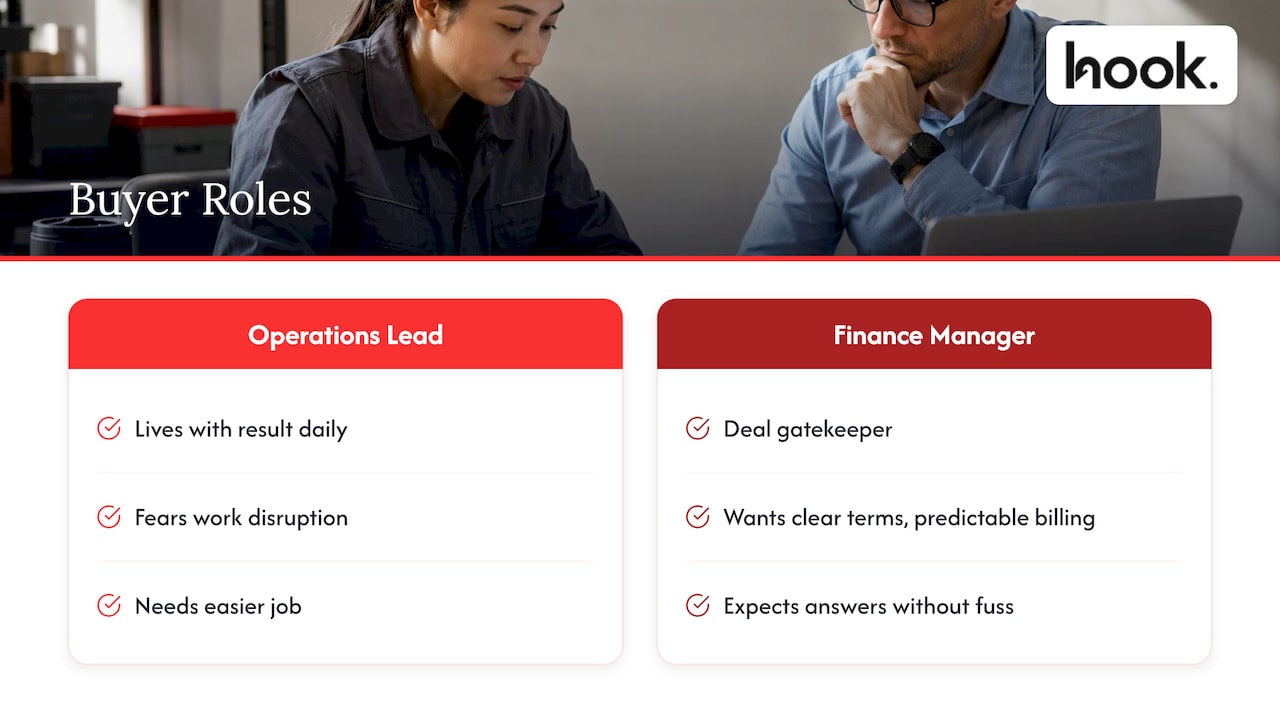
“Operations Lead Sam” will live with the result every day. His fear is disruption, so he needs to see that the work makes his job easier, not harder.
“Finance Manager Joanne” is the gatekeeper. She does not care about your creative ideas. She wants clear terms, predictable billing and a supplier who answers questions without fuss.
These two rarely decide, but either can slow or stop a deal. A short section on your site written for each of them often does more than another sales call.
Example 4: the negative persona
“Bargain Ben”, owner of a very small business, wants a full brand and website for a fraction of the going rate and expects unlimited revisions.
NI Business Info recommends creating “negative personas” to exclude customer groups that will not be profitable. Writing one down gives your team a quick filter: if an enquiry looks like Ben, you know the conversation will be about price, and your advertising should stop attracting him.
Who is in a B2B buying decision?
The four examples above map onto roles that recur in most business purchases. Names vary by company, but the pattern is consistent.
| Role | Typical Oxfordshire job title | Main question | What helps |
|---|---|---|---|
| Approver (economic buyer) | MD, owner, finance director | Is this worth the money and the risk? | Commercial case, clear scope |
| Champion | Marketing manager, head of department | Will this make me look good? | Case studies, internal summary |
| Evaluator | Technical or functional lead | Does it actually work for us? | Detail, specifics, process |
| End user | Team member | Will my day get harder? | Simple onboarding, clear support |
| Gatekeeper | Procurement, finance, compliance | Are the boxes ticked? | Terms, documentation |
In a business of 20 or 30 people, one person often holds two or three of these roles. In a larger organisation, expect five or six people. Map the real cast from your last five wins rather than copying a textbook list.
A B2B buyer persona template you can copy
Keep it to one page. If it cannot be read in two minutes, nobody on your team will use it.
| Section | What to write |
|---|---|
| Name and role | A working name, job title, role in the decision |
| Company | Size, sector, location, growth stage |
| Goals | The 2 or 3 outcomes they are measured on |
| Challenges | What blocks those goals today |
| Information sources | Where they search, read and ask for advice |
| Objections | The exact doubts they raise, in their words |
| Buying trigger | What made them act now rather than last year |
| Content that helps | Formats and topics that answer their questions |
| Quote | One real sentence from an interview |
The NI Business Info guide offers a downloadable template covering where customers get information, traits, frustrations and motivations. Whatever layout you use, the “quote” row is the one that keeps the persona honest: if you cannot fill it with something a customer actually said, you have not done the research yet.
How to create buyer personas from real evidence
The most common failure is writing personas in a workshop from memory. Do this instead.
Step 1: decide what the persona is for
Pick the decision it will support. If you are choosing channels, information sources matter most. If you are tightening sales conversations, roles, objections and buying criteria matter most. Naming the purpose stops the profile ballooning into a document nobody reads.
Step 2: mine what you already hold
Before interviewing anyone, look at your CRM records, website analytics, enquiry forms, sales emails and the notes from won and lost deals. Patterns often show up straight away: the same job titles, the same sector, the same first question.
Step 3: talk to real buyers
Interview five to ten recent customers, and include at least one or two people who chose someone else or went quiet. Ask them to walk you through their most recent purchase, not what they would hypothetically do. Four questions do most of the work:
- Why did you buy?
- What else did you consider, and why did you choose us?
- Where did you look for information?
- Why then, and not six months earlier or later?
NI Business Info lists further research methods: polls and surveys on social media, email surveys to your marketing database, face-to-face interviews and competitor research. Email surveys to your own list are the cheapest route if time is short.
If you also sell online, the data you already collect about customers can feed this work. Approaches such as attribute-based personalisation on Shopify show how stored customer attributes can be put to use once you know which ones matter.
Step 4: find the patterns
Write each answer on a note and group them. A theme that appears in several interviews is a finding. A one-off comment is an anecdote. Use the customers’ own words for objections and frustrations, because those phrases are what your headlines should sound like.
Step 5: write, then check
Turn each pattern into the one-page template. Then show the draft to two or three people who fit the profile and ask what is wrong. Fix it, date it, and plan to revisit it each year, because roles and priorities shift.
Putting personas to work
A persona that sits in a folder is wasted. These are the places it earns its keep.
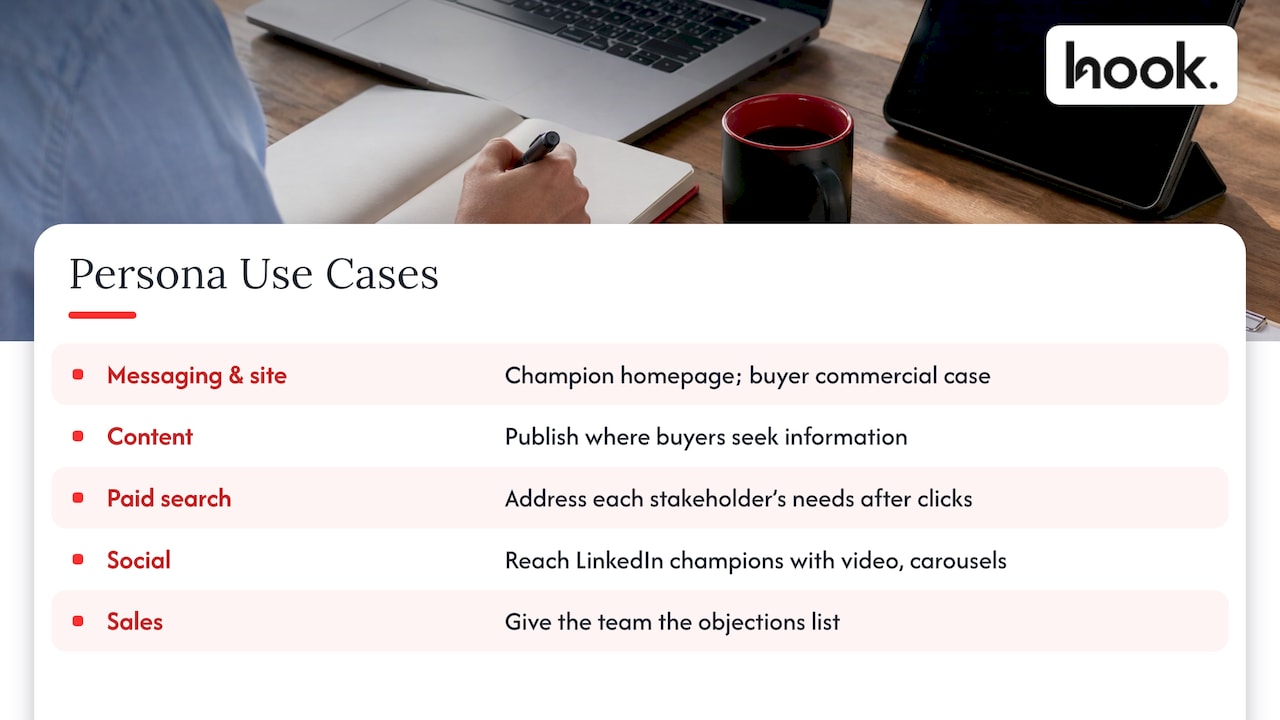
Messaging and website. Write the homepage for the champion and the commercial case for the economic buyer. Each persona’s objections become a section, an FAQ or a case study.
Content. The sources your persona uses tell you where to publish. If your buyers search first and ask peers second, you need pages that answer their questions and a reputation people will vouch for. Our guide to content marketing for business owners shows how to turn those answers into a steady plan.
Paid search. Personas tell you which problems people type into Google, and what each stakeholder needs to see after the click. Our piece on B2B Google Ads that deliver pipeline goes into how that plays out in practice.
Social. If your champion lives on LinkedIn, short, specific video and carousel posts can reach her where she already is. See our practical guide to Instagram Reels for B2B and how to develop a social media strategy that works.
Sales. Give the sales team the objections list. Most lost deals trace back to a doubt that nobody answered.
Personas and your brand name
If you are choosing a name for a new business or a rebrand, the persona comes first. Business.gov.uk advises getting clear on why the business exists, its values and the problems it solves, then identifying the target customer’s age, location, demographics and where they will find your brand, before shaping the visual identity and personality.
In practice, a simple naming process looks like this:
- Brief: write down what you do, for whom, and the personality you want (from your personas and values).
- Criteria: a good name is easy to say and spell, sounds credible to your champion and your economic buyer, and fits the way you will grow.
- Shortlist: generate a long list, then cut to a handful against the criteria.
- Test: say each name aloud on a phone call, look at it on a business card and a website address, and ask people who fit your persona what they expect the company does.
- Check availability: confirm the name is free as a company name, a web domain and a social handle before you fall in love with it.
Our guide to brand identity explains how the name, logo, voice and visual system fit together once the name is chosen.
Common mistakes with B2B personas
- One persona for the whole company. A single portrait leaves you with nobody specific to write for. Build one per role.
- Demographic padding. Hobbies and star signs make a profile look rich without changing a single decision.
- Only interviewing happy customers. Lost deals and lapsed accounts show you the objections that matter.
- No owner and no date. Give each persona an owner and a review date.
- No action attached. For every persona, list the one change you will make to your website, content or campaigns because of it.
How we can help
Building personas is one job. Turning them into a brand, a website, photography, video, social content and ads is another, and it is where projects often stall because several suppliers each hold part of the picture. Hook Digital is an Oxfordshire marketing agency built so you only have to talk to one team, with project scopes tailored to you rather than forced packages. Our client portal keeps updates and communication in one place, and we aim for a 48-hour turnaround on content and website amends.
If your personas point towards a rebrand, start with branding and design. If they point towards several channels at once, full service marketing keeps them under one roof.
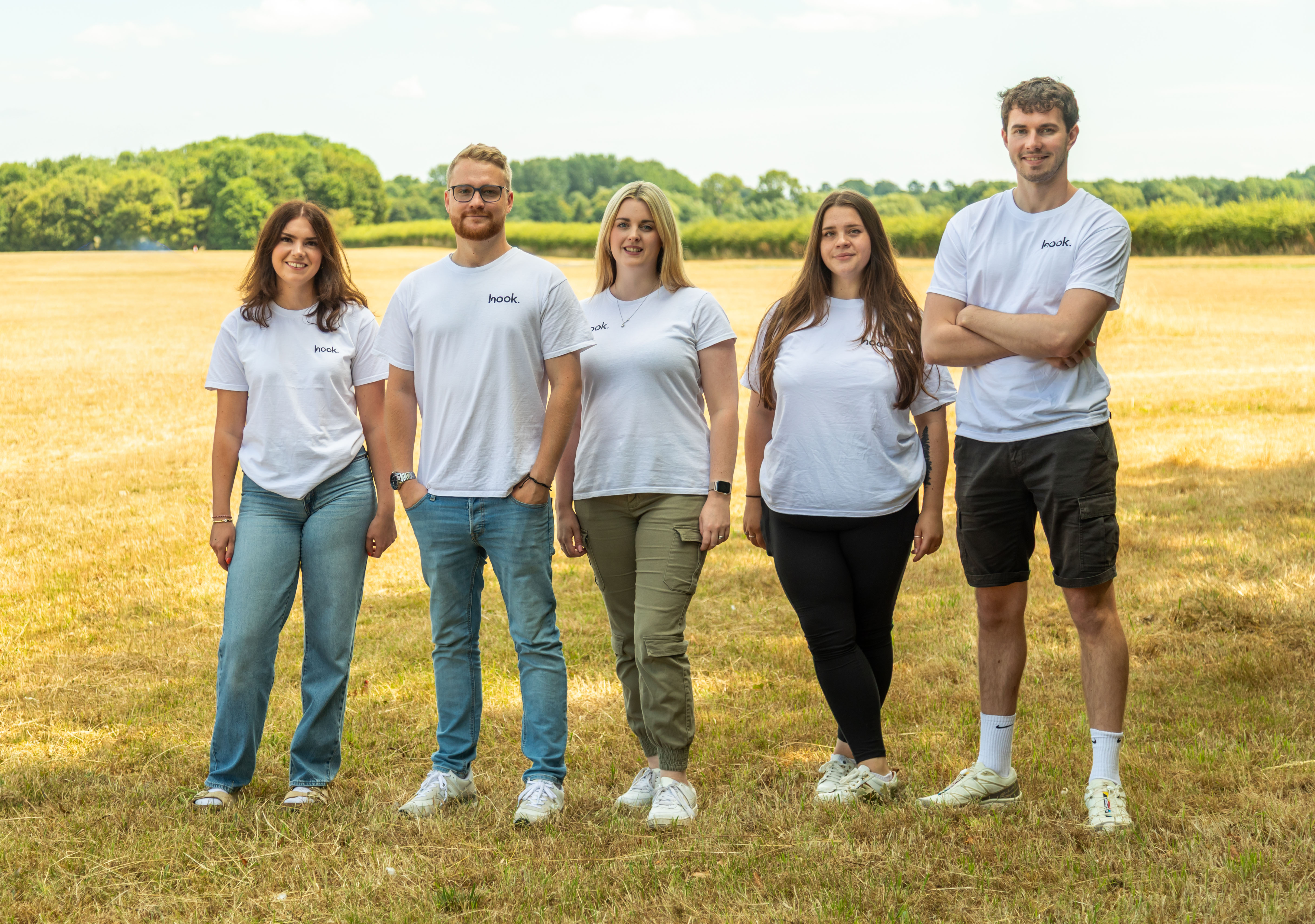
Tell us who you sell to and what you want to change, and we will show you how we would turn it into a plan through Hook Digital.
Our view
We think the best personas are the shortest ones. Most of the businesses we speak to in Oxfordshire do not lack data; they lack a single page that tells their team who they are writing for and what that person needs to hear.
Our advice is to build one persona per person in the buying decision, base it on real conversations, and then make sure the same picture reaches every piece of marketing you produce: the name, the logo, the website, the photography, the video, the social posts and the ads.
That last step is why we exist as one team. When branding, web, content and paid media are handled together, the persona does not get lost between suppliers, and you have one team to brief instead of five.
Hook
FAQ
What is a good example of a B2B buyer persona?
A good example names a role, such as a marketing manager at a 50-person company, and states their goals, frustrations, information sources, objections and buying trigger, with a real quote from an interview. It sits alongside profiles for the budget holder and anyone who can block the deal.
How many buyer personas does a business need?
Most B2B businesses need between two and five: one for each key role in the decision, plus a negative persona. Start with the person who signs and the person who champions your offer internally, then add others as your research shows they matter.
How many customers should I interview?
Five to ten one-to-one conversations is a sensible starting point, and a survey of at least 20 can stand in where interviews are not possible. Include some lost prospects, and stop when new interviews stop producing new themes.
How often should I update my personas?
Review them at least once a year, and sooner after a major change such as a new service, a new market or a run of lost deals. Date each one so the team knows how current it is.


