

.webp)

.svg)
Seven agency briefing mistakes that quietly wreck campaigns
Most failed campaigns trace back to seven recurring briefing mistakes: chasing multiple objectives at once, describing audiences by demographics alone, hiding the budget, writing shopping lists instead of problems, skipping formal sign-off, over-writing the brief, and leaving out inspiration and assessment criteria. Each has one clear fix. Marketing Week frames briefing as a strategic skill rather than admin, The Drum flags budget secrecy as a top offender, and at Hook-digital we see the same patterns on repeat with Oxfordshire clients.
The seven, in order of how often they surface:
- Multiple macro objectives fighting for attention in one brief.
- Audience descriptions that stop at age, gender, and postcode.
- No budget figure and no access to existing data or ad accounts.
- A list of deliverables instead of a problem to solve.
- No named sign-off, so the brief mutates after work has started.
- A brief so long the actual ask gets buried.
- No insight, no inspiration, and no criteria for judging the ideas that come back.
Fix each one at source and agencies stop guessing. That is the whole game.
Key Takeaways
Briefing failures come from ambiguity, not effort: naming one objective, one approver, and clear criteria fixes most campaign misalignment before it starts.
| Point | Details |
|---|---|
| Pick one objective | Rank competing goals and commit to a single primary objective before writing the brief. |
| Share budget and data | Give a budget range and read-only data access to stop agencies guessing at scale. |
| Name the decision-maker | State who has final sign-off in the brief itself, not in a separate email chain. |
| Keep it to two pages | Move research and data to an appendix; the core brief should state one problem clearly. |
| Hook-digital co-creates the brief | Hook-digital runs brief workshops with Oxfordshire clients before delivering the creative work in-house. |
Table of Contents
- Common agency briefing mistakes: prioritising too many objectives
- Common briefing issues: vague, demographic-only audiences
- Withholding budget and blocking data access
- Prescribing deliverables instead of stating the problem
- No sign-off, no change control
- Briefs that are too long to act on
- Failing to inspire or set assessment criteria
- A one-page brief template you can use today
- Lack of clarity on who actually decides
- Not specifying target channels or mediums
- Why briefing deserves real investment, not an afterthought
- How Hook-digital helps you brief better and deliver faster
- Sources
- FAQ
Common agency briefing mistakes: prioritising too many objectives
A brief that asks for brand awareness, lead generation, and sales uplift all at once forces the agency to guess which one you actually care about. The creative ends up generic because it is trying to serve three masters, and the measurement gets messy because nobody agreed which number counts as success. This is one of the most common agency briefing mistakes, and it is almost always self-inflicted by committee editing.
Rank your objectives before you write a word of the brief:
- List every goal stakeholders have mentioned, however informally.
- Score each on business impact and urgency, not on who asked for it.
- Choose one winner and demote the rest to secondary context, not competing headlines.
Pro Tip: If two genuinely separate goals both need dedicated creative thinking, split them into two briefs rather than force a single agency response to cover both.
Common briefing issues: vague, demographic-only audiences
“Women aged 25 to 45” tells an agency almost nothing about what stops that person acting. Demographic bands describe who someone is, not why they hesitate, and that gap is where creative ideas go generic.
- Name the persona and give them a real behaviour, not a label.
- State their specific barrier: price doubt, inertia, lack of trust, competing priority.
- Describe the moment they’re most likely to act, whether that’s payday, a life event, or a seasonal trigger.
A quick test: if your audience description could apply to three unrelated products, it’s not specific enough to brief against.
Withholding budget and blocking data access
Not sharing budget or platform access is one of the biggest mistakes brands make when briefing agencies, and it wastes time on both sides. An agency pitching blind either lowballs the ambition or proposes something you could never afford, and both outcomes cost you a wasted round of work.
Share, at minimum:
- A budget range, even a wide one, rather than “tell us what you’d recommend.”
- Read-only access to analytics, ad accounts, or CRM exports relevant to the brief.
- Any prior campaign results, even messy ones, so the agency isn’t starting from zero.
Pro Tip: Read-only dashboard access usually satisfies data protection concerns without exposing anything sensitive, and it saves days of back-and-forth requests once the project starts.
Prescribing deliverables instead of stating the problem
A brief that says “we need six social videos and a landing page” has already made the creative decision before the agency has looked at the problem. It’s a shopping list, not a brief, and it strips out the exact thinking you’re paying an agency to provide.
- Weak: “We need three Instagram Reels and a paid search campaign.”
- Strong: “We must lift trial sign-ups among lapsed users by the end of Q2.”
Set guardrails instead of formats: mandatory constraints (legal copy, brand colours, launch date) stay fixed, but channel and asset choices stay open for the agency to propose. That’s genuinely where a full-service partner earns its fee, because format decisions should follow strategy, not precede it.
No sign-off, no change control
The classic failure mode: the brief goes out, work begins, and three weeks later a stakeholder who never saw the original document asks for a completely different direction. Rewriting by committee after the fact is one of the more damaging mistakes in agency scope management, because it burns budget on work that gets discarded.
- Name every stakeholder who must sign off before the brief goes out, not after.
- Get one written approval, even a short email, confirming the objective and scope.
- Agree a single rule: changes after sign-off go through a formal change request, evaluated against the same criteria as the original brief, not a hallway conversation.
Formalising this step is exactly how you manage agency scope creep before it starts, and it’s worth pairing with a clear view of who owns account management on both sides.
Briefs that are too long to act on
A forty-slide deck feels thorough, but it usually means nobody made the hard calls about what actually matters. Shorter, sharper briefs get better creative responses, because the agency spends its energy solving the problem rather than extracting it from noise.
- Cut anything that describes the market rather than the decision you need made.
- Remove every sentence that could apply to a competitor’s brand just as easily.
- Force yourself to a single-minded proposition; if you can’t state it in one sentence, the brief isn’t ready.
Pro Tip: Move research decks, past campaign data, and category analysis into an appendix. The core brief should run to two pages; everything else supports it rather than competing with it.
Failing to inspire or set assessment criteria
Data tells an agency what happened. Insight tells them why, and insight is what actually sparks strong creative work. A brief stuffed with market statistics but no human observation about the audience’s behaviour rarely produces memorable output, because there’s nothing to react to emotionally.
- State what success looks like in plain terms, not just a KPI number.
- Explain how ideas will be judged: against the objective, the persona’s barrier, or the single-minded proposition.
- Attach something that builds empathy, such as real customer feedback, a call recording transcript, or a short brand immersion session, rather than a market report alone.
Evaluation criteria written into the brief give both sides a shared language for judging ideas, which cuts down the subjective “I just don’t love it” feedback that kills good work late in the process.
A one-page brief template you can use today
Everything above compresses into a single page. Use these fields every time:
- Single objective — one sentence, one metric.
- Target persona — name, behaviour, barrier, moment to act.
- Single-minded proposition — the one idea everything else supports.
- Mandatory constraints — legal, brand, technical, non-negotiable.
- Budget range — even approximate.
- Success metrics — how you’ll know it worked.
- Sign-off — named approver, dated.
For format-specific detail, our guides on briefing a design agency and briefing a video production agency walk through worked examples for each medium.
A short checklist before you send anything:
- Objective ranked and singular, not plural.
- Persona has a stated barrier, not just an age bracket.
- Budget range and data access confirmed.
- Deliverables left open unless genuinely mandatory.
- Sign-off named and dated.
- Brief under two pages, with data in an appendix.
- Assessment criteria attached.
Lack of clarity on who actually decides
A brief can be flawless and still fail if nobody knows who has final say on the work that comes back. This shows up as a stakeholder vetoing an approved direction three weeks in, or a junior marketer signing off work that a director later reverses. Both scenarios cost the agency real hours and cost you trust.

Name the decision-maker in the brief itself, not in a separate email thread. State who has final approval, who reviews for input only, and who is simply informed once a decision is made. These are three distinct roles, and treating them as interchangeable is where most internal friction starts.
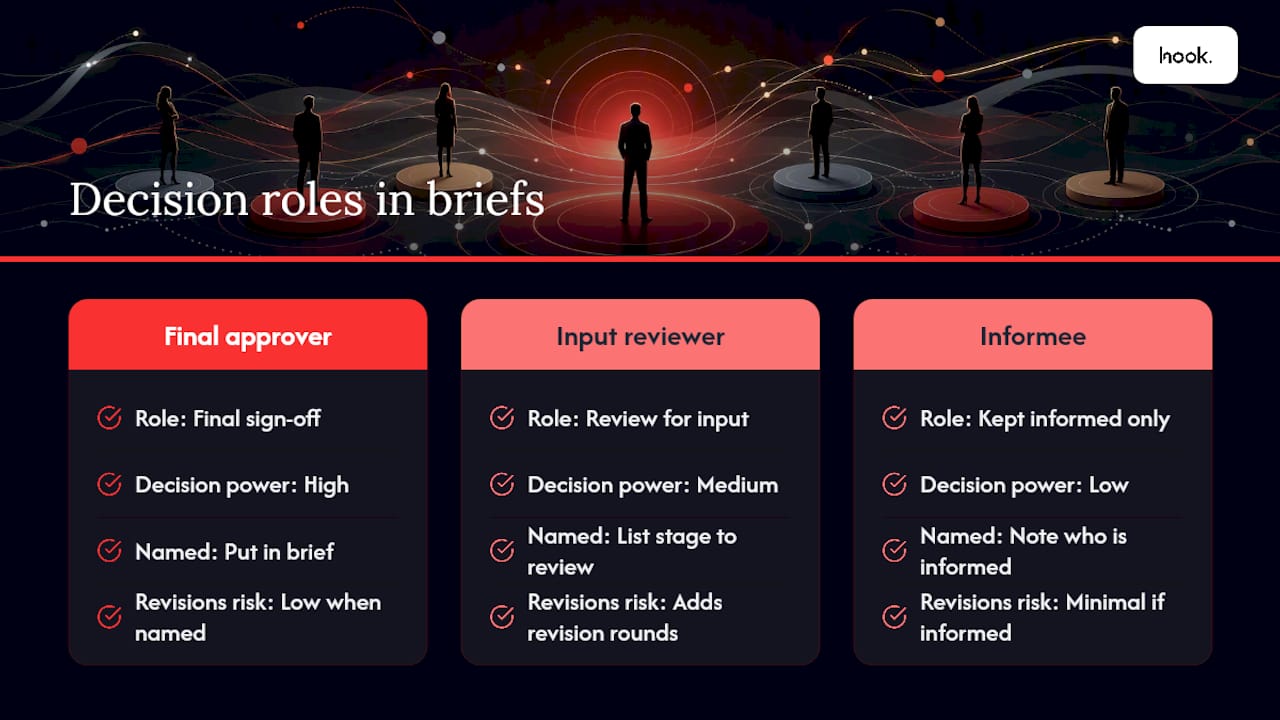
Agencies that work regularly with larger organisations often ask for this explicitly before starting, because a brief without a named approver is effectively a brief with several competing approvers, each entitled to redirect the work. That ambiguity is expensive: every extra layer of informal feedback adds a round of revisions that was never budgeted for.
The fix costs nothing beyond a moment of internal clarity. Write the approver’s name and title directly into the brief, alongside anyone else whose input matters and the stage at which they see the work. If your organisation has a marketing and sales alignment problem underneath this, it’s worth resolving how those teams work together before the next brief goes out, because unclear authority in briefing is often a symptom of unclear authority more broadly.
Not specifying target channels or mediums
Leaving channel choice entirely open can be a genuine strength, provided it’s a deliberate decision rather than an oversight. Too many briefs simply forget to mention where the campaign needs to live, which forces the agency to guess between paid social, search, out-of-home, email, or a mix, often defaulting to whatever they know the client has used before rather than what the objective actually calls for.
There’s a difference between leaving format open as a constraint you’ve consciously removed, and never addressing it at all. State explicitly whether channel selection is part of what you want the agency to propose, or whether certain channels are fixed for budget, contractual, or timing reasons. A brief for a product launch tied to a trade show has a real deadline and a real physical presence to consider. A brief for always-on lead generation does not, and treating the two the same wastes strategic thinking on the wrong constraints.

Where you do have channel requirements, state them as constraints alongside the mandatory items already in your one-page template, not as a separate afterthought. Where you don’t, say so plainly: “channel and medium open to agency recommendation” is a complete, useful instruction, whereas silence just reads as an omission the agency has to chase down.
Why briefing deserves real investment, not an afterthought
Marketing teams put enormous effort into strategy decks and then dash off the brief that actually carries that strategy to the people building the work. That mismatch is the biggest waste in the whole process. One brand’s shift from a five-page tactical document to a single-page objective-and-persona brief cut revision rounds noticeably, simply because the agency stopped guessing at priorities.
Treat briefing as a skill your team practises, not a form you fill in between meetings. The return on that investment shows up in fewer rewrites and sharper first drafts.
— Hook
How Hook-digital helps you brief better and deliver faster
You don’t have to fix all seven mistakes alone. Hook-digital runs short brief co-creation workshops with Oxfordshire clients, turning a vague set of goals into a single-page brief before any creative work begins, then delivers against it in-house across branding and design, video, websites, social, and paid media. That in-house structure removes the usual friction of coordinating separate specialist agencies each with their own briefing process and sign-off chain.

If your last campaign brief went through five rewrites before anyone touched creative, that’s the exact problem this process solves. Book a free marketing consultation and bring your current brief, however rough. We’ll help you sharpen the objective, name the persona’s real barrier, and agree assessment criteria together before a single asset gets made.
Sources
- ‘A strategic act’: Why agency briefing ‘isn’t a soft skill’ — Marketing Week
- The 5 biggest mistakes brands make when briefing agencies — The Drum
- The best way for a client to brief an agency — IPA / AAAA (PDF)
FAQ
What is the most common agency briefing mistake?
Chasing several macro objectives at once is the most frequent issue, because it stops the agency forming one clear creative proposition.
How long should a good agency brief be?
Aim for around two pages; shorter, focused briefs tend to get better creative responses than long tactical decks.
Should I share my budget with an agency before they pitch?
Yes. Withholding budget is one of the biggest briefing mistakes brands make, and even a wide range helps agencies scope realistic proposals.
How do I stop scope creep after a brief is signed off?
Agree a single change control rule upfront: any change after sign-off goes through a formal request judged against the original evaluation criteria, not an informal conversation.
Can Hook-digital help write our brief, not just deliver against it?
Yes, Hook-digital runs short brief co-creation workshops with clients before starting design, video, web, or paid media work, so the brief and the delivery come from one place.
Recommended
- How to brief a design agency: a practical guide | Hook Digital - Oxford’s Premier Full-Service Marketing Agency
- How to brief a video production agency effectively | Hook Digital - Oxford’s Premier Full-Service Marketing Agency
- Marketing agency evaluation checklist: 2026 guide | Hook Digital - Oxford’s Premier Full-Service Marketing Agency
- Role of agency account management: a clear guide | Hook Digital - Oxford’s Premier Full-Service Marketing Agency
.png)


