
.webp)

.svg)
Develop a social media strategy that actually works

A social media strategy is a documented, goal-driven plan that connects your social media activity to measurable business outcomes. Without one, you are posting into the void and hoping something sticks. The industry term is “social media marketing strategy,” and it covers everything from audience research and platform selection to content planning and performance measurement. Marketing teams without a documented strategy waste resources on vanity metrics rather than outcomes that move the business forward. This guide gives you a practical framework to develop a social media strategy that builds real brand presence and drives genuine engagement.
How to develop a social media strategy: the foundation
Social media strategy is the planned reasoning behind every marketing action you take on social platforms. It defines your business objectives, your target audience, your platform choices, and the frameworks you will use to measure success. Tactics, by contrast, are the individual actions: posting a reel, running a paid ad, or replying to a comment. Confusing the two is the most common mistake business owners make.
A documented strategy prevents you from drifting. When your team knows why you are posting, not just what to post, every piece of content serves a purpose. Developing a structured strategy typically takes marketing teams two to four weeks to finalise into a living guide. That investment pays back quickly when you stop producing content that generates likes but no leads.

The strategy also acts as a filter. When a new platform trend appears or a team member suggests a new content idea, your documented strategy tells you whether it fits your goals. Without that filter, you end up chasing every shiny new feature and spreading your effort too thin.
How do you set goals that actually guide your social media plan?
Clear goals are the engine of any social media marketing strategy. The SMART framework, which stands for Specific, Measurable, Achievable, Relevant, and Time-bound, gives your goals the structure they need to be useful. A vague goal like “grow our Instagram” tells you nothing. A SMART goal like “increase Instagram profile visits by 25% within 90 days” gives you a target, a timeline, and a way to know whether you succeeded.
Common social media goals fall into four categories:
- Brand awareness: Reach new audiences and increase visibility for your business.
- Engagement: Build a community through comments, shares, and saves.
- Lead generation: Drive traffic to landing pages or capture enquiries directly through social platforms.
- Sales: Convert followers into paying customers through product posts, offers, or direct messages.
Each goal connects directly to a key performance indicator, or KPI. Brand awareness maps to reach and impressions. Engagement maps to interaction rate. Lead generation maps to click-through rate and form completions. Sales map to conversion rate and revenue attributed to social. Knowing your KPIs before you start posting means you are measuring what matters, not just what is easy to count.
Pro Tip: Set no more than two primary goals per quarter. Chasing five goals at once dilutes your focus and makes it impossible to know which actions are working.

How to research your audience before choosing platforms or content
Audience research is the step most business owners skip, and it is the reason their content fails to connect. You cannot get your audience to notice you if you do not understand what they care about, where they spend their time, and what problems they are trying to solve.
Start with these four steps:
- Analyse your existing customers. Look at who already buys from you. What are their ages, locations, and job roles? What questions do they ask before purchasing?
- Use social listening. Search relevant hashtags, keywords, and competitor accounts to see what conversations your potential customers are already having.
- Study platform demographics. LinkedIn skews towards professionals and B2B decision-makers. Instagram and TikTok attract younger, visually driven audiences. Facebook still holds the largest overall user base across age groups.
- Identify content preferences. Some audiences respond to short video. Others prefer detailed written posts or infographics. Your research should tell you which format your audience consumes most.
Once you have this picture, segment your audience into two or three distinct groups based on their needs and motivations. Each segment may need slightly different content themes, even if they all follow the same account. Unlocking audience needs before you create a single post is the difference between content that resonates and content that gets scrolled past.
Pro Tip: Run a simple poll or question sticker on your existing social channels. Direct audience feedback is faster and more reliable than any third-party demographic report.
Which social media platforms should you focus on?
The instinct to be everywhere is understandable, but it is counterproductive. The “everything, everywhere” approach dissipates your resources and produces shallow engagement on every platform rather than meaningful connection on any of them. Focusing on one or two platforms where your audience is most active drives deeper engagement and better results.
Use these three criteria to select your platforms:
| Criterion | What to assess |
|---|---|
| Audience presence | Where do your specific customer segments spend time? |
| Content format fit | Does the platform suit the content you can realistically produce? |
| Resource capacity | Do you have the time and skills to show up consistently here? |
A professional services firm with a B2B audience will almost always get more return from LinkedIn than from TikTok. A local food business with strong visual content will find Instagram or Facebook more productive than LinkedIn. The right platform is not the most popular one. It is the one where your audience already is and where your content format fits naturally.
Focusing on fewer platforms also lets you post at the right times and respond to comments and messages properly. That responsiveness builds community, which is increasingly what social media algorithms reward.
How to create a social media content plan that you will actually stick to
A content plan without a calendar is just a list of good intentions. A practical social media content plan has three components: content pillars, a posting cadence, and a production workflow.
Define your content pillars
Content pillars are the three to five recurring themes your account covers. Experts advise defining these pillars before choosing any scheduling tools, because the pillars determine your content rhythm. For a marketing agency, pillars might be: client results, marketing education, behind-the-scenes culture, and industry news. Every post fits into one of these buckets.
Set a realistic posting cadence
Consistency beats frequency. Posting three times a week reliably outperforms posting daily for two weeks and then going silent. Decide how frequently you will post based on what your team can sustain, not what you think the algorithm wants. Assign each day of the week a content pillar so you never face a blank page.
Build a batching workflow
Batching content creation into dedicated sessions eliminates daily decision fatigue and improves both creative output and brand consistency. A practical monthly workflow looks like this:
- Week 1: Ideation session (30 minutes). Review performance data and brainstorm next month’s posts.
- Week 1–2: Creation block (2–4 hours). Write captions, design graphics, and record any video content.
- Week 2: Scheduling session (30–60 minutes). Load all content into your scheduling tool and review for consistency.
The distinction between a content calendar and a scheduler matters here. Your calendar is the plan: what you will post, when, and why. Your scheduler is the automation tool that publishes it. Build the plan first, then choose the tool that fits your workflow.
Pro Tip: Use a simple spreadsheet as your content calendar before committing to a paid scheduling platform. Once your content rhythm is established, you will know exactly which features you need from a tool.
How do you measure and refine your social media strategy?
Measurement is where most social media plans fall apart. Business owners track follower counts and likes because those numbers are visible and satisfying. But only documented strategies enable consistent measurement of outcomes that actually affect the business, such as website traffic, enquiries, and sales.
Separate your metrics into two categories:
- Vanity metrics: Follower count, likes, impressions. These indicate reach but not business impact.
- Business metrics: Click-through rate, conversion rate, cost per lead, revenue influenced. These connect social activity to real outcomes.
Set up a simple dashboard that tracks your chosen KPIs across platforms in one place. Review it on three cadences:
- Weekly: Check tactical performance. Is a specific post format underperforming? Adjust next week’s content.
- Monthly: Look for trends. Which content pillar drives the most engagement or traffic? Shift your mix accordingly.
- Quarterly: Review the strategy itself. Are your goals still relevant? Do your platforms still match your audience?
Planning digital campaigns with organic growth in mind requires this kind of iterative loop. Social listening also feeds into measurement: monitor brand mentions, relevant keywords, and audience sentiment to spot shifts before they show up in your analytics. Strategy should be treated as an iterative process with monthly reviews refining performance against KPIs.
Pro Tip: Screenshot your baseline metrics before you launch any new strategy. Without a starting point, you cannot prove progress to yourself or your stakeholders.
Key takeaways
A social media strategy works when it connects every post, platform choice, and metric to a specific business goal, not to a posting schedule or a follower target.
| Point | Details |
|---|---|
| Strategy before tactics | Define your goals and audience before choosing platforms or content formats. |
| SMART goals drive results | Set Specific, Measurable, Achievable, Relevant, and Time-bound goals tied to clear KPIs. |
| Fewer platforms, deeper impact | Focus on one or two platforms where your audience is active rather than spreading thin. |
| Batch and schedule content | Dedicate set sessions to creation and scheduling to maintain consistency without burnout. |
| Measure business outcomes | Track click-through rates and conversions, not just likes and follower counts. |
What I have learned from building social media strategies for real businesses
The most common mistake I see is businesses reaching for tools before they have a plan. They sign up for a scheduling platform, fill in a content calendar template, and start posting without ever asking what they are trying to achieve. The posts look professional, but they produce nothing measurable.
The second mistake is platform overreach. A small team cannot maintain genuine presence on five platforms simultaneously. The accounts that build real communities are almost always the ones that chose two platforms and committed to them properly. Depth beats breadth every time.
The thing I keep coming back to is this: a social media strategy is a living document, not a one-off project. The businesses that treat it as something to revisit quarterly, adjusting their content mix based on what the data tells them, are the ones that see compounding results over time. The ones that set it and forget it plateau within six months.
Creativity and data are not opposites in social media. The best-performing accounts use analytics to identify what resonates, then give their creative team the freedom to execute within that framework. That balance is harder to find than it sounds, but it is what separates brands that grow from brands that just post.
— Hook
How Hook-digital can help you build a strategy that delivers
Knowing what a social media strategy should look like and actually building one are two very different things. Hook-digital is a full-service marketing agency based in Oxford, and we work with business owners and marketing teams to create strategies that connect directly to business goals.
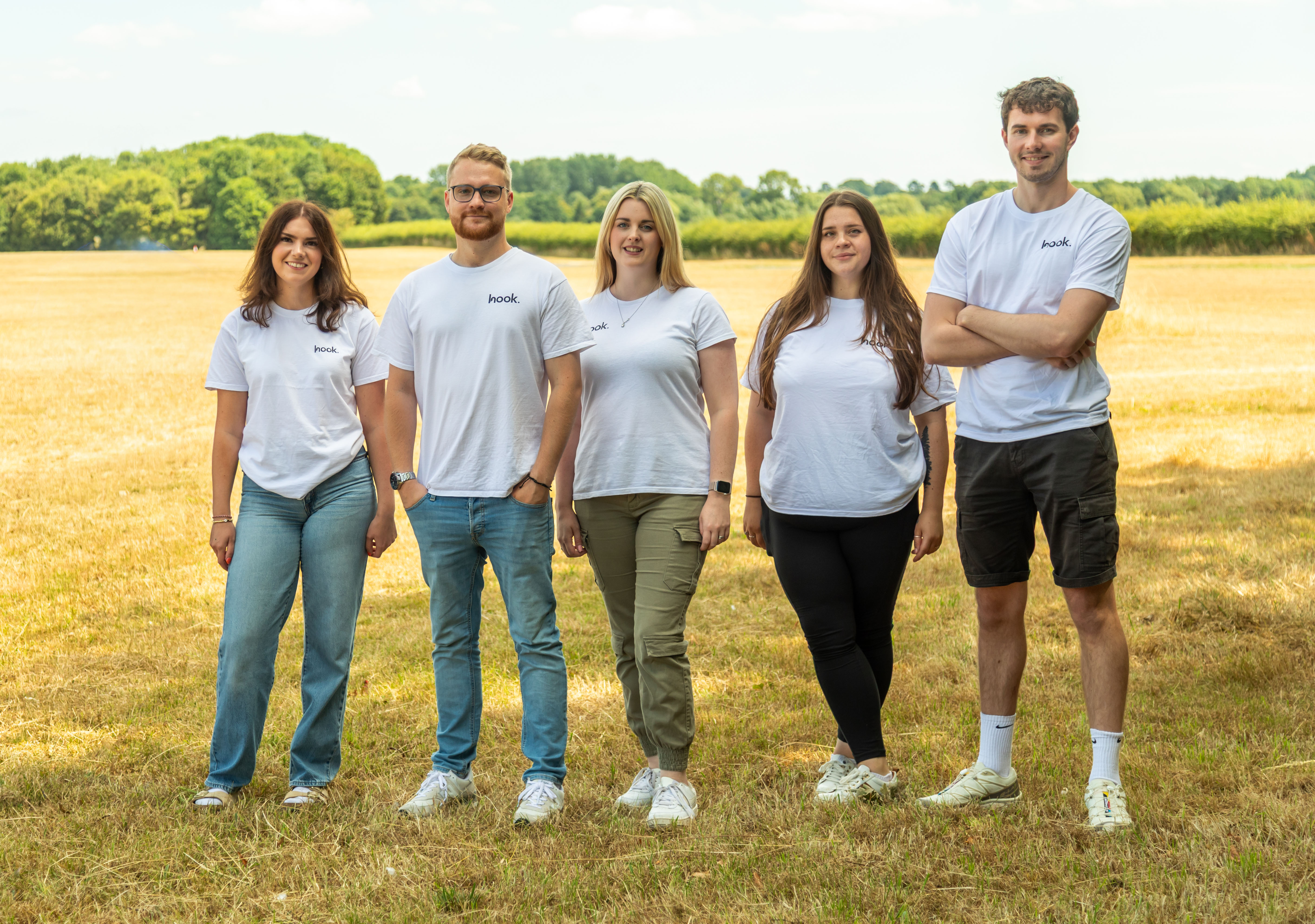
From branding and design that gives your social presence a consistent, professional identity, to content planning and platform management, Hook-digital handles the work so you can focus on running your business. You only need to talk to one agency. No coordination headaches, no gaps between teams. If you are ready to build a social media presence that actually performs, get in touch with Hook-digital today.
FAQ
What is a social media strategy?
A social media strategy is a documented plan that defines your business goals, target audience, platform choices, content approach, and measurement framework. It is the reasoning behind your social media activity, not the activity itself.
How long does it take to develop a social media strategy?
Marketing teams typically take two to four weeks to finalise a documented social media strategy. However, a structured content calendar focused on core pillars and posting cadence can be set up in as little as two hours.
How many social media platforms should a business focus on?
Most businesses get better results by focusing on one or two platforms where their audience is most active. Spreading effort across five or more platforms reduces the quality of engagement on all of them.
What is the difference between a content calendar and a social media strategy?
A social media strategy defines your goals, audience, and platform choices. A content calendar is the operational plan that schedules what you will post and when, sitting within the broader strategy.
How do you measure whether a social media strategy is working?
Track business metrics such as click-through rate, website traffic from social, and conversion rate rather than vanity metrics like follower count. Review performance weekly for tactical adjustments and monthly for strategic trends.
Recommended
- How Can Businesses Use Social Media for Marketing | Hook Digital - Oxford’s Premier Full-Service Marketing Agency
- How Frequently Should You Post on Social Media? | Hook Digital - Oxford’s Premier Full-Service Marketing Agency
- Here’s how Hook Digital can help alleviate the stress of managing social media accounts by taking care of the work for you: | Hook Digital - Oxford’s Premier Full-Service Marketing Agency
- How AI can revolutionise social media and marketing for small businesses | Hook Digital - Oxford’s Premier Full-Service Marketing Agency
.png)


