


Drone Filming Rules in the UK: What Businesses Need to Know

If you are filming from the air for your business in the UK, you need an Operator ID for the organisation, a Flyer ID for the person at the controls, third-party insurance, and a check of the airspace and the land before every flight. You also need to stay below 120m and respect privacy law. This guide walks through each rule in plain English, so you know what to expect before you brief a crew or commission aerial footage.
TL;DR
- Businesses flying a camera drone must register for an Operator ID, and the remote pilot needs a Flyer ID for drones of 100g or more.
- Commercial drone operators are legally required to carry third-party insurance.
- The height limit is 120m (400ft), and the distance you must keep from people depends on the drone and the Open Category sub-category.
- Flight Restriction Zones around airports and airfields, plus protected sites, need permission before you fly.
- Landowner permission for take-off and landing, and data protection compliance for footage of people, are part of every commercial shoot.
Table of Contents
- Do you need a drone licence to film for a business?
- The Open Category: height, distance and people
- When the Open Category is not enough
- Drone no-fly zones in the UK
- Private property, take-off and landing
- Privacy and data protection when filming from the air
- A pre-shoot checklist
- Our perspective on aerial filming
- Planning aerial footage with Hook
- FAQ
- Sources
Do you need a drone licence to film for a business?
UK drone pilots do not hold a “licence” in the way car drivers do. Instead, the Civil Aviation Authority (CAA) uses two registrations, and a business shoot normally involves both.
Operator ID. This belongs to the person or organisation responsible for the drone. The CAA says an organisation responsible for a drone must register for an Operator ID, except for drones below 250g without a camera. Because every filming drone has a camera, that exception does not help you. The CAA also states you need an Operator ID even when you hold permission to fly from another organisation, such as an airport.
Flyer ID. This belongs to the individual pilot. The CAA requires remote pilots to hold a Flyer ID if they fly a drone weighing 100g or more, and you get it by passing a theory test.
So when the question is whether you need a licence to film commercially, the answer is: you need both IDs, and you need to be able to show them. If you hire a drone operator, ask for their Operator ID, their Flyer ID and proof of insurance before the day of the shoot. A professional will hand these over without fuss.

Insurance is not optional
Recreational pilots may choose to insure their drones. Commercial operators do not get that choice: the CAA states that commercial drone operators are legally required to carry third-party insurance. If a drone comes down on a car, a building or a member of the public, this is the cover that responds. When you are hiring, ask whether the policy covers the type of work and the location you have in mind.
The Open Category: height, distance and people
Most business filming in the UK happens in the Open Category, which covers lower-risk flying without individual CAA approval. The core limits, as set out in the CAA’s Drone and Model Aircraft Code, are these.
Height
The maximum legal flight height is 120m (400ft) above the nearest point of the earth’s surface. Footage that looks higher usually comes from a hillside or a building, where the drone still sits within 120m of the ground below it.
Distance from people
The separation you need depends on the sub-category your drone and pilot qualify for:
| Sub-category | Distance rule (per the CAA Code) |
|---|---|
| A1 | Permits closer flight than the other sub-categories |
| A2 | 30m from people for UK2 drones, or 5m in low-speed mode |
| A3 | 50m from uninvolved people and 150m from listed areas |
This matters for planning. A shoot at a busy town-centre site with uninvolved passers-by is a very different proposition from a shot of a rural factory or a field. If the distances do not work for your location, your operator may be able to move the shot, change the drone, or apply for authorisation to fly outside the Open Category rules.
Keep it in sight
The general rule is that the pilot keeps the drone in view at all times. The Code also stresses that the pilot remains responsible for avoiding other aircraft. NATS makes the same point from the air traffic side: air traffic control clearance does not exempt a pilot from the Air Navigation Order.
When the Open Category is not enough
Some commercial ideas break the Open Category limits: flying closer to buildings and crowds than the distances above allow, or operating in a built-up residential area. In those cases the CAA says authorisation is needed to fly outside the rules in the Code.
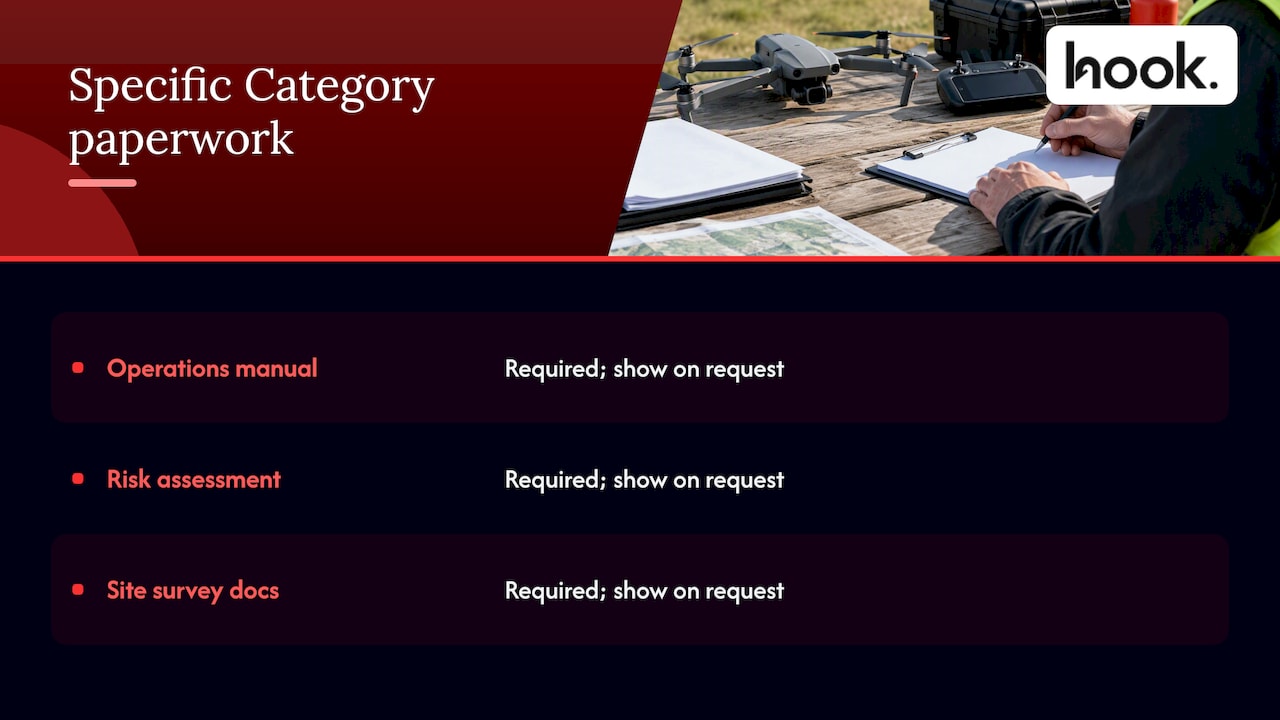
One route is the Specific Category. The CAA’s PDRA01 Operational Authorisation, which covers work such as roof inspections and building photography, costs £524 per year. Working in this category also brings paperwork. Guidance published for local authorities notes that an operations manual, risk assessment and site survey documentation are required and must be shown to authorities on request. In practice, the operator is then under direct CAA oversight, with documented safety procedures.
For most marketing teams, you will not apply for this yourself. You will hire an operator who already holds the right permissions and ask which category your shoot falls into.
Drone no-fly zones in the UK
No-fly zones are the most common reason a planned shot gets cancelled, so check them early.
Flight Restriction Zones
The Code explains that Flight Restriction Zones exist around most airports, airfields and spaceports. To fly inside one you need permission from the airport, airfield or spaceport. Oxford itself is a good example of why checking matters: the area has airfields and flying sites, and a location a few miles from your office may sit inside a zone you would not expect.
How to check a location
The Code points pilots to the NATS map of airspace restrictions or to drone apps. It also warns that some short-notice restrictions may not appear, and that software built into the drone may not be up to date. So a good operator checks more than once: when scoping the shoot, again a few days before, and again on the morning.
Protected and managed sites
Heritage sites, nature reserves, National Trust land, university grounds and business parks often have their own rules on top of aviation law. Drones should not be flown over Sites of Special Scientific Interest or Special Protection Areas without consent from Natural England, and many heritage landowners ask you to apply for filming permission in advance. Local authorities can grant permission to use council or public property, and the Filming in England guidance notes that commercial drone flights on public highways require consent from the relevant highways authority.
Treat this as a lead-time issue. Permissions from landowners and councils can take weeks, so raise them at the briefing stage and not the week of the shoot.
Private property, take-off and landing
Whether you can fly over private land and whether you can take off from it are different questions. Flying through the air above a property is not the same as using the ground it sits on.
For take-off and landing, the position is clear: operators must obtain landowner permission. The CAA’s wider regulatory guidance adds that pilots should observe trespass laws and local byelaws and get any applicable permission before flying from privately owned sites.
A few practical habits keep this simple:
- Get written permission from the landowner for the take-off and landing point, and for any land you cross.
- Tell neighbours and site users when a shoot will be visible to them.
- Keep a copy of the permissions with your Operator ID and insurance on the day.
Property and development marketing adds another layer. Aerial footage often has to be combined with proposed designs, and a drone photomontage workflow shows how the capture stage, landowner consent and location permissions need to be planned before the first flight.
Privacy and data protection when filming from the air
A drone camera sees a lot, and the rules treat it like any other camera. The CAA Code says to respect privacy and warns that recording where people can expect privacy, such as inside a home or garden, is likely to break data protection laws. It adds that images and recordings may be covered by GDPR.
For businesses, there is a further point: commercial image recording brings extra requirements as a data controller. For a marketing team, that translates into some sensible habits:
- Plan shots so that identifiable people are not in frame unless they know about it and agree.
- Put up clear notices or brief staff when you film at a workplace or event.
- Avoid framing gardens, windows or private spaces.
- Store and share raw footage with the same care as any personal data.
If your finished video will carry music, a related legal check applies too. Our music licensing checklist for marketers covers how to avoid delays at the edit stage. And if the video ends up on a website, our GDPR cookie consent checklist covers the page it sits on.
A pre-shoot checklist
Use this before you sign off a drone shoot, whether you hire or run it in-house.
- IDs: confirm the Operator ID and the pilot’s Flyer ID.
- Insurance: ask to see commercial third-party cover.
- Airspace: check the NATS map or a drone app for Flight Restriction Zones, and look again on the day.
- Site rules: identify protected, heritage or managed sites and apply for consent.
- Land: get take-off and landing permission in writing; ask the highways authority if roads are involved.
- People: check the distances against the drone’s sub-category and the crowd you expect.
- Privacy: decide how you will handle identifiable people and footage.
- Backup plan: agree a fallback date and a ground-based alternative if weather or restrictions stop the flight.
If you are still working out the creative side, how to brief a video production agency effectively will help you give the crew what they need to plan the legal side with you.
Our perspective on aerial filming
Most of the aerial shoots that go wrong for our clients do not fail in the air. They fail on paper: a missed permission, an unchecked zone, or a brief that asked for a shot the site could never allow.
That is why we think drone footage works best when it is planned as part of the whole video and marketing project, and not bought separately as an add-on. When the same team writes the brief, checks the location, shoots the footage and edits it for your website and social channels, the rules become part of the plan and not a surprise.
It is also why we built Hook around talking to one agency. You have one point of contact, a client portal for updates, and a scope tailored to your project with no forced packages. If your video needs changes after the shoot, we aim for a 48-hour turnaround on content amends.
Hook
Planning aerial footage with Hook
If you would like aerial shots in a brand film, a property or site tour, or social content, we can plan the video around the rules above and fit it into your wider marketing. Our video production service covers brand films and social content for Oxfordshire businesses, and our photography and video team handles brand, product and commercial shoots.
Tell us what you want to film and where, and we will scope it with you. If you want video as part of a broader plan, see our full service marketing offer, or start from the Hook Digital homepage. For ideas on getting more from a single shoot, read our guide to corporate video types for business owners.
FAQ
Do I need a drone licence in the UK?
Not a licence as such, but you need registrations. Organisations must register for an Operator ID, and remote pilots need a Flyer ID for drones of 100g or more, gained by passing a theory test. Commercial operators must also carry third-party insurance.
What is the maximum height I can fly a drone?
The limit is 120m (400ft) above the nearest point of the earth’s surface under the CAA’s March 2026 Drone and Model Aircraft Code. Other limits apply on top, including distances from people and restrictions near airports.
Can I fly a drone over private property?
The rules focus on permission to take off and land and on privacy. You need the landowner’s permission for take-off and landing, and you must follow trespass laws and local byelaws. Recording people in places where they expect privacy, such as gardens, can breach data protection law.
Where can I check drone no-fly zones?
Use the NATS map of airspace restrictions or a drone app. The CAA warns that short-notice restrictions may not show up and that software built into the drone may be out of date, so check again on the day of the shoot.
Can I film for a business with a small drone?
Yes, but a camera drone used for business still needs an Operator ID, a pilot with a Flyer ID if it weighs 100g or more, and commercial third-party insurance. Landowner permission and privacy rules apply however small the drone is.
Sources
- Flying drones for work, UK Civil Aviation Authority
- Registering to fly drones and model aircraft, UK Civil Aviation Authority
- The Drone and Model Aircraft Code, March 2026, UK Civil Aviation Authority
- Filming with Drones: Local Authority Guide, Filming in England
- Non-Standard Flight applications, NATS
- UK regulatory framework for drones and other unmanned aircraft, UK Civil Aviation Authority


