
.webp)

.svg)
Go viral meaning: what creators must know in 2026
Going viral is defined as the rapid, widespread spread of content across social platforms, reaching audiences far beyond a creator’s existing followers through shares, saves, and algorithmic amplification. The term borrows from epidemiology: content spreads person to person like a virus, multiplying reach exponentially. In 2026, platforms like TikTok, YouTube Shorts, and Instagram have shifted to interest-graph recommendation systems, meaning any piece of content can reach millions regardless of follower count. Understanding the go viral meaning is no longer optional for creators and marketers. It is the foundation of modern content strategy.
What does it mean to go viral? the core definition
Going viral means your content enters a self-reinforcing loop of sharing. One person shares it, their network sees it, some of them share it again, and the cycle accelerates. The gone viral meaning in practice is a sudden, steep spike in reach, impressions, and engagement that far outpaces your normal performance.
The academic term for this is viral diffusion, and Jonah Berger’s STEPPS framework is the most cited model for explaining why it happens. STEPPS stands for Social Currency, Triggers, Emotion, Public, Practical Value, and Stories. Each principle represents a psychological driver that makes people want to pass content along. Using three or more of these principles simultaneously increases viral potential significantly.

The definition of viral content has also evolved. In 2020, going viral meant millions of views. In 2026, virality is niche-relative. A post reaching 50,000 people in a specialist B2B community is genuinely viral for that space. The threshold depends entirely on your platform and audience.
What psychological factors make content go viral?
Human beings share content for social reasons, not informational ones. Sharing is a form of identity performance. When you share something funny, insightful, or shocking, you are telling your network something about who you are. That is the real engine behind virality.
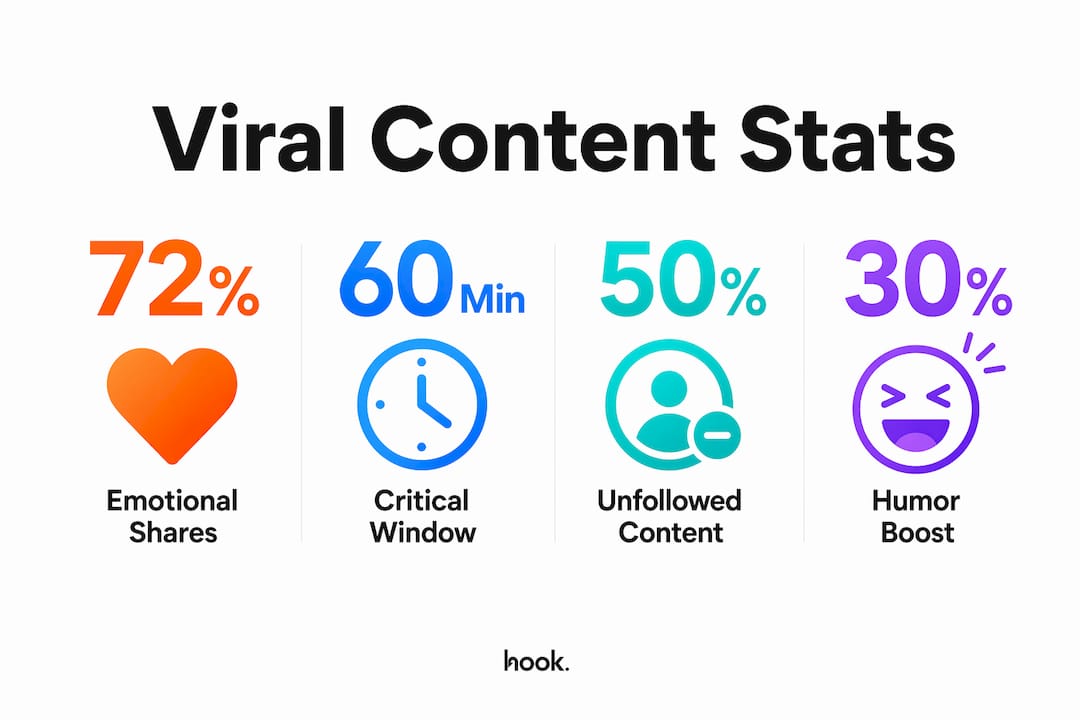
High-arousal emotions like awe, humour, anger, and excitement drive 72% of social shares. Humorous posts earn 30% more shares than neutral content. This matters because most branded content is produced in a low-arousal register: polished, professional, and emotionally flat. That content gets scrolled past.
The emotions that underperform are sadness, contentment, and mild interest. These are low-arousal states. They do not create the urgency to share. Over-produced content often falls into this trap because it prioritises aesthetics over emotional impact.
Here is what actually drives shares:
- Awe and surprise: Content that reveals something unexpected or counterintuitive
- Humour: Relatable observations, absurdist scenarios, or self-deprecating brand moments
- Anger and moral outrage: Content that challenges injustice or exposes hypocrisy
- Practical value: Tutorials, tips, and frameworks people want to save and revisit
- Storytelling: Narratives with a clear arc, tension, and resolution
Pro Tip: Before publishing any piece of content, ask yourself: “Would I send this to a specific person in my life right now?” If the answer is no, the emotional trigger is not strong enough.
Sharing also functions as social currency. People share content that makes them look informed, funny, or ahead of the curve. Content that gives your audience something to show off with will always outperform content that simply informs.
How do algorithms in 2026 influence content virality?
Platform algorithms in 2026 do not care about your follower count. They care about behaviour signals. The question every algorithm is asking is: “Does this content make people stop, watch, and act?”
The signals that matter most, in order of weight, are:
- Completion rate: Did viewers watch to the end? A high completion rate tells the algorithm the content is worth showing to more people.
- Shares and saves: Shares and saves outrank likes as quality signals. A post with high likes but low shares is often flagged as filler content and deprioritised.
- Comments: Especially comments that spark further conversation or debate.
- Dwell time: How long did someone pause on the post before scrolling?
The first hour after posting is critical. Early engagement within 60 minutes determines 70–80% of a post’s total reach. Platforms test content on a small sample audience first. If that sample engages strongly, the algorithm pushes the content to a wider pool. If it does not, the content is quietly buried.
Your hook is therefore not a creative choice. It is a technical requirement. Content must disrupt patterns within the first three seconds to pass machine-driven quality filters. A strong hook makes a bold claim, poses an unexpected question, or opens a loop the viewer needs to close.
Facebook now serves up to 50% of content from accounts users do not follow. TikTok’s For You Page has operated this way since its launch. This shift from follower-based feeds to interest-graph systems is the single biggest structural change in viral mechanics since 2024. It means a brand-new account with zero followers can reach half a million people if the content earns the right signals.
Raw, authentic content consistently outperforms polished production in this environment. Audiences have developed strong filters for corporate content. A shaky, genuine moment filmed on a phone can outperform a £10,000 production if it triggers the right emotional response.
Comparing viral content types and platforms
Viral thresholds and mechanics differ significantly across platforms. What counts as viral on LinkedIn would barely register on TikTok. Understanding these differences helps you set realistic benchmarks and choose the right format for your goals.
| Platform | Viral Threshold | Top Format | Key Algorithm Signal | Dark Social Role |
|---|---|---|---|---|
| TikTok | 500,000+ views | Short-form video (15–60 sec) | Completion rate | High (DMs and group chats) |
| 100,000+ interactions | Reels and carousels | Saves and shares | Very high (Stories DMs) | |
| YouTube Shorts | 1,000,000+ views | Vertical video under 60 sec | Watch time and likes | Moderate |
| 50,000+ impressions | Text posts and documents | Comments and reshares | Low | |
| 100,000+ shares | Video and link posts | Shares and reactions | High |
Video dominates viral reach across every platform. Short-form video in particular benefits from the highest algorithmic amplification because completion rates are easier to achieve in under 60 seconds.
Private sharing through direct messages and group chats, often called dark social, is now a primary driver of virality. Platforms reward this behaviour because it signals that content is genuinely valued. You cannot track dark social through standard analytics, but you can design for it. Content that feels personal, relatable, or like an inside joke travels through DMs far more readily than broadcast-style posts.
The formats that travel best through private channels include:
- Memes and reaction content that reflect shared experiences
- Short videos that make a single, punchy point
- Carousels with practical tips people want to save and send
- Content that calls out a specific profession, personality type, or situation
Pro Tip: Design at least one piece of content per week specifically for private sharing. Ask: “Which of my followers would send this to a friend, and why?” Build the content around that answer.
Practical strategies to maximise your viral potential
Virality is not luck. It is a system you can build. The STEPPS framework gives you a repeatable structure for engineering content that spreads. Here is how to apply it practically:
- Social Currency: Give your audience something that makes them look good for sharing it. Exclusive data, counterintuitive insights, and early access to trends all qualify.
- Triggers: Connect your content to something your audience encounters regularly. A post about Monday morning productivity gets shared every Monday because the trigger is built into the week.
- Emotion: Audit every piece of content for emotional arousal before publishing. If it does not make you feel something, it will not make your audience share it.
- Public: Make sharing visible and easy. Use calls to action that reference the act of sharing, such as “Send this to someone who needs it.”
- Practical Value: Tutorials, checklists, and frameworks earn saves. Saves are one of the strongest algorithmic signals you can generate.
- Stories: Wrap your message in a narrative. A before-and-after story, a failure-to-success arc, or a behind-the-scenes reveal all perform better than a direct announcement.
Post timing matters more than most creators realise. Posting when your specific audience is most active gives your content the best chance of generating strong early engagement within that critical first hour. Use platform analytics to identify your peak windows, then test consistently.
Generative AI tools now allow creators to produce content at volume, which is essential because virality is partly a numbers game. The more content you publish, the more chances you have to find the combination of emotional trigger, format, and timing that lands. Volume without pattern recognition is noise, but volume with systematic testing is how most consistent viral creators operate. Tools like AI-assisted social media planning can help you scale this process without sacrificing quality.
Focus your measurement on shares and saves rather than likes. Likes feel good but they do not move the algorithm. A post with 200 saves and 150 shares will outperform a post with 2,000 likes and 10 shares every time. Reframe your success metrics accordingly.
Key takeaways
Virality is a repeatable system built on emotional triggers, algorithmic signals, and consistent volume, not chance or luck.
| Point | Details |
|---|---|
| Define virality correctly | Going viral means content enters a self-reinforcing sharing loop, reaching far beyond your existing audience. |
| Emotion drives shares | High-arousal emotions like awe and humour generate 72% of social shares; low-arousal content underperforms. |
| The first hour is critical | Early engagement within 60 minutes determines 70–80% of total reach due to algorithmic testing windows. |
| Saves and shares beat likes | Algorithms treat shares and saves as quality signals; high likes with low shares can suppress distribution. |
| Use STEPPS systematically | Applying three or more STEPPS principles simultaneously increases viral potential significantly. |
Virality is a system, not a stroke of luck
Here is something most viral content guides will not tell you: the creators who go viral consistently are not more creative than you. They are more systematic. They have built a repeatable process for identifying emotional triggers, testing formats, and reading algorithmic signals. Creativity is the input, but the system is what produces results.
The biggest mistake I see marketers make is chasing vanity metrics. A post with five million views that generates zero enquiries has not helped your business. Successful viral campaigns compress months of brand awareness into days, but the ones that actually move the needle are engineered for a follow-up action: a sign-up, a purchase, a DM. Always connect your viral content to a measurable business outcome.
The other shift worth taking seriously is the move to private sharing. Public metrics like views and likes are becoming less reliable indicators of genuine impact. Content that travels through DMs and group chats is reaching people in a high-trust context. That is where real influence happens. If you are not designing for private sharing and retention, you are optimising for the wrong signal.
My honest advice: stop trying to go viral and start trying to be genuinely useful or genuinely entertaining to a specific person. When you get that right, the algorithm does the rest.
— Hook
Ready to build content that actually spreads?
Understanding the going viral definition is one thing. Putting it into practice across your brand’s social channels is another challenge entirely.
Hook-digital works with businesses across Oxfordshire and beyond to build content strategies grounded in exactly the kind of psychological and algorithmic thinking covered in this article. From branding and design that makes your content instantly recognisable, to social media and paid campaigns that amplify your reach at the right moment, Hook-digital brings everything under one roof. You get a joined-up strategy without the headache of managing multiple agencies. Get in touch with the team to find out how we can help your content work harder.
FAQ
What does “go viral” mean in marketing?
Going viral in marketing means content spreads rapidly across social platforms through shares, saves, and algorithmic amplification, reaching audiences far beyond the creator’s existing followers. The definition of viral content is niche-relative: thresholds vary by platform and audience size.
What emotions make content go viral?
High-arousal emotions including awe, humour, anger, and excitement drive the majority of social shares. Low-arousal emotions like contentment or mild interest rarely produce the urgency needed to prompt sharing.
How quickly does viral content spread?
The first 60 minutes after posting determine 70–80% of a post’s total reach. Platforms test content on small audiences first, then amplify it broadly if early engagement signals like shares and saves are strong.
Does your follower count affect whether content goes viral?
Follower count matters far less than it did before 2024. Platforms like TikTok and Facebook now serve significant portions of content to users who do not follow the creator, meaning strong content can reach large audiences from a standing start.
What is the STEPPS framework and how does it help with virality?
STEPPS is Jonah Berger’s model for why content spreads, covering Social Currency, Triggers, Emotion, Public, Practical Value, and Stories. Applying three or more of these principles to a single piece of content increases viral potential significantly.
Recommended
- From Reach to Retention: Why 2026 Marketing Is About Being Shared, Saved & Sent in DMs | Hook Digital - Oxford’s Premier Full-Service Marketing Agency
- Marketing Trends to Watch in February 2026 | Hook Digital - Oxford’s Premier Full-Service Marketing Agency
- How to Get Your Target Audience to Notice You | Hook Digital - Oxford’s Premier Full-Service Marketing Agency
- How AI can revolutionise social media and marketing for small businesses | Hook Digital - Oxford’s Premier Full-Service Marketing Agency
.png)


