

.webp)

.svg)
B2B Google Ads That Deliver Pipeline in 60–90 Days
Google Ads works for B2B when you structure campaigns around intent tiers, feed pipeline data back into the platform, and stop measuring success by cost per lead alone. Get the architecture and measurement right, and Google Ads becomes one of the most reliable channels for finding buyers who are already searching for what you sell. The highest-leverage moves are simple to list, harder to execute: build intent-tiered campaigns, import offline conversions from your CRM back to Google via GCLID, write message-matched landing pages with proper qualification fields, and maintain a strict negative-keyword list from the start.
TL;DR:
- Separating campaigns by intent tiers ensures Google’s bidding algorithm can optimize for high-value leads rather than blending broad and bottom-funnel terms.
- Focusing on offline conversion tracking and pipeline value mapping makes cost per lead a meaningful metric rather than vanity metrics.
- Campaigns should prioritize bottom-funnel search and retargeting first, before scaling awareness efforts on display, video, or social channels.
- Weekly review of search terms and negative keyword management significantly reduces wasted spend and refines targeting.
- Patience is crucial, as most B2B campaigns take at least 60 to 90 days to generate stable bidding data and four to six months to fully prove pipeline impact.
Table of Contents
- How Google Ads maps to the B2B funnel
- Building account architecture around intent tiers
- Getting keyword strategy and negatives right for B2B
- Choosing bidding strategies that match your conversion volume
- Designing landing pages that actually qualify B2B leads
- Measuring what actually matters: pipeline, not clicks
- Using remarketing and audience layering to reach the whole committee
- Deciding when to add LinkedIn or Microsoft Advertising
- A realistic optimisation schedule for B2B accounts
- Hook-digital’s implementation checklist for B2B accounts
- Why patience with the data beats early panic
- Let Hook-digital build the account that survives quarter two
- Sources
- FAQ
How Google Ads maps to the B2B funnel
Most B2B accounts fail because they run every campaign the same way, regardless of where the buyer sits in their decision process. That mismatch between ad format and buyer readiness wastes budget faster than almost anything else in the account.
Search, display, video and lead-form formats each serve a different job. Google’s own guidance on the B2B marketing funnel makes this explicit: Search captures people who already know what they need, while Display and Video are better suited to building awareness among people who don’t yet know your company exists.
Here’s how that plays out by stage:
- Top of funnel (TOFU): Display and YouTube campaigns targeting broad industry or in-market audiences. The goal is brand recall, not conversions. Offers here should be low-friction: original research, industry benchmarks, or a short explainer video.
- Middle of funnel (MOFU): Search campaigns on category and problem-aware terms, paired with retargeting display. Offers shift to webinars, comparison guides, and case studies that build a credible case for your solution.
- Bottom of funnel (BOFU): Search campaigns on high-intent, branded, and comparison terms, plus lead-form ads for warm retargeting audiences. Offers here should be direct: a demo booking, a pricing consultation, or an ROI calculator.
Measuring success also changes by stage. TOFU should be judged on reach and view-through rate, not conversions. MOFU should track content engagement and marketing-qualified leads. BOFU is the only stage where cost per lead is a meaningful number on its own, and even then it needs the pipeline context covered later in this guide.
Building account architecture around intent tiers
Tier separation is the single structural decision that determines whether your account produces clean signal or a confusing mess of blended data. When bottom-funnel search terms sit in the same campaign as broad awareness terms, Google’s bidding algorithm can’t tell which conversions actually matter, and neither can you when you’re reviewing performance reports. Klucco’s B2B lead generation strategy recommends separating campaigns by buying intent precisely so offline conversion data can teach the algorithm what a high-value lead looks like, tier by tier.
A practical setup follows this sequence:
- Define three or four intent tiers based on keyword and audience readiness: bottom-funnel branded and comparison terms, mid-funnel category terms, top-funnel awareness audiences, and (optionally) a competitor-conquesting tier.
- Fund bottom-funnel capture first. Before you spend a pound on awareness campaigns, make sure your highest-intent search terms have enough budget to capture nearly all available impression share. Demand generation only pays off once you can catch the demand it creates.
- Name campaigns by tier and function, not by product line alone, so anyone auditing the account in six months can see structure at a glance (for example, “Search, BOFU, Branded” rather than “Campaign 3”).
- Split by geography or product only once volume justifies it. A campaign with fewer than ten conversions a month rarely benefits from further segmentation. Consolidate instead.
- Audit ad group structure quarterly. Tight, single-theme ad groups keep quality scores healthy and make negative-keyword management far easier to maintain.
This structure feels like extra admin at first, but it pays for itself the moment you start importing offline conversions, because the algorithm can only optimise for value when it can see which tier and which keyword actually produced it.
Getting keyword strategy and negatives right for B2B
Match types deserve more caution in B2B than in most consumer verticals. Search volumes are smaller, deal values are higher, and a single mistargeted click on a broad-match term can burn more budget than ten wasted retail clicks combined. Start with phrase and exact match on your core buyer-intent terms, and only graduate to broad match once you’ve built a negative list solid enough to catch the noise broad match inevitably brings in.
Long-tail, buyer-intent keywords are where B2B accounts usually find their best return. Terms like “enterprise scheduling software for healthcare teams” convert at a completely different rate than “scheduling software,” even though the second term carries ten times the volume. Group these long-tail terms into tightly themed ad groups so your ad copy and landing page can speak directly to the specific use case someone searched for.
Negative keywords need their own operational routine, not a one-off setup. Categories worth excluding from nearly every B2B account include:
- Job-seeker and career-related terms (“jobs,” “salary,” “careers at”)
- Educational and training queries from students rather than buyers
- Free, DIY, and open-source modifiers if you sell a paid, managed solution
- Terms tied to unrelated industries that share vocabulary with yours
- Support and troubleshooting queries from existing customers, not prospects
Review search terms weekly for the first three months of a new campaign, then move to fortnightly once patterns settle. Build a shared negative-keyword list at the account level so every new campaign inherits your accumulated learning automatically. Betts & Burton’s B2B Google Ads playbook points to disciplined negative management, alongside CRM-linked offline conversions, as the most common fix for accounts that show plenty of “conversions” in the platform but almost no real pipeline. That negative discipline alone often reduces wasted spend significantly in the early months of a properly managed account.
Pro Tip: Build your negative list in a shared Google Sheet before launch, organised by category. When you spot a new irrelevant search term, add it to the sheet and the campaign in the same sitting, rather than waiting for a monthly review to catch up on a backlog.
Choosing bidding strategies that match your conversion volume
Smart Bidding is only as smart as the data you feed it, and this is where most B2B accounts get impatient. Automated bidding strategies like Target CPA or Target ROAS need a meaningful number of conversions each month to find a reliable pattern. Feed the algorithm five conversions a month and it will guess. Feed it fifty and it will learn.
DigitCog’s B2B PPC strategy guide sets out a practical bidding matrix tied to monthly conversion volume, which is worth treating as a starting framework rather than a rigid rule:
| Monthly conversions | Recommended approach |
|---|---|
| Under 15 | Manual CPC or Enhanced CPC, with close manual review |
| 15 to 30 | Maximise Conversions with a CPA cap as a guardrail |
| Target CPA once conversion data stabilises | Target CPA once conversion data stabilises |
| 50+ | Target ROAS or full value-based bidding using imported CRM values |
Once you’re importing CRM-valued conversions (covered in detail below), value-based bidding becomes the strongest option available, because it lets the algorithm chase pipeline value rather than form-fill volume. Budget guidance varies enormously by category and deal size, but most B2B accounts need roughly £3,000 to £10,000 a month before they generate enough signal for algorithmic bidding to outperform manual control. Below that, expect to run manual bidding for longer and be more hands-on with search term audits. Set a conversion window that reflects your actual sales cycle length, not the default 30 days, and consider portfolio bidding once you’re running several campaigns that share a bidding goal.
Designing landing pages that actually qualify B2B leads
A landing page that matches its ad’s promise converts at a materially higher rate than a generic homepage redirect, and message match is the cheapest lead-quality fix available to most accounts. If your ad promises a specific ROI calculator, the landing page needs that calculator above the fold, not three paragraphs of company history before it.
Qualification fields are a balancing act. Add too few and you drown in unqualified leads; add too many and your conversion rate collapses before sales ever sees a name. The fields that consistently earn their place on a B2B form are:
- Company email address (filters out personal Gmail and Yahoo submissions)
- Job title or role (lets sales prioritise decision-makers over researchers)
- Company size or employee count (a fast proxy for deal size)
- A single open field for context, if the offer is a demo or consultation
Buying committees rarely consist of one person, so role-based content blocks matter more in B2B than almost any other landing-page decision. A finance director and a technical lead are looking for different proof points on the same page. Trust signals like client logos, security certifications, or third-party review scores do real work here because they answer the unspoken question every committee member asks: has this been vetted by someone like me? For more detail on structuring pages that hold attention past the first few seconds, see this breakdown of landing pages built to pass the three-second test.
Offer selection should follow the funnel logic from earlier in this guide. MOFU pages perform best with gated reports or comparison guides; BOFU pages convert best with a direct, low-friction path to a conversation, such as a demo booking or a scoped consultation request.
Measuring what actually matters: pipeline, not clicks
Cost per lead is a vanity metric in B2B unless you can see what happens to that lead after the form submits. This is where GCLID capture and offline conversion imports become the single most important technical implementation in the entire account.
When someone clicks your ad, Google attaches a Google Click Identifier (GCLID) to the URL. Capture that value in a hidden form field and store it against the CRM record the moment the lead comes in. Google’s own conversion tracking guidance covers the mechanics of uploading offline conversions once you have that identifier linked to a business outcome further down the pipeline.
The value model matters as much as the technical wiring. Klucco’s guidance recommends mapping CRM stages directly to Google conversion actions, each carrying a representative value:
| CRM stage | Suggested Google conversion label | Typical relative value |
|---|---|---|
| Marketing Qualified Lead (MQL) | “MQL Created” | Low |
| Sales Qualified Lead (SQL) | “SQL Confirmed” | Medium |
| Opportunity | “Opportunity Created” | Medium-high |
| Closed-Won | “Deal Closed” | Full deal value |
Report on cost per SQL and cost per opportunity alongside pipeline-to-spend ratio, and review these figures in cohorts rather than single months, since a lead generated in January might not close until April. Import frequency matters too: daily or weekly imports give Smart Bidding fresher signal than a monthly batch upload, which can leave the algorithm optimising on stale data for weeks at a stretch. Most well-run accounts see usable data for bidding optimisation within 60 to 90 days, with reliable full-funnel attribution typically taking four to six months to mature.
Using remarketing and audience layering to reach the whole committee
A single click rarely closes a B2B deal, because the person who clicked your ad is almost never the only person who signs off on the purchase. Your remarketing strategy needs to account for a buying committee, not a single browser.
- Set remarketing windows to 90 to 180 days, well beyond the 30-day default many accounts leave in place, since B2B sales cycles routinely run longer than a typical consumer purchase decision.
- Sequence your messaging across touchpoints. Someone who visited your pricing page a week ago should see a different ad than someone who downloaded a whitepaper three months back. Progress the creative from educational to evaluative to direct.
- Layer account-based audiences on top of standard remarketing by uploading target account lists (matched via Customer Match) alongside behavioural retargeting, so you’re reaching multiple stakeholders within the same target company.
- Cap frequency and rotate creative every few weeks. Buying committees include people who see your ads repeatedly over months, and stale creative reads as neglect rather than persistence.
Deciding when to add LinkedIn or Microsoft Advertising
Google Ads captures people already searching, which makes it the strongest channel for bottom-funnel demand capture. LinkedIn earns its budget for precision: targeting by job title, seniority, or company size that Google simply can’t match. Microsoft Advertising is worth testing once your Google campaigns are mature, since it often reaches a slightly older, more senior B2B audience at a lower cost per click.
Add social once you’ve secured your bottom-funnel search terms and want to scale account-based reach further up the funnel. Keep offers consistent across platforms so a prospect doesn’t see three different pitches for the same problem, and treat cross-channel attribution loosely. Multi-touch influence is normal in B2B, and chasing a single “last click wins” model across channels tends to misrepresent what’s actually driving pipeline. For a closer look at how these two channels compare on cost and targeting, see Meta Ads vs Google Ads.
A realistic optimisation schedule for B2B accounts
B2B accounts punish impatience. Reviewing performance daily and reacting to noise is one of the fastest ways to kill a campaign before it has any real chance to prove itself.
- Weekly: review search terms and add negatives, check spend pacing against budget, and sanity-check that conversion events are firing correctly.
- Monthly: run landing-page tests, review bidding performance, assess audience segments, and reconcile offline conversion imports against your CRM.
- Quarterly: reassess channel mix and budget allocation, refresh creative that’s grown stale, and analyse pipeline performance by cohort rather than by month.
Pro Tip: When presenting results to commercial stakeholders, lead with pipeline-to-spend ratio and cost per opportunity, not cost per lead. A board that sees “£4,200 per opportunity, three closed this quarter worth £180,000” reacts very differently to the same account than one shown “£38 per lead.”
Hook-digital’s implementation checklist for B2B accounts
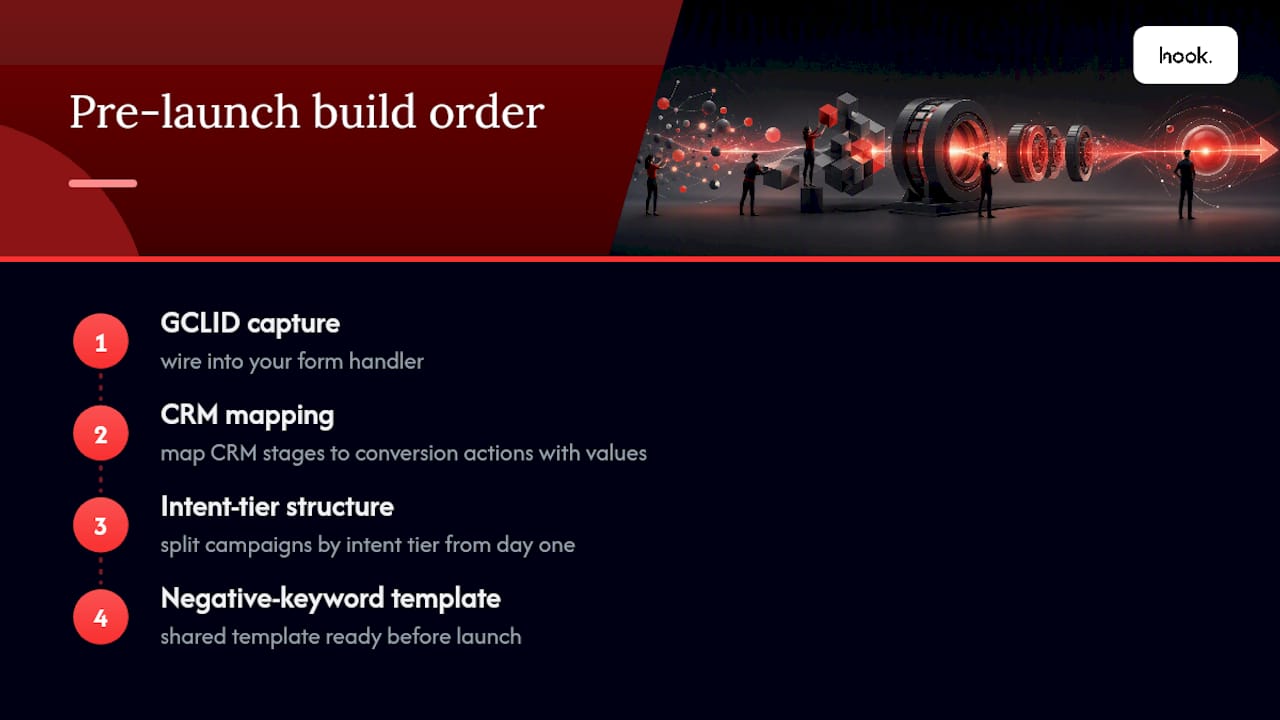
Running this playbook properly means getting a handful of technical pieces right before the first campaign even launches. A practical build order looks like this: GCLID capture wired into your form handler, CRM stages mapped to conversion actions with representative values, campaigns split by intent tier from day one, and a shared negative-keyword template ready before launch rather than built reactively.
The most common pitfall is treating this as a one-off setup rather than an ongoing discipline. Offline conversion imports that run for one month and then get forgotten teach Google nothing useful… An outside agency engagement often resolves the gap between a technically correct setup and one that actually holds up under scrutiny each quarter.
Why patience with the data beats early panic
Most B2B Google Ads accounts don’t fail because the channel doesn’t work. They fail because someone in the business pulls the plug after six weeks of a campaign that hadn’t yet had time to produce a closed deal, let alone teach the bidding algorithm anything useful. A 90-day patience rule exists for a reason: campaigns that look mediocre in week four often convert into the highest-value deals in the pipeline by week twelve.
We’ve seen accounts where the switch from raw lead-volume reporting to pipeline-value reporting changed the entire internal narrative about whether Google Ads was “working,” without a single change to the ads themselves. The data had been there all along. Nobody had connected it to the CRM.
Commit to the learning window before you commit the budget.
— Hook
Let Hook-digital build the account that survives quarter two
Most B2B businesses either run Google Ads in-house with no real bandwidth to manage it properly, or hire an agency once the in-house attempt has already burned through a quarter’s budget on unqualified clicks. An agency like Hook-digital can build the account with intent-tiered campaign structure, GCLID and CRM integration, offline conversion imports mapped to sales stages, landing pages built for conversion, and reporting dashboards that show pipeline value instead of vanity metrics.

If your team has the resources to manage weekly search-term reviews, monthly landing-page tests, and CRM-to-Google data pipelines, running in-house can work. If that sounds like more admin than your marketing function has time for, that’s exactly the gap Hook-digital exists to close. As a full-service agency based in Oxford, we build the campaign architecture and the landing pages and websites that support it under one roof, so you’re not coordinating separate suppliers for ads, CRO and web development. Get in touch to talk through what a properly measured B2B account could look like for your pipeline.
Sources
This guide draws on Google’s own B2B marketing funnel guidance, practical playbooks from Klucco, DigitCog, and Betts & Burton, and analysis from Unbounce on paid search performance for B2B revenue quality. For a broader view of how funnel structure connects to lead generation and SEO more widely, see this analysis of marketing funnel optimisation. Readers planning a first Google Ads account should also see Hook-digital’s practical guide for businesses considering Google Ads.
- Navigating the B2B marketing funnel with Google Ads
- Google Ads for B2B lead generation: the complete strategy (Klucco)
- B2B PPC strategy: build paid search for high-value leads (DigitCog)
FAQ
Is £10 a day enough for Google Ads in B2B?
Rarely. B2B clicks in competitive categories often cost more than a £10 daily budget allows for even a handful of clicks, and a budget that small won’t generate enough conversions for Smart Bidding to learn effectively.
How much do Google Ads cost per 1,000 views in B2B?
Costs vary enormously by industry and format, but B2B advertisers typically pay far more per click than consumer brands due to smaller audiences and higher competition for decision-maker searches.
Is £500 a month enough for Google Ads for B2B?
It can support a narrow, tightly targeted bottom-funnel campaign in a lower-cost category, but most B2B accounts need closer to £3,000 to £10,000 a month to generate the conversion volume automated bidding needs to work well.
Are Google Ads worth it for small B2B businesses?
Yes, when campaigns are structured by intent tier and measured against pipeline value rather than raw lead count; the channel captures buyers who are already searching, which is hard to replicate through other means at a similar cost.
How long before Google Ads B2B campaigns show results?
Expect initial leads within the first month, 60 to 90 days before bidding data stabilises, and four to six months before full-funnel attribution and pipeline reporting mature properly.
.png)


