
.webp)

.svg)
How to brief a design agency: a practical guide
A design agency brief is a concise project document that defines your objectives, audience, deliverables, timeline, and budget before any creative work begins. Without one, even the most talented agency will struggle to deliver what you actually need. Most agency projects fail due to vague or incomplete briefs, not lack of talent. The brief is a risk reduction tool, not administrative paperwork. Platforms like Breef, Clariva, and Mediabistro have all documented how a well-constructed brief improves alignment, reduces revision cycles, and protects both your budget and your deadline.

What does a design agency brief need to include?
A complete design agency project brief covers eight core elements. Each one serves a specific purpose, and leaving any out creates a gap the agency will fill with assumptions.
-
Project overview and context. Describe what you need and why, in plain language. Two or three sentences are enough. The agency needs to understand your business situation before they can solve your problem.
-
Measurable success criteria. Replace vague goals with specific, measurable targets such as driving 5,000 new visitors in the first month or generating 200 qualified leads. Vague statements like “increase brand awareness” give the agency nothing to aim at.
-
Target audience profile. Describe your audience’s demographics, pain points, and decision factors. The more specific you are here, the more relevant the creative output will be.
-
Deliverables list. Specify format, quantity, and platform for every deliverable. “A logo” is not a deliverable. “A primary logo, a secondary logo, and a favicon, delivered as SVG and PNG files” is a deliverable.
-
Timeline with milestones. Include dates for content delivery, design reviews, and development phases, not just the final deadline. Key milestones structure the workflow and keep feedback timely.
-
Budget range. Share a realistic budget range early. Not disclosing your budget at the briefing stage is a significant risk flag. It forces the agency to guess at scope, which leads to proposals that miss the mark entirely.
-
Stakeholders and approval chain. Name the people involved, their roles, and who has final sign-off. Ambiguity here causes delays when revisions need approval.
-
Technical constraints. List any fixed requirements: brand guidelines, existing platforms, accessibility standards, or file format restrictions.
Pro Tip: When writing your deliverables list, include a scope boundary. State explicitly what is not included. This single sentence prevents more scope creep than almost anything else in the brief.
What is the right order for briefing documents?
The sequence of project documents matters as much as their content. Skipping steps or merging documents prematurely is one of the most common causes of scope creep and payment disputes.
-
Discovery. Before any document is written, the agency needs to understand your business, your market, and your goals. A discovery conversation or questionnaire comes first.
-
Proposal. The agency responds with a proposed approach, timeline, and cost. Nothing is agreed yet.
-
Statement of work (SOW). This is the legally binding document that defines exactly what will be delivered, when, and for how much. Sign this before the brief is finalised. The correct document flow is discovery, proposal, SOW, contract, brief, and then kickoff. Skipping the SOW is the single most reliable way to end up in a scope dispute.
-
Contract or master service agreement. This covers payment terms, intellectual property, and liability. It sits alongside or just after the SOW.
-
Creative brief. Once the SOW is signed, the brief provides the creative direction. The brief must align perfectly with the SOW. Any contradiction triggers a formal scope change, which means renegotiation and delay.
-
Kickoff meeting. After the brief is shared, a kickoff meeting aligns the full team on priorities, timelines, and communication channels. This is your last chance to catch misunderstandings before work begins.
Getting this sequence right protects your budget and keeps the project moving. Treat each document as a checkpoint, not a formality.
How should you manage revision rounds in your brief?
Revision rounds are where most design projects quietly go wrong. The brief and the SOW should both define revision limits clearly, before the first design is shared.
-
Define what a revision round is. A revision round is one consolidated set of feedback submitted through a single agreed channel. It is not a series of individual emails sent over several days.
-
Set a limit. Revision rounds should be limited to 2–3 included rounds, with additional rounds billed separately. This figure should appear in both the SOW and the kickoff materials.
-
Use a single feedback channel. Designate one channel for all feedback, whether that is email, a shared document, or a project management tool. Mixed channels create confusion and missed comments.
-
Set feedback windows with a deadline. Give stakeholders a fixed window to submit feedback. After that window closes, silence equals approval. This rule prevents the “one more tweak” cycle that derails timelines.
-
Define overage charges. State clearly what additional revision rounds cost. Knowing the price in advance changes how stakeholders prioritise their feedback.
-
Communicate the policy at onboarding. Establishing revision policies proactively protects the relationship and shifts revisions from a contractual clause to a communication discipline. Agencies that raise this at the start of a project report far fewer disputes.
Pro Tip: Ask your agency to include a revision log in their project management tool. Every round of feedback gets timestamped and recorded. This removes ambiguity about what was requested and when.
Common mistakes when briefing a design agency
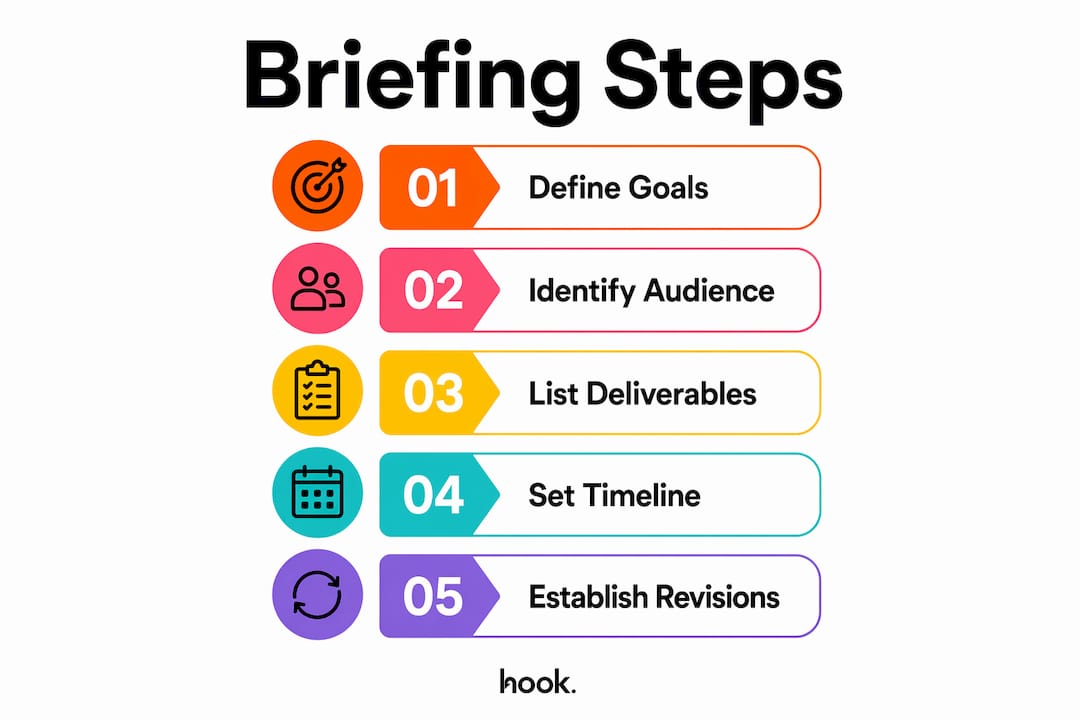
Even experienced marketing professionals make avoidable errors when creating a design agency brief. Each mistake below has a direct consequence.
Vague goals. Writing “improve our brand image” gives the agency no direction. Replace every vague goal with a measurable outcome. Vague briefs are the primary cause of revision rounds multiplying as teams try to retroactively figure out what success looks like.
Incomplete deliverables. Listing “social media assets” without specifying platforms, dimensions, quantities, or file formats leaves the agency guessing. Every deliverable needs a complete description.
Missing stakeholder information. If the brief does not name who approves work and in what order, feedback arrives from multiple directions at different times. This slows every stage of the project.
Skipping the SOW. Merging the proposal and the SOW into one document, or skipping the SOW entirely, removes the legal clarity that protects both parties. The brief cannot substitute for a signed SOW.
No intermediate milestones. A brief that lists only a final delivery date gives the agency no accountability checkpoints. Without milestones, problems surface too late to fix without cost.
Pro Tip: Before you send your brief, read it as if you are the agency receiving it for the first time. If you cannot answer “what does success look like?” and “exactly what will I deliver?” from the document alone, it needs more work.
Key takeaways
A well-written design agency brief is the single most effective way to protect your budget, reduce revisions, and get better creative output from your agency.
| Point | Details |
|---|---|
| Define measurable goals | Replace vague aims with specific targets such as visitor numbers or lead volumes. |
| List every deliverable precisely | Include format, quantity, platform, and scope boundaries for each item. |
| Follow the document sequence | Complete discovery, proposal, SOW, and contract before finalising the brief. |
| Set revision limits in writing | Include 2–3 revision rounds in the SOW and define overage charges upfront. |
| Name your approval chain | Specify who reviews and who signs off to prevent feedback delays. |
The real cost of a weak brief
Working with agencies across Oxford and beyond, the pattern is consistent. The projects that run over budget and over time almost always trace back to a brief that was written in a hurry or skipped entirely. Business owners often treat the brief as a formality, something to get through before the “real” work starts. That instinct is expensive.
A good brief does something that no amount of talent can replace. It gives the agency permission to make decisions confidently. When the objectives are clear, the audience is defined, and the deliverables are specific, the creative team can focus on quality rather than second-guessing what you want. The result is faster delivery, fewer rounds of feedback, and work that actually lands.
The document sequence matters too, and this is where I see the most avoidable damage. Clients who skip the SOW and go straight to a brief are essentially handing the agency a creative direction with no legal framework underneath it. When scope changes, and it always does, there is nothing to refer back to. The brief becomes a source of dispute rather than a source of clarity.
Revision policies feel awkward to raise at the start of a project. Raise them anyway. Setting a clear revision policy at onboarding is one of the most professional things you can do as a client. It signals that you respect the agency’s time, and it protects your own budget. Treat your brief as a strategic investment in the project, not a box to tick.
— Hook
Working with Hook-digital on your design projects
Hook-digital works with business owners and marketing professionals across Oxfordshire and beyond, handling branding, design, websites, social media, and more from a single team. You get one point of contact, no coordination headaches, and a team that understands how to turn a well-written brief into work that performs.

If you are ready to put your next design project on solid ground, Hook-digital’s branding and design services cover everything from initial discovery through to final delivery. You can also browse the design portfolio to see how previous briefs have translated into finished work. When you are ready to talk through your project, book a free consultation and we will help you shape a brief that sets the whole project up for success.
FAQ
What is a design agency brief?
A design agency brief is a written document that defines your project objectives, audience, deliverables, timeline, budget, and approval process. It gives the agency clear direction before any creative work begins.
How long should a design agency brief be?
A brief should be as long as it needs to be to cover all eight core elements clearly, typically one to three pages. Brevity matters, but completeness matters more.
What should I include in a design brief for a logo project?
Include your brand values, target audience, colour preferences, formats required (such as SVG, PNG, and favicon), usage contexts, and the number of revision rounds included. Specify who has final approval.
How many revision rounds should a design brief allow?
Best practice is 2–3 revision rounds included in the project fee, with additional rounds billed separately. This figure should appear in both the brief and the statement of work.
Do I need a statement of work before writing a design brief?
Yes. The statement of work should be signed before the brief is finalised. The brief must align with the SOW to avoid contradictions that trigger scope changes and renegotiation.
Recommended
- How to brief a video production agency effectively | Hook Digital - Oxford’s Premier Full-Service Marketing Agency
- Marketing agency evaluation checklist: 2026 guide | Hook Digital - Oxford’s Premier Full-Service Marketing Agency
- What is a full service agency? a clear guide | Hook Digital - Oxford’s Premier Full-Service Marketing Agency
- Commercial Photography Oxford | Brand & Product Shoots | Hook Digital
.png)


