

.webp)

.svg)
How to brief a video production agency effectively

A video production brief is a structured document that communicates your project requirements to a video production agency, aligning creative output with your business goals from the outset. Getting this document right is the difference between a smooth, on-budget production and a cycle of costly revisions. Whether you are commissioning a brand film, a social media series, or a product explainer, a well-prepared brief saves time, protects your budget, and gives the agency everything it needs to produce work that actually performs. Resources like templates from Ben Matthews and Ivory Media show that the most effective briefs cover objectives, audience, deliverables, timeline, budget, and approval process in a single, clear document.
What should you include when you brief a video production agency?
A comprehensive video brief must cover ten core components: background and context, objectives, audience, key messages, tone and style references, format and length, distribution channels, timeline, budget, and approval process. Each component serves a specific purpose. Together, they give the agency enough information to build a realistic proposal and a creative strategy that fits your brand.
Business context and your primary objective
Start with your business context. Explain what your company does, where you sit in the market, and what prompted this video project. Then state a single primary objective. Vague goals like “raise brand awareness” are not objectives. A clear objective sounds like: “We want 30% of viewers to click through to our product page.” One focused outcome is far more useful to a creative team than three competing ambitions.

Your audience and viewing context
Defining the specific viewer and the context in which they will watch your video directly shapes format and tone. A 60-second LinkedIn clip watched on a commute demands different pacing and subtitling to a two-minute homepage hero video viewed on a desktop. Describe your audience by role, sector, and mindset, not just age and gender. The more precise you are, the more targeted the creative response will be.
Deliverables, formats, and rights
Specify deliverables precisely, including the hero video, any cut-downs, subtitles, aspect ratios for different platforms, and how many rounds of revisions you expect. This level of detail prevents misunderstandings and protects your budget. Rights and licensing deserve equal attention. Paying for a video does not automatically transfer copyright ownership to you. Your brief should flag that you need a written agreement covering copyright assignment or licence scope, particularly if you plan to use the footage in paid advertising.
Rights clearance also covers music licences and appearance releases for anyone filmed. A broad usage rights agreement reduces legal risk and makes distribution far simpler. Raise this in the brief so the agency factors it into their quote and workflow from day one.
- Business context: One paragraph on your company, sector, and what prompted the project.
- Single objective: One measurable outcome, not a list of aspirations.
- Audience profile: Role, sector, mindset, and viewing context.
- Key messages: No more than three core points you want viewers to take away.
- Tone and style references: Links to videos you admire, with notes on what specifically appeals to you.
- Deliverables: Hero video, cut-downs, aspect ratios, subtitles, and revision rounds.
- Distribution plan: Every platform where the video will appear.
- Timeline: Key milestones and your internal approval process.
- Budget range: A realistic figure or range, not “as low as possible.”
- Rights and licensing: Copyright ownership, music licences, and appearance releases.
Pro Tip: Include three to five reference videos with brief notes on what you like about each one. This single addition cuts creative misalignment faster than any written description.
How do you write a clear and concise video production brief?
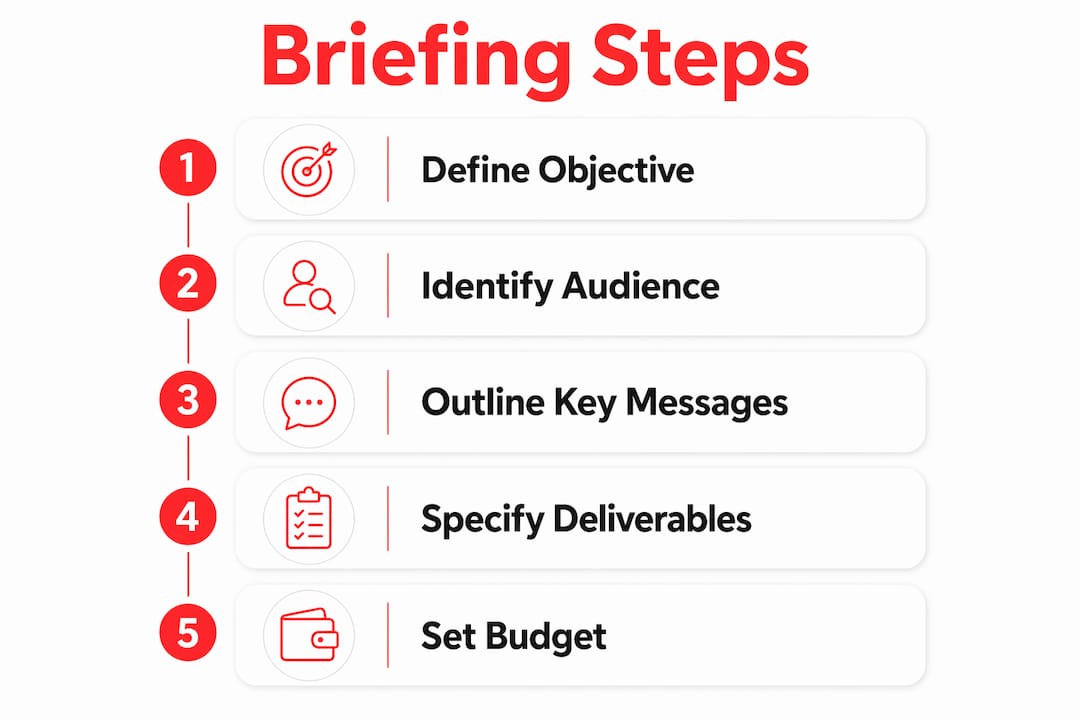
Brief length matters less than clarity. A well-structured brief of one to two pages outperforms a sprawling ten-page document that buries the key information. Before you write a single word, answer these foundational questions internally: What does success look like? Who is watching? What do we want them to do next? Only once you have clear answers should you start writing.
Follow this logical order when structuring your brief:
- Company and project context — who you are and why this video is needed now.
- Objective — the single business outcome this video must achieve.
- Audience — specific description of the viewer and their viewing context.
- Key messages — the two or three things viewers must remember.
- Tone and style — reference videos and notes on what appeals to you about them.
- Deliverables — every asset you need, described at the individual file level.
- Distribution plan — every platform, including paid media if applicable.
- Timeline — production milestones, review dates, and final delivery deadline.
- Budget range — a realistic figure that allows the agency to design a workable approach.
- Approval process — who signs off at each stage and how long approvals take.
Language matters as much as structure. Avoid vague terms like “feel inspired” or “something fresh.” Replace them with specific, observable outcomes. Instead of “we want it to feel premium,” write “we want the colour palette and pacing to match the tone of [reference video link].” Make the desired viewer action explicit. “We want viewers to book a demo” is far more useful than “we want to drive engagement.”
The table below shows how vague language compares to specific language in a brief:
| Vague phrasing | Specific alternative |
|---|---|
| “Raise brand awareness” | “Drive 500 new email sign-ups via the video landing page” |
| “Feel premium and modern” | “Match the visual tone of [reference video], cool palette, slow cuts” |
| “Target young professionals” | “B2B buyers aged 28–40 in the SaaS sector, watching on LinkedIn” |
| “A short video” | “90-second hero video plus 30-second cut-down for Instagram Stories” |
| “Flexible on budget” | “Budget range of £8,000–£12,000 including post-production” |
Pro Tip: Treat your brief as a version-controlled document. Lock the objective, key message, and success metric before sharing it with the agency. Any changes after that point should be logged as a formal revision to prevent scope creep and timeline slippage.
What are the most common briefing mistakes to avoid?
Poor briefs are the leading cause of video projects running over budget and over time. Most mistakes fall into predictable patterns, and all of them are avoidable.
“Agencies that don’t ask about audience or objectives, and instead focus on equipment or give quick unspecific quotes, often produce poor creative outcomes. A strong brief filters out the wrong partners before a single meeting takes place.” — Ivory Media
The most damaging mistakes include:
- Leading with format instead of goals. Asking for “a two-minute explainer video” before defining the business objective puts the cart before the horse. Briefs should focus on the business goal and the required viewer action. Format follows from that.
- Vague audience descriptions. “Everyone aged 18 to 65” is not an audience. It is an instruction to produce something generic. Undefined personas lead to creative that connects with nobody.
- Ignoring rights and licensing until post-production. Copyright and music licensing issues discovered after filming are expensive to fix. Raise them in the brief so the agency builds clearance into their workflow from the start.
- Under-specifying deliverables. If you need a 9:16 version for Instagram Stories and a 16:9 version for YouTube, say so in the brief. Requesting additional formats after delivery is a common source of unexpected costs.
- Omitting the budget range. A budget range in the brief enables agencies to design realistic proposals. Without it, you receive either inflated quotes or vague estimates that fall apart during production.
- Skipping the approval process. If your organisation requires sign-off from three stakeholders before any edit can be approved, the agency needs to know this upfront. Unplanned approval delays are one of the most common causes of missed deadlines.
Understanding your audience’s attention before you brief the agency also helps you write a sharper brief. The more you know about how your audience consumes content, the more specific your brief will be.
What happens after you submit the brief?
Submitting your brief is the start of a conversation, not the end of your involvement. Here is what to expect from the agency collaboration process:
- Clarifying questions. A good agency will come back with questions. This is a positive sign. It means they have read the brief carefully and are thinking strategically about your project. Answer questions fully and update the brief to reflect any agreed changes.
- Creative proposal and quote. The agency uses your brief to build a creative approach and a realistic budget. The more specific your brief, the more accurate and comparable the quotes you receive will be.
- Brief iterations. Scope sometimes changes. When it does, update the brief formally rather than communicating changes verbally. A written record protects both parties.
- Production and approval milestones. Your brief should have outlined the approval process. Stick to the agreed review timelines. Late approvals push back delivery dates and can incur additional costs.
- Deliverables and rights handover. At project close, confirm that all agreed assets have been delivered and that copyright or licence agreements are in writing. Do not assume ownership without a signed contract.
- Measuring success. Define your success metric in the brief and measure against it after launch. Views and likes are vanity metrics. Measure click-through rates, conversions, or whatever outcome your objective specified.
A well-written brief also helps you plan your marketing more effectively across the whole campaign, not just the video itself. When the brief is clear, the agency can flag opportunities you may not have considered, such as repurposing footage for social content or adapting the hero video for paid media.
Key takeaways
A strong video production brief is the single most effective way to protect your budget, align creative output with your goals, and avoid costly revisions.
| Point | Details |
|---|---|
| Define one clear objective | State a single measurable outcome rather than a list of vague aspirations. |
| Specify every deliverable | List all assets including cut-downs, aspect ratios, and subtitles at the file level. |
| Include a budget range | A realistic range enables agencies to propose workable creative solutions. |
| Address rights upfront | Agree copyright ownership and music licences in writing before production begins. |
| Treat the brief as a live document | Lock the objective early and log all changes formally to prevent scope creep. |
What we have learned from briefing video agencies
After working with businesses across Oxfordshire and beyond on their video and branding projects, one pattern stands out clearly. The clients who get the best results are not always the ones with the biggest budgets. They are the ones who arrive with a clear brief.
The most common mistake we see is businesses focusing on the format they want rather than the outcome they need. Someone will say “we need a two-minute company video” before they have defined what that video should make a viewer do. That is working backwards. Start with the business goal and let the format follow from it.
The second thing we have learned is that legal and licensing considerations are almost always left too late. Music rights, appearance releases, and copyright ownership feel like administrative details until they become expensive problems. Raising them in the brief is not bureaucratic. It is practical.
We also believe strongly in budget transparency. Sharing a realistic range does not weaken your negotiating position. It gives the agency permission to be creative within real constraints rather than presenting you with an aspirational proposal that bears no relation to what you can actually spend.
Finally, the brief is not a document you hand over and forget. It is the north star for the entire project. Refer back to it at every review stage. If a creative decision does not serve the stated objective, the brief gives you the authority to say so clearly and constructively.
— Hook
Work with Hook-digital on your next video project
Hook-digital is a full-service marketing agency based in Oxford, and video production is one of our core specialisms. We work with businesses to develop clear, well-structured briefs before a single frame is shot, so that the creative work is grounded in your actual business goals from day one.

Whether you are starting from scratch or refining an existing idea, our team can help you think through your objectives, audience, deliverables, and distribution plan. We also bring our branding and design expertise to every project, so your video sits within a coherent visual identity rather than feeling disconnected from the rest of your marketing. If you are ready to commission a video that actually performs, get in touch with Hook-digital today.
FAQ
What is a video production brief?
A video production brief is a structured document that outlines your project objectives, audience, key messages, deliverables, timeline, and budget for a video production agency. It aligns the agency’s creative work with your business goals before production begins.
How long should a video production brief be?
A well-structured brief is typically one to two pages. Clarity matters more than length, and a concise brief covering all core components is more useful to an agency than a lengthy document that buries the key information.
Do i need to include a budget in my video brief?
Yes. Including a budget range allows the agency to design a realistic creative proposal rather than an aspirational one. Without a figure, quotes are often vague or misaligned with what you can actually spend.
Who owns the copyright to a commissioned video?
Paying for a video does not automatically transfer copyright to you. Ownership depends on a written agreement. Your brief should flag the need for a copyright assignment or licence covering all intended uses, including paid advertising.
What deliverables should i specify in a video brief?
Specify every asset you need, including the hero video, cut-down versions, aspect ratios for each platform, subtitles, and the number of revision rounds included. Asset-level detail prevents unexpected costs and production delays.
.png)


