

.webp)

.svg)
How to target local customers online in 2026

Targeting local customers online is the process of using digital marketing techniques to attract and engage people within a specific geographic area. 97% of consumers use online sources to learn about local businesses, and 88% of mobile local searches result in a call or visit within 24 hours. Those numbers make local digital marketing one of the highest-return activities a business owner can invest in. This guide covers the tools, content strategies, and ad campaign structures that actually move the needle for local businesses in 2026.
What tools do you need to target local customers online?
The foundation of any local digital marketing strategy is your Google Business Profile (GBP). Optimising your GBP is a low-cost, high-impact starting point. A complete profile with accurate hours, photos, and a keyword-rich description puts you in front of people actively searching for what you offer nearby.
Local SEO builds on that foundation by optimising your website to rank for location-specific search terms. When someone types “plumber in Oxford” or “coffee shop near me,” local SEO is what determines whether your business appears. Targeting phrases that include your town or neighbourhood directly increases the relevance of your traffic and the intent behind each visit.

Beyond Google, platforms like Nextdoor offer something no other major network can match. Nextdoor provides verified residential targeting at the neighbourhood level, using confirmed home addresses rather than inferred location data. That precision matters enormously when you want to reach people who actually live and shop in your area.
Here is a quick comparison of the core tools and what each one does best:
| Tool | Primary function | Targeting precision |
|---|---|---|
| Google Business Profile | Local search visibility | City and postcode level |
| Local SEO | Organic website rankings | Location-specific search terms |
| Google Ads (location targeting) | Paid search with radius options | Radius and postcode |
| Meta Ads | Social feed and story ads | Radius and interest layering |
| Nextdoor Ads | Neighbourhood-level paid reach | Verified residential address |
- Claim and verify your Google Business Profile before anything else.
- Build location pages on your website for each area you serve.
- List your business on Apple Maps, Bing Places, and Yell.
- Use marketing tools for small businesses to manage multiple channels without burning hours.
Pro Tip: Complete every field in your Google Business Profile, including the Q&A section. Profiles with more than five photos receive significantly more direction requests than those with fewer.
How do you create content that resonates with a local audience?

Local content works because it feels personal. A post that mentions a specific street, a nearby landmark, or a community event speaks directly to the reader in a way that generic content never can. Your neighbours are your customers, and your content should reflect that.
The most effective local content strategies share a few common traits:
- Use place names in your copy. Mention your town, neighbourhood, or even a well-known local landmark. This signals relevance to both readers and search engines.
- Feature local reviews prominently. User-generated content such as Google Business Profile review screenshots outperforms polished ad creative for service-based businesses. A genuine five-star review from someone in your area carries more weight than a professionally produced image.
- Tie posts to community events. A post about a local festival, a charity run, or a school fundraiser shows you are part of the community, not just selling to it.
- Respond to every review publicly. Your response is visible to everyone reading your profile. A thoughtful reply to a negative review builds more trust than a wall of five-star ratings with no engagement.
Social media engagement focused on community interests boosts local brand loyalty and repeat visits. The key is consistency. One well-crafted local post per week outperforms five generic ones.
Pro Tip: Screenshot your best local reviews and use them as ad creative on Meta. Add the reviewer’s first name and neighbourhood for maximum authenticity. This single tactic regularly outperforms brand-produced imagery.
How do you run a location-based online advertising campaign?
A well-structured local ad campaign follows a clear sequence. Skipping steps early on leads to wasted budget and unfocused results.
-
Set your radius, then go beyond it. Start with a 5–10 mile radius around your location on Google Ads or Meta Ads. Understand, though, that radius targeting on Meta Ads is a soft constraint. The platform may show your ads slightly outside that boundary if it predicts a strong conversion. Your ad creative, not just the radius, is what filters out irrelevant audiences.
-
Name your neighbourhoods in the ad copy. If your radius targeting is a soft signal, your creative is the hard filter. Mentioning “Oxford city centre” or “Cowley Road” in your headline tells the algorithm and the reader exactly who the ad is for. People who do not recognise those places will scroll past.
-
Segment by neighbourhood clusters. Segmenting ad sets by neighbourhood allows you to tailor messaging and allocate budget based on where your best customers actually live. A campaign for Jericho residents can use different language and offers than one targeting Headington.
-
Allocate budget by performance, not assumption. Run all neighbourhood segments for two weeks, then shift spend toward the clusters generating the lowest cost per lead. Let the data decide, not your instinct.
-
Retarget website visitors and social engagers. People who visited your website or engaged with your social posts already know your brand. A retargeting ad with a specific local offer, such as a discount for residents of a named area, converts at a much higher rate than a cold audience ad.
For a deeper look at how Google Ads and Meta Ads compare for local campaigns, the Meta Ads vs. Google Ads guide from Hook-digital breaks down which platform suits which business type.
Pro Tip: On Nextdoor, create separate ad sets for each postcode cluster rather than one broad campaign. Verified residential data means your impressions are genuinely local, so tighter segmentation gives you cleaner performance data.
What are the common challenges with local online targeting?
Local digital marketing has specific pitfalls that broader national campaigns do not face. Knowing them in advance saves you time and money.
-
Signal scarcity from privacy changes. Cookie deprecation and privacy updates have fragmented audience data across most ad platforms. Platforms that rely on inferred location signals are less reliable than they were two years ago. Platforms with verified first-party location data, such as Nextdoor, are now more valuable precisely because of this shift.
-
Over-reliance on radius targeting. A radius is a starting point, not a strategy. Relying on it alone without local creative or neighbourhood-specific copy means your ads reach people in the right postcode but with no reason to care about your business specifically.
-
Inconsistent business information across directories. Consistent Name, Address, and Phone Number (NAP) information across online directories builds trust and supports search rankings. Many local businesses have outdated phone numbers or old addresses on Yell, Yelp, or Apple Maps. That inconsistency confuses both search engines and potential customers.
-
Neglecting creative refresh. Local audiences are small. If you run the same ad to the same 5,000 people for three months, fatigue sets in fast. Rotate creative every four to six weeks and test new offers regularly.
The businesses that win locally are not always the ones with the biggest budgets. They are the ones with the most consistent presence, the most accurate information, and the most relevant message for their specific community.
How do you measure success in local digital marketing?
Measurement turns guesswork into a repeatable process. Without it, you are spending money and hoping for the best.
Tracking calls, store visits, and conversions from local digital marketing lets you see exactly which channels and campaigns are driving real business. Google Business Profile Insights shows how many people called you directly from search, requested directions, or visited your website from your listing.
Key metrics to monitor regularly:
- Direction requests and calls from GBP. These are high-intent signals. A rise in direction requests after a campaign launch confirms the campaign is working.
- Local keyword rankings. Track your position for your core service plus location terms monthly. Movement here reflects the cumulative effect of your SEO work.
- Cost per lead by neighbourhood. Break down your ad spend by the neighbourhood clusters you set up. This tells you where your budget is most efficient.
- Review velocity. The rate at which you receive new reviews matters as much as the overall score. A business with 200 reviews and no new ones in six months looks stagnant.
- Website sessions from organic local search. Use Google Search Console to filter by location-specific queries. Growth here shows your local SEO is compounding over time.
Adjust your targeting areas based on this data every 30 days. If one postcode cluster consistently underperforms, reduce its budget and redirect spend to areas showing stronger returns. Connecting your website to your local campaigns as the central conversion point makes measurement far cleaner.
Key takeaways
Reaching local customers online requires combining accurate location data, consistent business information, and locally relevant content across every channel you use.
| Point | Details |
|---|---|
| Start with Google Business Profile | A complete, optimised GBP is the single highest-return starting point for local visibility. |
| Use local creative, not just radius targeting | Naming neighbourhoods in ad copy filters irrelevant audiences more effectively than radius settings alone. |
| Verified location data beats inferred data | Platforms like Nextdoor use confirmed addresses, making them more reliable as privacy changes reduce signal quality. |
| Segment campaigns by neighbourhood | Splitting ad sets by area gives cleaner data and lets you allocate budget where it performs best. |
| Measure direction requests and call volume | These high-intent actions confirm whether your local campaigns are driving real-world visits and enquiries. |
What I have learned about local marketing that most guides miss
Most articles about local digital marketing treat radius targeting as the main event. In my experience working with local businesses, it is actually one of the least reliable parts of the whole system. The radius tells the platform where to look. Your creative tells the customer whether the ad is meant for them.
The shift I have seen make the biggest difference is moving from location as a setting to location as a message. When a business in Oxford writes ad copy that says “serving Summertown and North Oxford since 2015,” it does something a 5-mile radius cannot. It creates instant recognition. The reader sees their neighbourhood and stops scrolling.
The other thing I keep coming back to is the value of authentic peer recommendations over polished creative. A screenshot of a real review from a named local customer, placed inside a Meta ad, consistently outperforms a designed graphic with a tagline. It is not glamorous. It does not win design awards. But it converts, because it is real.
Privacy changes are also reshaping the tools worth investing in. First-party location data, the kind that comes from verified addresses rather than browsed behaviour, is becoming the most dependable signal available. Platforms built on that foundation are worth prioritising, even if they feel less familiar than the big names.
The businesses I see winning locally are not outspending their competitors. They are out-communicating them. Consistent information, genuine community presence, and creative that speaks to a specific place. That combination is harder to copy than a big ad budget.
— Hook
How Hook-digital can support your local marketing
Strong local marketing starts with a strong identity. If your branding does not clearly communicate who you are and where you operate, even the best-targeted ad will underperform.
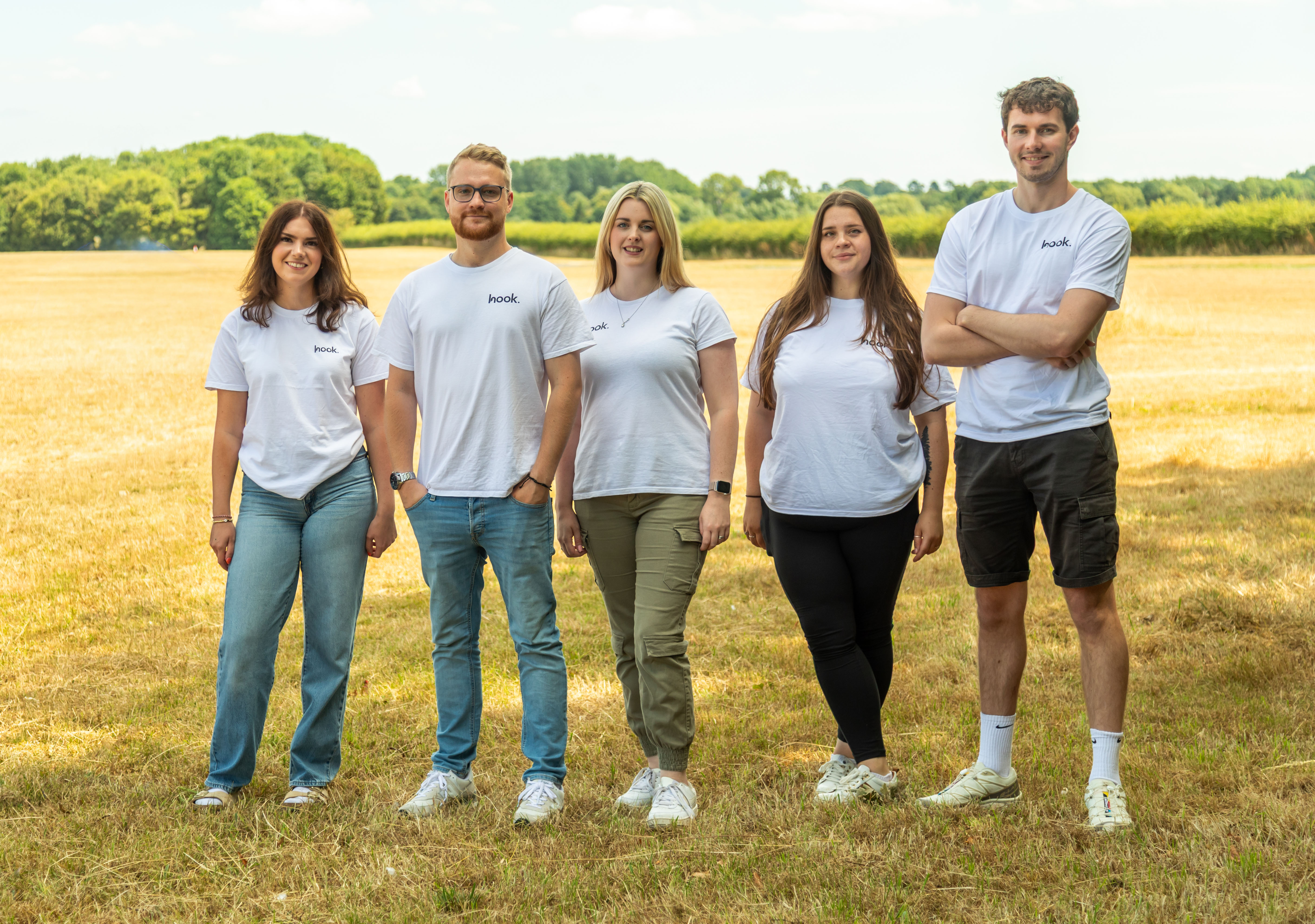
Hook-digital is a full-service marketing agency based in Oxford. We handle branding, design, websites, social media, Google Ads, SEO, and more, so you only need to talk to one team. If you are ready to build a local presence that actually converts, our branding and design services give your business the visual identity and messaging foundation that local campaigns need to succeed. Take a look at what we offer and get in touch when you are ready to move forward.
FAQ
What does it mean to target local customers online?
Targeting local customers online means using digital marketing techniques, such as local SEO, geo-targeted ads, and Google Business Profile optimisation, to attract people within a specific geographic area to your business.
How does local SEO differ from general SEO?
Local SEO focuses on ranking for location-specific search terms, such as “electrician in Oxford,” rather than broad national keywords. It directly improves foot traffic and enquiries from people searching nearby.
Is radius targeting enough for local ad campaigns?
Radius targeting alone is not sufficient. On platforms like Meta Ads, it acts as a soft constraint, so ad creative that explicitly names local neighbourhoods is necessary to filter out irrelevant impressions effectively.
How do I find customers in my area using social media?
Post content tied to local events, community interests, and neighbourhood names. Platforms like Nextdoor also allow you to reach verified residents in specific postcodes, which is more precise than standard social targeting.
How often should I update my local ad creative?
Rotate your ad creative every four to six weeks. Local audiences are small, so the same creative shown repeatedly to the same people causes fatigue and reduces performance quickly.
Recommended
- Why local marketing matters for your business | Hook Digital - Oxford’s Premier Full-Service Marketing Agency
- How to Get Your Target Audience to Notice You | Hook Digital - Oxford’s Premier Full-Service Marketing Agency
- Marketing Trends to Watch in February 2026 | Hook Digital - Oxford’s Premier Full-Service Marketing Agency
- From Reach to Retention: Why 2026 Marketing Is About Being Shared, Saved & Sent in DMs | Hook Digital - Oxford’s Premier Full-Service Marketing Agency
.png)


