

.webp)

.svg)
Stop Wasting Ad Budget: Keyword Match Types for UK Advertisers

Keyword match types decide how closely a search has to line up with your keyword before Google will show your ad, and they now judge that closeness by meaning, not spelling. Broad match paired with Smart Bidding and solid conversion tracking is the strongest default for most advertisers today; phrase and exact still earn their place when you need tighter control or work in a sensitive vertical.
TL;DR:
- Broad match combined with Smart Bidding and reliable conversion tracking offers the best scale and performance for most advertisers, especially on high-volume accounts.
- Exact match keywords still prioritize word-for-word matches but can trigger on similar intents, so original exact match terms must exist in the account for guaranteed relevance.
- Using broad match effectively depends on structured negative keywords, regular search term reviews, and matching landing pages to search intent to prevent wasted spend.
- Flaws such as poor conversion data, overlapping keywords, and weak negative controls often undermine broad match performance and should be addressed first.
- Relying solely on match types without proper infrastructure increases risk; well-optimized accounts can confidently use broad match alongside layered negatives and clean data.
Table of Contents
- What are keyword match types? Broad, phrase and exact compared
- How does Google actually decide which keyword wins?
- When should you use broad, phrase or exact match?
- Making broad match work: Smart Bidding, tracking and negatives
- Why isn’t your match type strategy working?
- Choosing your match-type strategy: a short decision framework
- How Hook-digital approaches match types for clients
- Where to check the details yourself
- Hook Digital’s take: stop treating match type as the whole strategy
- Sources
- FAQ
What are keyword match types? Broad, phrase and exact compared
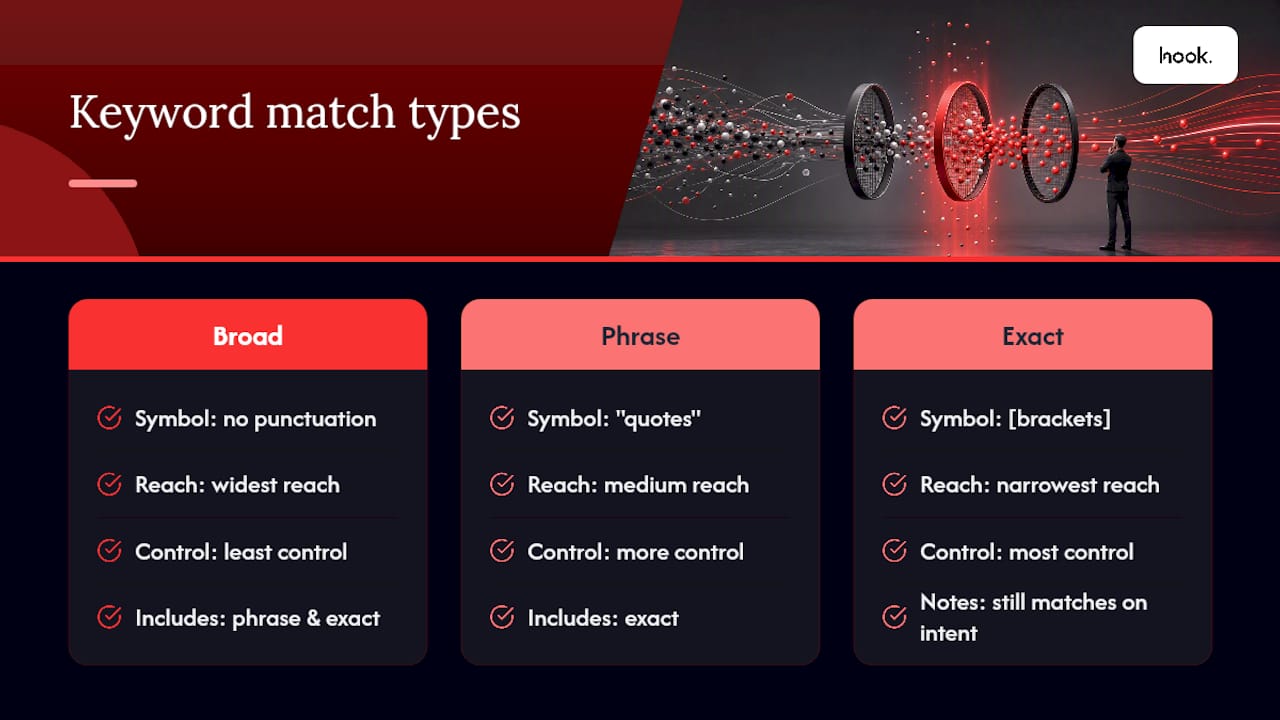
Broad match carries no punctuation, phrase match sits inside quotation marks, and exact match sits inside square brackets. Those symbols are the only thing that hasn’t changed. What each one does has shifted: Google Ads now matches on the meaning behind a search rather than the literal words in it, so even an exact match keyword can trigger against a query that doesn’t share every word, provided the intent lines up closely enough.
Reach and steering sit on opposite ends of a see-saw. The broader the match type, the more searches you catch, but the less say you have over which ones. Here’s how the three stack up:
One rule ties them together: broader match types capture everything narrower ones do, and more. Phrase reaches every query exact match reaches, and broad reaches everything phrase does, plus a wider net beyond that.
How does Google actually decide which keyword wins?
Match type only sets the boundary of what’s eligible. Inside that boundary, a separate set of rules decides which keyword actually fires and which ad gets shown.
- Identical match wins first. If an exact match keyword identical to the search query exists and is eligible, the system prioritises it over anything broader.
- Relevance and Ad Rank break the tie. When no keyword matches word-for-word, Google weighs relevance signals and Ad Rank to pick the keyword and ad it serves.
- Signals go beyond the keyword itself. Landing page content, other keywords sitting in the same ad group, and recent search trends all feed into that relevance judgment.
- Performance Max blurs the lines further. Phrase and broad match keywords can share priority with Performance Max search themes when both are eligible for the same query, which means your Search campaign isn’t always competing in isolation.
The practical takeaway: if you want a specific keyword to fire for its own search every time, it needs to exist as an exact match term in your account. Relying on broad match to “eventually” catch your best-performing query is a bet, not a guarantee.
When should you use broad, phrase or exact match?
Match your default to what the campaign actually needs, not to habit.
- Use exact match for proven, high-value queries and brand terms. These are the searches you already know convert, or your own brand name, where you can’t afford someone else’s ad muscling in. Don’t expect “literal” behaviour though. Google can still expand an exact keyword to close variants it judges to have the same intent.
- Use phrase match for mid-funnel discovery with guardrails. A B2B software firm might use “invoice automation software” to catch a wide spread of related searches while keeping the core concept anchored, useful when you want more volume than exact but aren’t ready to hand full control to the algorithm.
- Use broad match for scale, but only with Smart Bidding underneath it. A local retailer launching a January sale might run broad match on “winter coats sale” and let Smart Bidding find buyers across phrasing they’d never have thought to add manually.
- Combine types deliberately for product launches. Pair exact match on the product name with broad match on the category problem it solves, so you capture people who already know what they want alongside people still describing the need.
The common thread: exact and phrase give you predictability, broad gives you reach, and the right call depends on whether you have the conversion data to let Smart Bidding do the steering for you.
Making broad match work: Smart Bidding, tracking and negatives
Broad match on its own is a blunt instrument. Google recommends pairing it with Smart Bidding because it gives the bidding system the widest possible query space to optimise against, letting the algorithm set bids per auction based on how likely a specific query is to convert, something a flat manual bid can never do.
That only works if the data feeding it is trustworthy. Before you lean on broad match, get this right:
- Track conversions that actually reflect revenue, not just clicks or form loads, and check volume is high enough for Smart Bidding to have something to learn from. Weak or sparse conversion signals leave the algorithm guessing.
- Review search terms on a schedule, weekly while a campaign is still learning, monthly once it’s stable, and add negatives as soon as a pattern of irrelevant traffic appears.
- Structure negatives in layers: brand exclusions at account level, category exclusions at campaign level, and fine-grained exclusions at ad group level, so one messy list doesn’t have to do every job.
- Check landing pages match the intent broad match is now catching, since Google uses that page content as one of its relevance signals.
If your conversion tracking isn’t in shape yet, fixing it before switching to broad match will do more for performance than any keyword change.
Pro Tip: Set a recurring calendar reminder for search-term reviews rather than relying on memory. Broad match accounts that go a month without a negative-keyword pass almost always leak budget on traffic nobody would have chosen on purpose.
Why isn’t your match type strategy working?
Most underperforming accounts share the same handful of faults, and they’re worth checking in this order.
- Broad match running on manual bidding. Without Smart Bidding adjusting per auction, broad’s query variance turns into wasted spend because the bid can’t flex to match conversion likelihood.
- Keywords quietly competing with each other. Overlapping broad and exact terms in the same account can bid against your own ads; check the auction insights and search-term reports for duplicate intent.
- A thin or ignored negative list. Negative keywords are your primary control surface once you’ve opened up match types, and an untouched search-term report is the clearest sign they’ve been neglected.
- Landing pages that don’t match the query. Smart Bidding optimises towards conversions, so a weak or mismatched page breaks the feedback loop no matter how well the keyword strategy is set up.
Choosing your match-type strategy: a short decision framework
Before touching match types, answer these in order:
- Do you have enough conversion volume to trust Smart Bidding? If tracking is patchy or volume is thin, lean on phrase and exact until that’s fixed.
- Pick an account default: exact-led or broad-led. Exact-led favours control for lower-volume or high-stakes campaigns; broad-led favours discovery once your data is solid.
- Set your negative-keyword review cadence now, not after the first wasted budget shows up, and allocate spend with that cadence in mind.
- Define your acceptable variance before switching defaults. Know what KPI movement would tell you the change isn’t working, so you’re not guessing later.
Reliable conversion data and sufficient volume are the prerequisite Google itself names for broad match to succeed under Smart Bidding, which is exactly why this framework starts with measurement, not match type.
How Hook-digital approaches match types for clients
Every Google Ads account we take on gets the same starting checklist: conversion tracking audited and fixed where needed, search-term reports pulled and reviewed, negative lists rebuilt into proper layers, and Smart Bidding configured against clean data rather than guesswork. We treat conversion tracking as the foundation, because no match-type decision matters if the numbers feeding it are wrong.
We also check landing pages match the intent broad match is catching, since a mismatched page undoes good keyword work fast. If your account needs that kind of hands-on management, or your website design itself needs work to convert the traffic you’re now reaching, Hook Digital’s branding and design team can help align the whole picture, not just the keyword list.
Where to check the details yourself
Google’s own documentation is worth reading directly rather than taking on trust secondhand. Google Ads Help’s guide to keyword matching covers syntax and the reach hierarchy in full. Google’s business guide to match types sets out the Smart Bidding recommendation in more depth. How matching works explains the priority rules behind which keyword actually fires. A closer look at ad-copy generation tools is also useful once your match-type strategy is set, since your ad assets need to speak to the wider intent broad match is now catching.
Hook Digital’s take: stop treating match type as the whole strategy
The conventional advice on this topic still talks about match types as if they’re a fixed dial you set once and leave alone. That’s outdated. Once matching runs on meaning rather than literal strings, the keyword itself is only half the control system, negative keywords and conversion data are the other half, and most accounts we review have invested far more thought in the first half than the second.
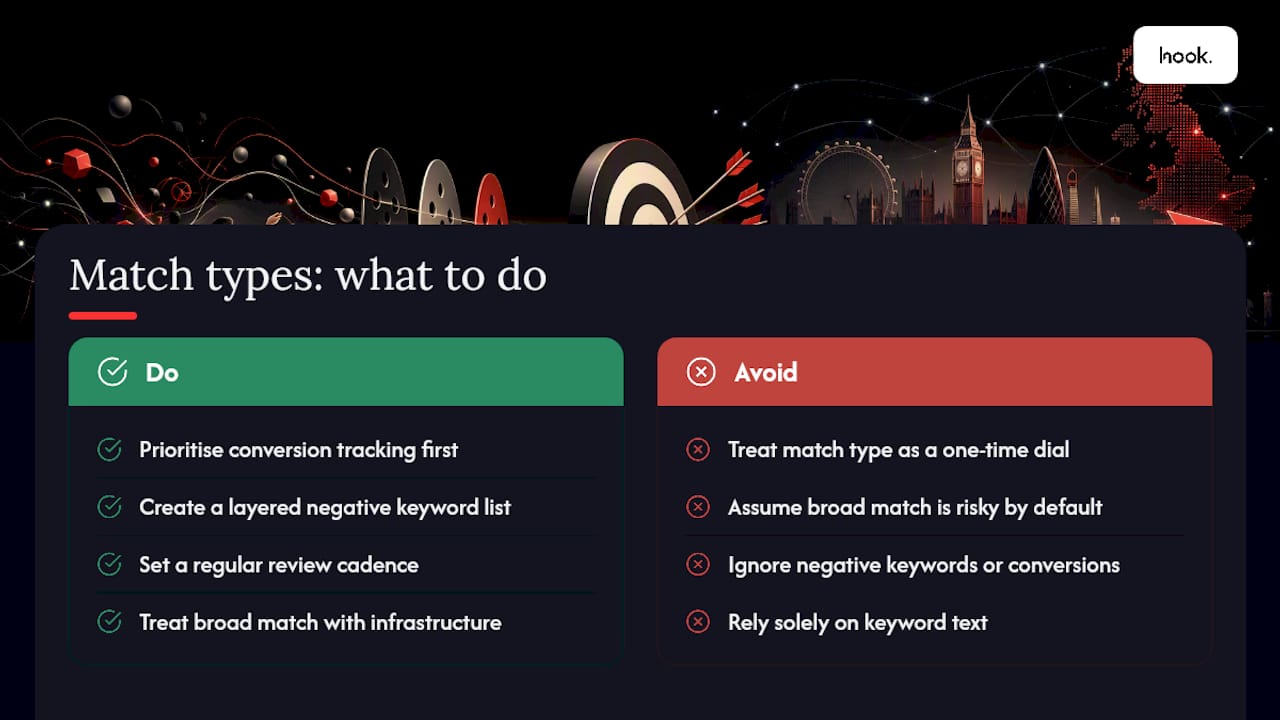
Where the standard guidance falls short is in treating broad match as risky by default. It isn’t risky on its own, it’s risky without infrastructure. An account with clean conversion tracking, a properly layered negative list, and a genuine review cadence can run broad match confidently. An account without those things will bleed budget on exact match too, just more slowly.
If you take one thing from this, prioritise your conversion tracking before you touch match types at all. Identical keywords still get priority when eligible, so your account structure hasn’t stopped mattering, it’s just no longer the only lever worth pulling.
— Hook
Sources
- About keyword matching options - Google Ads Help
- A guide to keyword match types in Google Ads
- How matching works - Google Ads Help
FAQ
How many keyword match types are there?
There are three: broad match, phrase match and exact match, each controlling how closely a search query needs to relate to your keyword before your ad becomes eligible.
What are the match types in Google Ads?
Broad match uses no punctuation and casts the widest net, phrase match sits inside quotation marks for a middle level of control, and exact match sits inside square brackets for the tightest targeting.
Does exact match only show my ad for the exact phrase I chose?
No. Exact match now matches on meaning, not literal wording, so Google can still show your ad for close variants it judges to share the same intent.
Should small businesses use broad match?
Only if conversion tracking is reliable and volume is high enough for Smart Bidding to optimise against; otherwise, phrase or exact gives more predictable results while that groundwork is built.
How often should I review negative keywords?
Weekly during a campaign’s learning phase and monthly once performance stabilises, since negatives are the main lever for keeping broader match types under control.
.png)


