



Marketing Audit Framework: A Practical Guide for 2026

A marketing audit framework is a repeatable structure for reviewing everything your marketing does, scoring how well it works and turning the findings into a short, ordered list of actions. The version below has six stages: set objectives and scope, review the environment, review the marketing mix and channels, measure with data, score the gaps, and prioritise. It works as a marketing health check for a business of any size, and you can run it in a week or two with the right people in the room.
TL;DR
- A good audit is objective, comprehensive, regular and actionable, and it ends with concrete short- and long-term recommendations.
- Start by fixing the objectives and scope, then review the environment, the marketing mix, your channels and your data, in that order.
- Score each area on a simple 0 to 5 scale so gaps are visible to everyone, then turn the lowest scores that matter most into a prioritised plan.
- Most businesses should audit once or twice a year, and again before a new plan or after a major campaign.
- You can lead it in-house or bring in an outside team; what matters is that the people running it know your goals and can read your numbers.
Table of Contents
- What a marketing audit actually is
- The six-stage framework at a glance
- Stage 1: Set the objectives and scope
- Stage 2: Review the environment
- Stage 3: Review the marketing mix and your channels
- Stage 4: Measure with data and fair benchmarks
- Stage 5: Score the gaps
- Stage 6: Prioritise and make a plan
- How often to audit, and who should do it
- Our perspective
- Common mistakes to avoid
- A worked example
- When it makes sense to bring in an agency
- Working with Hook
- FAQ
- Sources
What a marketing audit actually is
A marketing audit is a systematic review of performance across your channels, campaigns and investments. According to HubSpot’s guide, it can cover campaign and channel effectiveness, KPIs, customer journeys, competitors, market research, resources, technology and data, and a SWOT analysis.
The phrase “marketing health check” describes the same thing in friendlier words. Think of a medical check-up: you are not fixing anything yet, you are finding out what is working, what is not and what is quietly costing you money.
Shopify’s 2025 guidance gives four qualities that separate a useful audit from a box-ticking exercise:
- Objective: findings rest on data and evidence, not on who shouted loudest in the last meeting.
- Comprehensive: it looks at how each function connects to business goals, not just at one channel.
- Regular: it is repeated on a schedule, so you can compare like with like.
- Actionable: it ends with specific recommendations, split into short and long term.
If your audit produces a long report and no decisions, it has failed the last test. Keep that in mind as you build the framework.
The six-stage framework at a glance
| Stage | The question it answers | Typical output |
|---|---|---|
| 1. Objectives and scope | What are we auditing, and why? | One-page audit brief |
| 2. Environment review | What is happening around the business? | Customer, competitor and market summary |
| 3. Marketing mix and channels | What are we doing, and does it fit together? | Channel-by-channel inventory |
| 4. Data and measurement | What are the numbers saying? | KPI baseline and benchmarks |
| 5. Scoring | Where are the gaps? | Scorecard or radar chart |
| 6. Prioritisation | What do we do first? | Ranked action plan with owners |
The sections below take each stage in turn.
Stage 1: Set the objectives and scope
Most audits go wrong before they start, because nobody wrote down what they were for. Spend an hour on this stage and the rest becomes much quicker.
Name the business question
Pick one or two questions the audit must answer. Examples that come up often:
- Why are leads flat when spend has gone up?
- Which channels deserve more budget next year?
- Is the brand saying the same thing on the website, on social and in sales material?
- Are we ready to brief an agency, or to bring work in-house?
Tie each question to a commercial goal such as enquiries, sales, retention or reputation. This is the “connects to business goals” idea from Shopify’s guidance, put into practice.
Decide the scope
A full audit covers the whole marketing function and everything related to it. A focused audit covers one area, such as paid search, content or the website. Both are valid. The mistake is a half-defined scope that sprawls, so write down what is in and what is out.
A sensible rule for a first audit: go broad but shallow across all channels, then go deep only where the scorecard in Stage 5 shows a problem.
Fix the time window and the people
Choose the period you will review (the last 12 months is a common default, with the previous year for comparison where you have it) and name who is involved. Gather access to analytics, ad accounts, your CRM, email platform, social profiles and the website back end before you begin. Waiting for logins is the most common reason an audit drags on.
Stage 2: Review the environment
Before you judge your own activity, look at what surrounds it. The Chartered Institute of Marketing (CIM) defines a marketing audit through three layers of analysis in its 2024 Marketing Essentials specification:
- Macro environment: political, economic, sociocultural, technological, environmental and legal factors (the PESTLE headings).
- Micro environment: customers, competitors, suppliers, intermediaries and other stakeholders.
- Internal environment: resources, competencies, vision, mission and values.
For most businesses, you do not need pages on each. A short paragraph per heading is enough, with the emphasis on the parts that have changed. A local services firm might note rising costs affecting customers’ budgets, a new competitor that has started advertising, or a change in how people search. A B2B firm might look at how its buyers research suppliers and who inside the buying company has a say.
Finish this stage with a refreshed view of your customers: who actually buys, what they say made them choose you, and where they first heard of you. Your sales team and your inbox are often better sources than any survey.
Stage 3: Review the marketing mix and your channels
Now look inward at what you do. The same CIM specification says a marketing mix audit should examine product, price, place, promotion, process, people/technology and physical evidence. It adds integration, positioning, competitive advantage and online and offline customer journeys to the list.
In plain terms, ask these questions:
- Product and price: is the offer clearly described, and does the price fit what you say about yourself?
- Place: can customers find and buy from you where they expect to?
- Promotion: which channels are you using, and why those?
- Process and people: how smoothly does an enquiry move from first click to signed work, and who handles each step?
- Physical evidence: do your website, photography, video, signage and documents look like one business?
- Positioning: could a stranger tell in ten seconds what you do and who for?
Build a channel inventory
List every channel you use, including the quiet ones: website, search engine optimisation (SEO), Google Ads, paid social, organic social, email, events, print, partnerships and referrals. For each, record the owner, monthly spend (money and time), the goal and the current result. If you want a refresher on what belongs on the list, our guide to types of digital marketing channels sets them out.
This inventory often produces the first surprise. Businesses regularly find channels with no owner, no goal and a standing monthly cost.
Go deeper on the website and technical health
Your website is the one asset every channel feeds into, so it deserves a proper look. Mailchimp’s audit framework adds website and SEO technical health, page speed, mobile responsiveness and rankings to the review, alongside social reach, follower growth, engagement and lead-generation contribution.
For the website, check:
- Can search engines crawl and index the pages that matter? Our write-up of a 90-minute technical SEO audit shows what to look for.
- Does it load quickly and work well on a phone?
- Does every key page have one clear next step?
- Is the hosting fast and stable enough to support all of this? If you want specialist input, technical website audits are the kind of work a senior technical consultant can take on.
If paid search is in your mix, work through a PPC audit checklist so the account is reviewed with the same rigour as everything else. For social, use the right yardsticks: our guide to social media metrics explains what to track and how to read it.
Check the tools behind the channels
Technology belongs in the audit because it determines what you can measure and automate. List your analytics, CRM, email and scheduling tools, who uses them and what they cost. Our piece on the marketing tech stack argues for auditing first and only then deciding what to add or replace, and that order saves money.
Stage 4: Measure with data and fair benchmarks
Opinion is cheap. This stage swaps it for evidence.
Pick KPIs that tie to goals
The CIM specification lists the building blocks of marketing measurement: setting goals and objectives, KPIs, scheduled performance monitoring, accountability, transparency, return on investment (ROI), and the difference between actionable and vanity metrics. Its Level 4 specification goes further, covering SMART objectives, the validity, reliability and accuracy of measurement, trend and pattern analysis, reporting, and continuous improvement.
Translated into a working rule: for every channel, choose one or two numbers that connect directly to money, and a few supporting numbers that explain movement.
| Channel | Outcome metric | Supporting metrics |
|---|---|---|
| Website | Enquiries or sales | Conversion rate, page speed, top landing pages |
| SEO | Organic enquiries | Rankings, indexed pages, click-through rate |
| Google Ads | Cost per lead or sale | Click-through rate, quality of search terms, conversion tracking accuracy |
| Social | Leads or assisted conversions | Reach, engagement, follower growth |
| Revenue or enquiries | Open rate, click rate, list growth |
Likes and impressions are vanity metrics when nobody can connect them to a result. Keep them as supporting evidence, never as the headline.
Look at trends, not snapshots
One month tells you little. Compare the last 12 months against the year before where you can, and note seasonality. A dip every August may simply be your market on holiday. A steady slide across six months is a finding.
If you already produce monthly reports, they are a gold mine here. If you do not, our explainer on what a marketing report is and why it matters will help you set one up so the next audit starts with clean data.
Check the money too
Compare how your budget is split with how results are split. Our guide to marketing budget allocation covers the 70/20/10 approach, which can be a useful lens: how much goes to proven activity, how much to growth bets and how much to experiments.
Stage 5: Score the gaps
A scorecard turns a pile of findings into something a leadership team can read in two minutes.
Smart Insights offers a well-known model. Its benchmarking templates use a five-point capability-maturity scale from an unmanaged Level 1 to a well-managed Level 5, covering strategy, analytics, campaigns, content, customer experience, email, SEO, social, influencers and ecommerce. Its RACE health-check spreadsheet scores approximately 50 strategic questions from 0 to 5 and produces a radar chart.
You do not need the full spreadsheet to borrow the idea. Here is a simple version:
| Score | What it means |
|---|---|
| 0 to 1 | Not done, or done with no plan or tracking |
| 2 | Done occasionally, depends on one person, results unclear |
| 3 | Planned, measured and reviewed on a regular schedule |
| 4 | Optimised using data, with tests running |
| 5 | Fully integrated with other channels and business goals |
Score each area from your channel inventory and your data, ideally with two or three people scoring separately and then comparing. Disagreements are useful: they show where assumptions differ.
What a good score looks like
Do not chase a row of fives. In its 2024 survey report, Smart Insights reports an average capability of 2.4 on its five-point scale among 285 respondents, most of them from the UK or US. It recommends Level 3 as a suitable aspiration for resource-constrained small and medium businesses. A realistic target for most firms is a solid 3 on the areas that drive revenue.
Stage 6: Prioritise and make a plan
The scorecard shows where the gaps are. It does not tell you what to do first. Smart Insights recommends that benchmarked performance be visible to all stakeholders and then converted into a prioritised plan for moving to the next capability level, which is the right instinct: share the results widely, then pick a few moves.
A simple way to rank each gap is to rate it on three things from 1 to 5:
- Impact: how much could fixing this move revenue, leads or retention?
- Effort: how much time, money and skill does the fix need? (Score 5 for easy.)
- Urgency: is something broken now, such as tracking that does not work or a page that no longer loads?
Add the three scores and sort. Anything broken or leaking money goes to the top, followed by high-impact, low-effort fixes. Large projects such as a rebrand or a new website go into a longer-term column with a quarter attached.
Turn the ranking into an action plan
Shopify’s guidance asks for both short- and long-term recommendations, so structure the plan in three horizons:
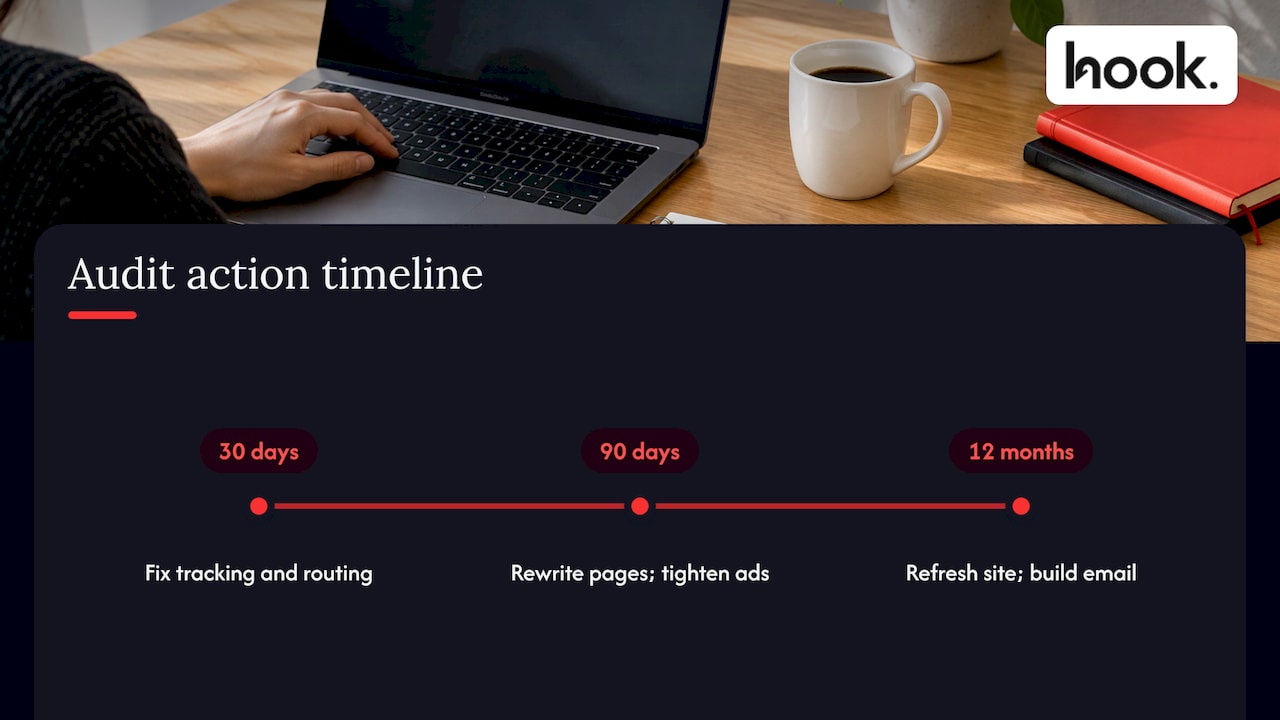
- Next 30 days: fixes and quick wins, such as repairing conversion tracking, pausing wasted spend or correcting broken pages.
- Next 90 days: the one or two bigger improvements, such as rewriting key landing pages or restructuring an ad account.
- Next 6 to 12 months: strategic work such as repositioning, new content programmes or a website rebuild.
Give every action an owner, a measure of success and a date to review. An action with no owner is a wish.
How often to audit, and who should do it
Pipedrive’s B2B guide to marketing audits says most businesses should audit once or twice a year. It also suggests auditing before a new marketing plan, after a major campaign and whenever performance falls below benchmarks.
The same guide notes that audits can be led by marketing professionals, directors or consultants. Smaller firms might use a founder or a marketer, while larger firms might use cross-functional teams or external specialists who understand the business goals, personas and performance measures.
A sensible split for many firms is a light internal check twice a year, using the scorecard, and a deeper review every year or two led by someone who is not too close to the work. Fresh eyes spot things that the team no longer sees.
Our perspective
Why we think the framework matters, and where an agency helps
Most marketing problems we are asked to solve are not about one channel. They sit in the gaps between channels: a website that does not match the brand, ads that send people to a page that cannot convert, social content that has no link to what sales actually needs. A framework like the one above is useful precisely because it makes those gaps visible.
That is why we built Hook around a single team covering branding, design, video, photography, websites, social media, Google Ads and SEO. When one team does the audit and the fixes, nothing is lost in translation between agencies, and the admin of coordinating several suppliers disappears.
We also believe findings should lead to a plan that fits your business, not a fixed package. Our project scopes are tailored and transparent, our clients have a personalised portal for updates and direct communication, and our aim is a 48-hour turnaround on content and website amends. Whatever your scorecard shows, the next step should be simple and clear.
Hook
Common mistakes to avoid
- Auditing without a goal. If you cannot say what decision the audit supports, narrow the scope until you can.
- Marking your own homework. The person who runs a channel is rarely the best judge of it. Ask someone else to score it, or compare scores.
- Confusing activity with results. Posting daily is not a result. Enquiries are.
- Ignoring the basics. Broken tracking, slow pages and unclaimed profiles cost more than missing clever tactics.
- Producing a report and stopping. Put dates in the diary for the 30-, 90- and 180-day reviews before the audit ends.
- Letting AI-written content go unchecked. If part of your content is produced with AI, review how it affects rankings; our hybrid AI and SEO workflow guide covers this.
A worked example
Imagine an Oxfordshire professional services firm with a team of 20. Leads have been flat for a year, though spend on Google Ads has risen.
Stage 1: the question is “why has spend not produced more enquiries?” The scope is website, Google Ads, SEO and the enquiry process.
Stage 2: a handful of customer calls shows that people mostly find the firm through a recommendation, then check the website before getting in touch.
Stage 3: the channel inventory finds an old social account with no owner, an email list that has not been used in a year and a contact form that sends to a shared inbox.
Stage 4: the data shows ad clicks are healthy but the conversion rate on the landing page is low, and form submissions are not being tracked correctly.
Stage 5: the scorecard gives analytics a 1, the website a 2, paid search a 2, SEO a 3 and email a 1.
Stage 6: the 30-day plan fixes form tracking and the inbox routing. The 90-day plan rewrites the landing pages and tightens the ad account. The 12-month plan refreshes the website and builds a regular email programme.
Nothing in this plan needed a bigger budget. It needed a clear look at what was already there.
When it makes sense to bring in an agency
You can run this framework yourself, and the first pass is a good exercise for a marketing manager. Outside help makes sense when your scorecard shows gaps in several disciplines at once, when your team lacks capacity to act on the findings or when you want an independent view. If you are weighing up suppliers, our marketing agency evaluation checklist sets out what to ask.
Working with Hook
If your audit turns up problems in more than one area, we can take them on together. Hook is an Oxfordshire marketing agency covering branding, design, video, photography, websites, social media, Google Ads and SEO, so you only need to talk to one team.

See how our full service marketing works, or get in touch to talk through your scorecard and where to start.
FAQ
What is a marketing audit?
A marketing audit is a structured review of your marketing activities, results and the environment you operate in. It looks at channels, campaigns, customers, competitors, resources and data, then ends in recommendations. A marketing health check is the same idea in plainer language.
How long does a marketing audit take?
It depends on scope and how quickly you can get access to your data. A focused review of one channel can be done in a few days, while a full audit across every channel often takes a couple of weeks. Gathering logins and reports first is the best way to speed it up.
What should a marketing audit include?
At minimum: your objectives, the customer and competitor picture, a review of the marketing mix and each channel, the website and its technical health, your key metrics against benchmarks, a scorecard of gaps and a prioritised action plan. Add budget and technology reviews if they have not been looked at recently.
Who should carry out the audit?
Smaller firms often use a founder or marketer, while larger firms may use a cross-functional team or external specialists. Choose people who understand your goals and can interpret the data, and try to include at least one person who does not run the channels being reviewed.
Sources
- What’s a Marketing Audit? (HubSpot)
- How To Conduct an Effective Marketing Audit (Shopify)
- CIM Level 3 Award in Marketing Essentials specification, 2024
- CIM Level 4 Award in Marketing Impact specification, 2024
- What is a Marketing Audit & How to Do One (Mailchimp)
- Digital marketing audit and benchmarking templates (Smart Insights)
- Digital marketing strategy audit and health check (Smart Insights)
- The Future of Digital Marketing report (Smart Insights)
- The B2B guide to doing a marketing audit (Pipedrive)


