

.webp)

.svg)
PPC advertising explained for small business owners
PPC advertising is defined as a digital model where you pay only when someone clicks your ad, giving your business immediate access to targeted web traffic. Known formally as pay-per-click advertising, it runs across platforms including Google Ads, Meta Ads Manager, and Microsoft Advertising. Unlike organic search, you are not waiting months to appear in front of the right people. About 55% of small businesses already use online advertising, yet many still find the bidding mechanics and performance models confusing. This article cuts through that confusion and gives you a clear, practical foundation.
How does PPC advertising work?
PPC advertising works through a real-time auction that runs in milliseconds every time someone searches a keyword or loads a page where ads can appear. You do not simply pay the most to win. The system is more nuanced than that, and understanding it gives you a genuine competitive edge.
Here is how the process unfolds, step by step:
- You choose your keywords or audience. You tell the platform, such as Google Ads, which search terms or audience segments you want to target. Every time a relevant search happens, your ad enters the auction.
- You set a maximum bid. This is the most you are willing to pay for a single click. It is not necessarily what you will pay, just your ceiling.
- The platform calculates your Ad Rank. Ad Rank combines your bid and Quality Score to determine where your ad appears. A higher Quality Score can place you above a competitor who bids more than you.
- Quality Score is assessed across three factors. These are your expected click-through rate (CTR), the relevance of your ad to the search query, and the quality of your landing page experience.
- Your ad is shown and you pay per click. You are only charged when someone actually clicks. The amount you pay is typically less than your maximum bid, calculated based on the Ad Rank of the advertiser below you.
The practical implication here is significant. Higher relevance can lower your cost per click while simultaneously improving your position. You are not in a pure spending contest. You are in a relevance contest, and that levels the playing field for smaller budgets.
Pro Tip: Before raising your bids, review your Quality Score in Google Ads. Improving your ad copy and landing page relevance often delivers better results than simply spending more.

PPC ads appear in several formats, each suited to different goals. Search ads target buyer intent, display ads build brand awareness across websites, video ads engage audiences on platforms like YouTube, and shopping ads drive e-commerce conversions directly from search results.
PPC vs SEO: which one does your business need?
PPC and SEO are not rivals. They are complementary tools, and understanding the difference helps you allocate your budget wisely.
| Factor | PPC Advertising | SEO (Organic Search) |
|---|---|---|
| Speed of results | Immediate traffic from day one | Typically 3–6 months to gain traction |
| Cost model | Pay per click | No direct cost per click, but requires time and resource |
| Control | Full control over targeting, budget, and timing | Limited control over rankings and algorithm changes |
| Longevity | Stops when budget runs out | Builds lasting authority over time |
| Best for | Launches, promotions, and precise targeting | Long-term brand visibility and content authority |
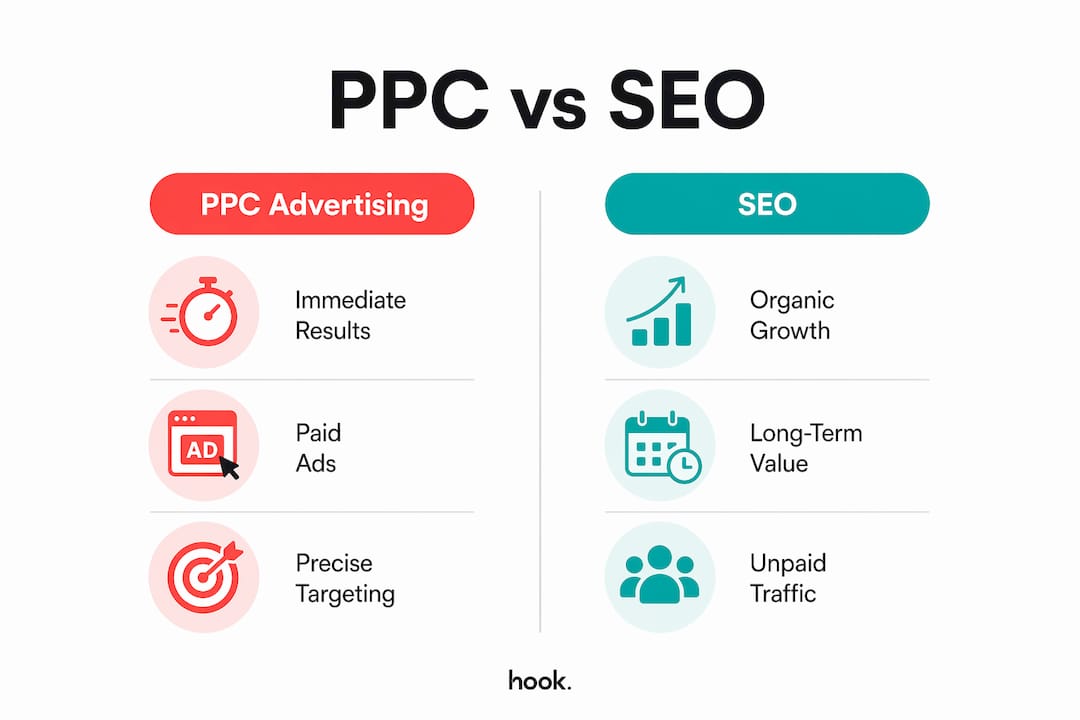
PPC delivers faster results and precise control compared to SEO’s longer-term organic growth. That speed is its defining advantage for businesses with time-sensitive goals.
SEO, by contrast, builds compounding value. A well-ranked page can drive traffic for years without ongoing spend. The limitation is that you cannot turn it on overnight, and algorithm updates can shift your position without warning.
The most effective digital marketing strategies combine both. You can use PPC to generate immediate traffic while your SEO efforts build momentum in the background. Many businesses use PPC data, specifically which keywords convert best, to inform their SEO content strategy. That feedback loop is one of the less-discussed advantages of running both channels together. For a direct comparison of platform options, the Meta Ads vs Google Ads breakdown from Hook-digital is worth reading before you commit budget.
What makes a PPC campaign management strategy work?
Effective PPC campaigns require keyword research, clear goals, optimised ad copy, and continuous testing. Getting these foundations right from the start saves significant budget and avoids the most common pitfalls.
Here are the core elements that separate well-run campaigns from wasted spend:
- Keyword research. Use tools like Google Keyword Planner or Semrush to identify terms your customers actually search. Focus on intent. A search for “buy running shoes Oxford” signals far more purchase readiness than “types of running shoes.”
- Clear campaign goals. Define what success looks like before you spend a penny. Are you driving phone calls, form submissions, or product purchases? Your goal shapes every other decision.
- Ad copy that earns the click. Your headline must match the searcher’s intent closely. If someone searches “accountant Oxford,” your ad should say exactly that, not a generic brand message.
- Landing page alignment. The page someone lands on after clicking must deliver on the promise of the ad. A mismatch between ad and landing page destroys both your conversion rate and your Quality Score. Hook-digital’s conversion-focused web builds are designed with this principle at their core.
- A/B testing. Run two versions of an ad simultaneously and let the data decide which performs better. Test one variable at a time, whether that is the headline, the call to action, or the offer.
- Bid and targeting adjustments. Review performance weekly, not monthly. Pause keywords that spend without converting. Increase bids on terms that deliver strong returns.
Pro Tip: Negative keywords are one of the most underused tools in PPC campaign management. Adding terms you do not want to trigger your ads prevents wasted spend on irrelevant clicks from day one.
Common mistakes include setting campaigns live without conversion tracking, targeting too broadly at the start, and neglecting to review search term reports. The search term report shows you exactly what people typed before clicking your ad. It is one of the most revealing documents in your entire marketing toolkit.
Which PPC platforms and metrics should you track?
PPC platforms include Google Ads, Meta Ads Manager, Microsoft Advertising, TikTok Ads Manager, and LinkedIn Campaign Manager, each with distinct strengths depending on your audience and objectives.
Google Ads is the dominant platform for intent-based search advertising. If people are actively searching for what you sell, Google Ads puts you in front of them at the exact moment of interest. Meta Ads Manager covers Facebook and Instagram, making it ideal for visually driven campaigns and audience-based targeting. Microsoft Advertising reaches users on Bing and tends to have lower competition, which often means a lower cost per click. LinkedIn Campaign Manager suits B2B businesses targeting by job title, industry, or company size. TikTok Ads Manager is worth considering if your audience skews younger and you have strong video creative.
Once your campaigns are live, these are the key metrics to monitor for ongoing optimisation:
| Metric | What It Measures | Why It Matters |
|---|---|---|
| CTR (Click-Through Rate) | Percentage of people who click after seeing your ad | Indicates ad relevance and creative strength |
| CPC (Cost Per Click) | Average amount paid per click | Tracks spend efficiency |
| Quality Score | Google’s rating of ad relevance and landing page | Directly affects Ad Rank and cost |
| Conversion Rate | Percentage of clicks that complete a desired action | Measures campaign effectiveness |
| ROAS (Return on Ad Spend) | Revenue generated per pound spent | The ultimate measure of campaign profitability |
A low CTR tells you your ad is not resonating. A high CTR with a low conversion rate tells you the landing page is the problem. Each metric points to a specific part of the funnel, which makes diagnosis straightforward once you know what to look for. For audience targeting strategies that complement your platform choices, Hook-digital’s guide on reaching your audience offers practical direction.
Key takeaways
PPC advertising works best when ad relevance, landing page quality, and continuous testing are prioritised over simply increasing bids.
| Point | Details |
|---|---|
| Pay only for clicks | You are charged only when someone clicks your ad, making budget control straightforward. |
| Quality Score drives performance | Higher ad relevance and better landing pages lower your cost per click and improve placement. |
| PPC and SEO work together | Use PPC for immediate traffic and SEO for long-term visibility, combining both for maximum reach. |
| Platform choice matters | Match your platform to your audience: Google Ads for search intent, Meta for social, LinkedIn for B2B. |
| Track the right metrics | Monitor CTR, CPC, conversion rate, and ROAS to identify exactly where campaigns need adjustment. |
What running PPC campaigns has taught us
From working with small and mid-sized businesses across Oxfordshire and beyond, one pattern stands out clearly. Most businesses that struggle with PPC are not losing because of their budget. They are losing because of relevance.
The instinct when a campaign underperforms is to spend more. Raise the bid, increase the daily budget, and hope the numbers improve. That rarely works. What actually moves the needle is tightening the match between what someone searches, what your ad says, and what your landing page delivers. When those three things align, Quality Score improves, costs fall, and results compound.
We have also seen businesses treat PPC as a standalone channel, completely disconnected from their website, branding, and wider marketing. That is a missed opportunity. A well-run Google Ads campaign feeding traffic to a poorly designed or slow-loading website is like filling a leaky bucket. The channel cannot compensate for a weak destination.
The other thing worth saying plainly: PPC rewards patience and curiosity. The businesses that get the best results are the ones that read their data regularly, ask why something is or is not working, and test their assumptions rather than guessing. You do not need a massive budget to compete. You need a clear goal, a relevant message, and the discipline to keep refining.
— Hook
Ready to get more from your paid advertising?
PPC advertising is one of the most direct ways to put your business in front of people who are actively looking for what you offer. Getting the setup right from the start makes a significant difference to both your results and your return on investment.
Hook-digital is a full-service marketing agency based in Oxford, and our PPC and paid social services are built around what actually works for small and mid-sized businesses. From Google Ads campaign management to Meta advertising and beyond, we handle the strategy, the creative, and the ongoing optimisation. You get one team, one point of contact, and campaigns built around your specific goals. Explore our full marketing services to see how we can support your growth.
FAQ
What is PPC advertising in simple terms?
PPC advertising is a digital model where you pay only when someone clicks your ad. It gives businesses immediate access to targeted traffic on platforms like Google Ads and Meta Ads Manager.
How much does PPC advertising cost?
The cost of PPC advertising varies based on your industry, keywords, and competition. You set your own daily budget and maximum bid, so you are always in control of your spend.
How does PPC differ from SEO?
PPC delivers immediate traffic through paid ads, while SEO builds organic visibility over time. Both perform best when used together as part of a coordinated digital marketing strategy.
What is a good quality score in google ads?
Quality Score is rated on a scale of 1–10 in Google Ads. A score of 7 or above is considered strong and typically results in lower costs and better ad placement.
Can small businesses compete with larger advertisers on PPC?
Yes. Because Ad Rank rewards relevance over raw spend, a small business with highly relevant ads and a well-optimised landing page can outrank a larger competitor with a bigger budget.
Recommended
- Unlocking Success: The Benefits of PPC/Google Ads for Marketing Your Business | Hook Digital - Oxford’s Premier Full-Service Marketing Agency
- A Practical Guide for Businesses and Brands Considering Google Ads | Hook Digital - Oxford’s Premier Full-Service Marketing Agency
- Meta Ads vs. Google Ads: Which One Is Right for Your Business? | Hook Digital - Oxford’s Premier Full-Service Marketing Agency
- Social Media & PPC Agency Oxford | Paid Ads & Content | Hook Digital
.png)


