

.webp)

.svg)
Stop Losing Clicks: PPC Landing Pages That Pass the Three Second Test
A PPC landing page is a standalone page built for one job: turning a paid click into a lead or sale. Nothing else earns its place on that page. Get this right and you’ll usually see it in two places at once — a lower cost per click, because Google rewards relevance with a better Quality Score, and a healthier return on every pound you spend on ads.
TL;DR:
- A PPC landing page should match the specific ad message exactly, with a clear headline that echoes the ad’s promise to maximize conversions.
- Building one landing page per ad group is ideal when the spend is concentrated, but for low-volume groups, using a flexible template with swapping elements is more cost-effective.
- Improving landing page elements such as message match, loading speed, and removing navigation can significantly increase quality scores and reduce cost per click.
- Tracking properly with conversion tags, UTM parameters, and cross-platform attribution is essential for accurate measurement and optimization of campaign performance.
- The simplest but most impactful fix is ensuring the headline directly reflects the ad, followed by making the CTA clearly visible without scrolling, especially on mobile devices.
Table of Contents
- What is a PPC landing page (and how is it different from a homepage)?
- Why do PPC landing pages matter for Quality Score and ROAS?
- What are the core elements of a high-converting PPC landing page?
- What do good PPC landing page examples actually look like?
- Best practices and mistakes that quietly cost you conversions
- How do you measure and A/B test a PPC landing page?
- What does Hook-digital actually deliver on a landing page project?
- How do you connect landing pages to Google Ads and Facebook Ads tracking?
- How do you write ad copy that matches your landing page?
- What legal and compliance rules apply to PPC landing pages?
- Why message match beats every other optimisation
- Get a PPC landing page built around what your ads actually promise
- Sources
- FAQ
What is a PPC landing page (and how is it different from a homepage)?
A PPC landing page is a page built specifically for one traffic source and one conversion goal. Unlike your homepage, which has to serve everyone from investors to job applicants to existing customers, a landing page has a single audience: the person who just clicked your ad.
That difference shows up in three ways. First, lifespan: a homepage is permanent, but a landing page can be spun up for a two-week promotion and retired afterwards. Second, searchability: your homepage is built to rank organically for broad terms, so it carries navigation menus, blog links and multiple calls to action to catch different search intents. A PPC landing page strips all of that away because the visitor has already told you exactly what they want by clicking the ad. Third, message focus: an SEO page is written to satisfy a search engine’s understanding of a topic; a landing page is written to satisfy the specific promise made in one ad.
This is why sending PPC traffic to your homepage is one of the most common ways businesses waste ad budget. The visitor lands somewhere that half answers their question and gives them four other things to click instead, and most of them leave.
The harder decision is scale: do you build one landing page per campaign, or one per ad group? The answer depends on where your spend is concentrated. If a small number of ad groups account for most of your budget, build a dedicated page for each one so the message match stays tight against that group’s specific keywords. For long-tail or low-volume ad groups, that level of investment rarely pays back. Build a flexible template instead, swap the headline and hero image for each group, and reuse the rest of the structure. This is standard practice in paid search campaigns where budget is spread across dozens of keyword clusters rather than concentrated in one or two.
Why do PPC landing pages matter for Quality Score and ROAS?
Landing page experience is one of the components Google Ads uses to calculate Quality Score, alongside expected click-through rate and ad relevance. A page that loads slowly, doesn’t match the ad’s promise, or buries the offer under thin content drags your Quality Score down, and a lower Quality Score means you pay more for the same ad position. Fix the landing page and the CPC often falls without you touching a bid.
The conversion argument is even more direct. Sending paid traffic to a dedicated landing page instead of a homepage or generic product page typically produces a meaningful uplift in conversion rate, because the page has one job and nothing distracts from it. Benchmarks vary a lot by vertical. A lead-generation page for a B2B service will convert differently to an e-commerce checkout flow, so treat any single “average conversion rate” figure with caution and benchmark against your own historical data instead.
Statistic callout: The majority of website traffic now comes from mobile devices, which means a landing page that hasn’t been built mobile-first is losing conversions before the visitor even reads your headline. If you’re only checking your page on a desktop monitor, you’re testing the wrong device.
Better landing pages also improve reporting. When each ad group points to its own page, you can attribute conversions, bounce rate and time-on-page back to a specific keyword theme instead of guessing which part of a shared page did the work. That precision compounds over time, letting you retire underperforming ad groups faster and reinvest in the ones that are actually earning their return on ad spend.
What are the core elements of a high-converting PPC landing page?
Treat this as a build checklist, not a wish list. Every item below earns its place because it maps directly to a conversion or cost outcome.
- Message match: your headline must repeat the specific promise made in the ad, ideally the same words or a very close variant. A visitor who clicked on “50% off winter boots” and lands on a generic “Welcome to our store” headline will bounce within seconds.
- One CTA, repeated logically: pick a single conversion action (buy, book a call, download) and repeat that same button copy at the top of the page, after your main value proposition, and at the bottom. Never introduce a second competing action.
- Minimal or no navigation: remove the header menu, footer links and anything that gives the visitor an exit route other than converting or leaving.
- Hero visuals that support the offer: a product shot, a short explainer graphic, or an image of the outcome the visitor wants. Decorative stock photography that doesn’t relate to the offer just slows the page down for no return.
- Concise, benefit-driven copy: lead with what the visitor gets, not what your company does. Cut any sentence that describes your history or mission unless the ad specifically promised that story.
- Short forms: four fields or fewer for most lead-gen offers. If you need more information, use a multi-step form that asks one or two questions per screen rather than a long single-page form.
- Trust signals above the fold: a star rating, a client logo strip, or a specific number (reviews, years trading, customers served) placed where the visitor sees it before scrolling.
- Mobile-first build with fast load times: aim for a Largest Contentful Paint under roughly 2.5 seconds and preload your hero image and key fonts so the page feels instant on a phone connection.
Pro Tip: Run the three-second test before you launch anything. Open the ad, click through, and time how long it takes a first-time visitor to understand the offer and the price. If it takes longer than three seconds, the headline or hero image needs work, not the rest of the page.
Two of these deserve extra attention because they’re where most pages fail. Message match is consistently the single biggest predictor of conversion lift, more than colour choice, more than button wording, more than which stock photo you picked. If a page underperforms and you only have time to fix one thing, fix the headline so it echoes the ad. And for mobile-heavy campaigns specifically, a sticky CTA bar pinned to the bottom of the screen tends to lift one-tap conversions noticeably, because it removes the need for a thumb to scroll back up to find the button.
Form length is the other quiet killer. Every field you ask for beyond the essentials costs you a percentage of visitors who were otherwise ready to convert. Ask yourself honestly whether you need a phone number and a job title at this stage, or whether that can wait until after the initial capture.
What do good PPC landing page examples actually look like?
Rather than abstract advice, here are four template patterns you can adapt directly, based on what tends to convert in each category.
-
The lead-gen short page: a hero section with a benefit headline and subheadline, a three-field form (name, email, phone) positioned beside or below the hero, and one trust snippet (a review count or client logo row) directly underneath. It converts because there’s nothing to read before the visitor can act, and the form is visible without scrolling on most screens.
-
The product purchase page: price shown clearly near the top, a single “Buy now” or “Add to basket” CTA, and either a scarcity cue (limited stock, offer ends date) or a guarantee (free returns, warranty length) sitting right next to the price. It converts because it answers the two questions every buyer has, “what does it cost” and “what happens if I don’t like it”, without making them hunt.
-
The local, call-first page: a click-to-call button fixed near the top of the screen, a short line of local proof (area served, years trading locally), and operating hours displayed clearly. This pattern works particularly well for trades and local services where a phone call converts better than a form, and it pairs well with local advertising strategies built around click-to-call intent.
-
The trial or signup page: a short bullet list of three to four core benefits, a form asking only for email and password (or a single-click social signup), and a clear statement of what happens immediately after signup. It converts because it removes the ambiguity that stalls software trials: what am I agreeing to, and what do I get straight away?
Each of these can be built as a reusable template with swappable headlines and hero images, which is exactly how you scale landing pages across dozens of ad groups without rebuilding from scratch every time.
Best practices and mistakes that quietly cost you conversions
Fix things in the order they affect the most visitors. Message match, CTA clarity and page speed touch every single person who lands on the page; a badly worded testimonial only affects the people who read that far down.
Highest-impact fixes, in order:
- Rewrite the headline so it mirrors the ad’s exact promise, not a paraphrase of it.
- Reduce to one CTA and make sure it’s visible without scrolling on a phone screen.
- Strip out header and footer navigation entirely.
- Compress hero images (WebP format, correct dimensions declared) so the page doesn’t stall on load.
Mistakes that show up again and again:
- Sending PPC traffic to the homepage because “we already have a page.” This is the single most common budget leak in accounts we review, because the homepage was never designed to answer one specific ad promise.
- Running two or three competing CTAs (“Buy now”, “Learn more”, “Contact us”) on the same page, which splits attention and reduces conversions on all three.
- Long, unoptimised forms that ask for information the business doesn’t actually need at this stage of the funnel.
- Ignoring mobile entirely, building and testing only on a desktop monitor, then wondering why conversion rates lag behind traffic volume.
Each of these has a straightforward fix, and none of them require a full rebuild. Most can be corrected within a single sprint if you prioritise the list above rather than trying to fix everything simultaneously.
How do you measure and A/B test a PPC landing page?
Five metrics matter more than any others: conversion rate, cost per acquisition (CPA), return on ad spend (ROAS), landing-page bounce rate, and time to convert. Track these at the ad-group level, not just the campaign level, or you’ll miss which specific pages are dragging down your average.
Landing Page Experience, the Google Ads metric that feeds into Quality Score, is worth checking directly in your account rather than guessing at it. A “Below average” rating almost always points to one of three causes: slow load speed, weak message match, or thin content that doesn’t answer the visitor’s question. Fixing the flagged issue tends to move your CPC down within a few weeks of the change registering.
Statistic callout: Because most traffic arrives on a mobile device, a Landing Page Experience rating built mostly on desktop testing is measuring the wrong experience for the majority of your visitors.
For A/B testing, follow a simple, disciplined workflow: form a hypothesis about why a page underperforms, then change one variable at a time, prioritising the elements with the biggest expected effect first: headline, CTA wording, then hero image. Resist the urge to test five things at once; you’ll never know which change actually moved the needle. Run each test until you reach statistical significance given your traffic volume, which for low-traffic ad groups might mean running the test for several weeks rather than days.
For diagnostics, Google Analytics 4 combined with your ad platform’s own landing page reports will flag most tracking or speed regressions quickly, provided conversion tracking is set up correctly before you start collecting data, not retrofitted afterwards.
What does Hook-digital actually deliver on a landing page project?
Our landing page process follows a fixed sequence because skipping a step is where most projects go wrong: brief, message-match copy, build, speed optimisation, tracking setup, then test. We start by reading the client’s ad copy line by line before a single design decision gets made, because the page has to answer the promise the ad already made.
A typical landing page project from Hook-digital includes strategy (working out which ad groups justify a dedicated page versus a template), the build itself, and measurement setup so conversion data flows back into the ad platform correctly from day one. [Case studies demonstrating specific client outcomes on landing page projects will be added here.] [Client testimonials on landing page and PPC campaign results will be added here.]
How do you connect landing pages to Google Ads and Facebook Ads tracking?
A landing page is only as useful as the data flowing back into your ad platform. Without correct tracking, you’re optimising blind, guessing which keywords or audiences actually produced a conversion rather than knowing.
Start with conversion tracking configured directly in Google Ads, using either a conversion tag on the thank-you page or Google Tag Manager for more complex setups involving multiple form types. For Facebook Ads, the Meta Pixel needs to fire on the same confirmation event, and ideally you’ll also implement server-side tracking through the Conversions API, because browser-based pixel tracking alone increasingly misses events due to ad blockers and privacy settings in modern browsers.
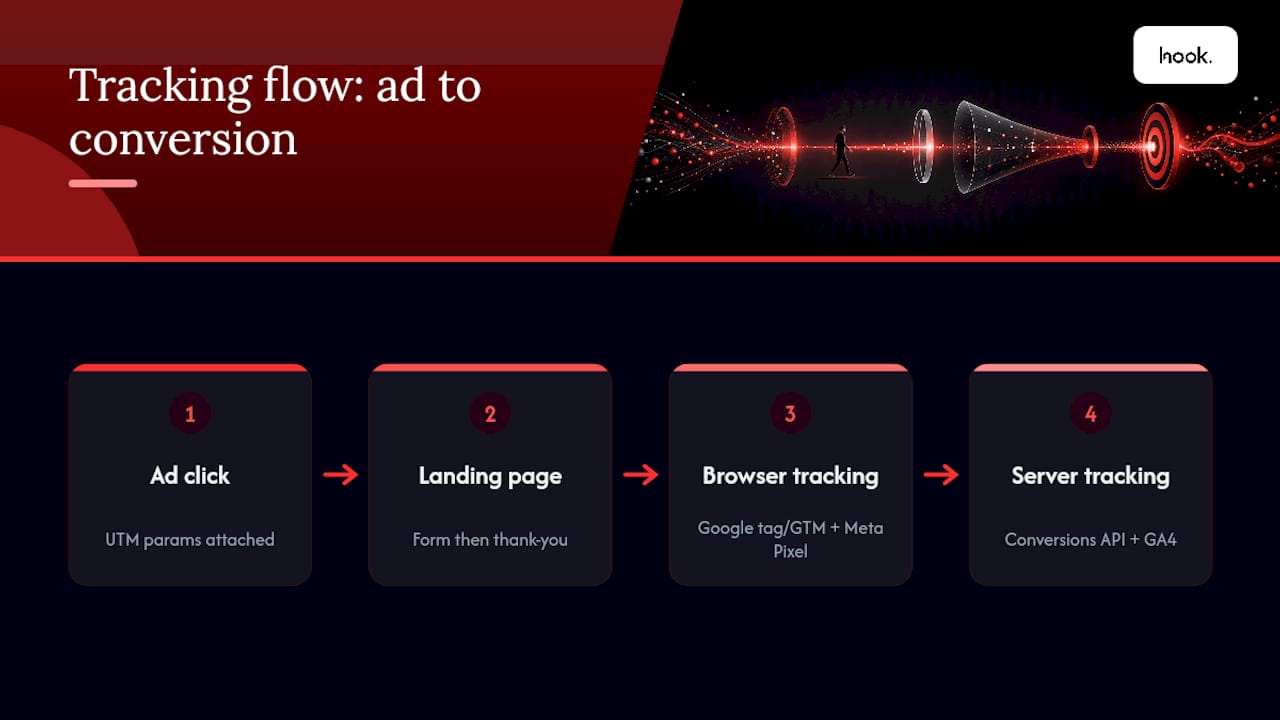
UTM parameters matter more than most marketers give them credit for. Tag every ad with consistent source, medium and campaign parameters so your landing page analytics can be filtered back to the exact ad group, not just the campaign. This is what makes the ad-group-level reporting mentioned earlier actually possible.
Cross-platform attribution remains genuinely difficult; a visitor might see a Facebook ad, later click a Google ad, then convert. Rather than chasing a perfect single source of truth, most businesses get more value from comparing platform-reported conversions against a shared source like Google Analytics 4, then treating discrepancies as a signal to investigate rather than a problem to solve perfectly. Get the tracking foundation right first; the attribution nuance can wait.
How do you write ad copy that matches your landing page?
Write the landing page headline first, then reverse-engineer the ad copy from it, not the other way round. Most message-match failures happen because the ad was written by one person under time pressure and the landing page was built weeks later by someone who never read the ad closely.
Use the specific offer language in both places. If your ad says “Free consultation, no obligation,” your landing page headline needs to say something extremely close to that, not a rebranded version like “Get expert advice today.” Any gap between the two creates a moment of doubt in the visitor’s mind, and doubt is what makes people click back.
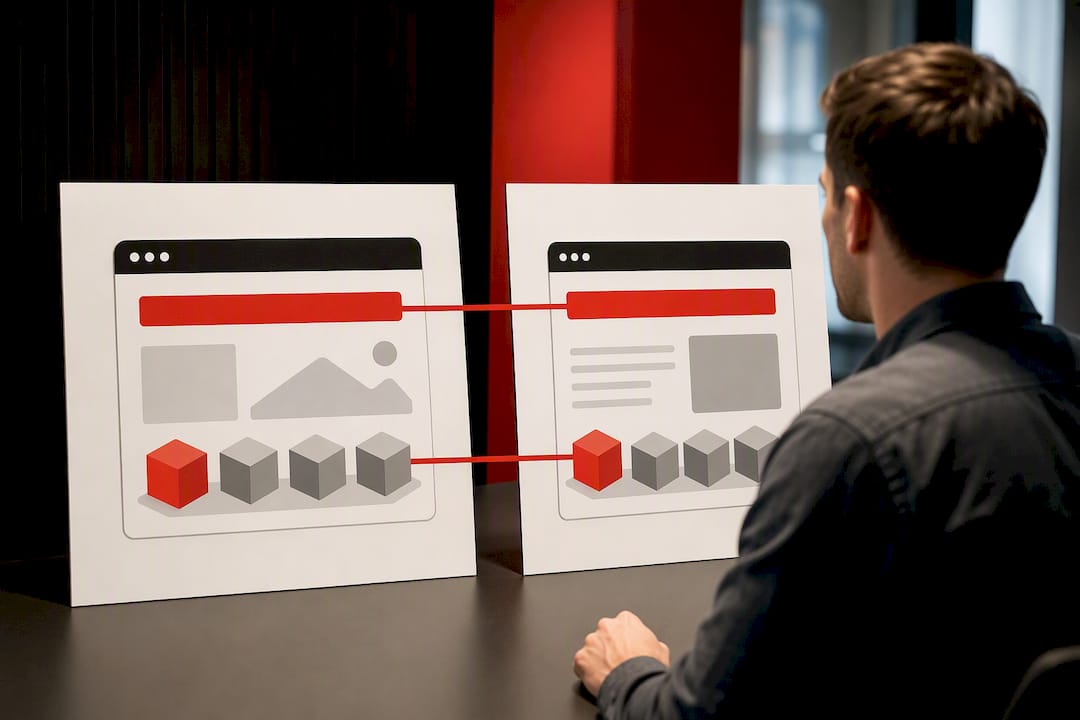
Match the tone as well as the wording. An ad written with urgency (“Ends this Sunday”) needs a landing page that reinforces that same urgency near the CTA, not a page that reads like a calm, evergreen product description.
Keep your ad copy specific rather than broad. This same discipline applies across every element of your PPC campaign strategy, not just the ad-to-page relationship: specificity beats breadth almost every time in paid search.
What legal and compliance rules apply to PPC landing pages?
Every PPC landing page that collects personal data, even a simple email field, needs a visible link to a privacy policy that explains what happens to that data. This isn’t optional guidance; it’s a baseline requirement under data protection law in the UK and EU, and Google Ads and Meta both require it as a condition of running ads at all.
If your form collects any personal data from EU or UK visitors, GDPR-equivalent UK data protection rules require a lawful basis for processing that data, typically consent for marketing purposes. That means a clear, unticked checkbox for marketing opt-in, not an assumption of consent buried in your terms and conditions.
Cookie consent matters too, particularly if your landing page fires tracking pixels from Google Ads or Meta before the visitor has interacted with a cookie banner. Configure your consent management setup so tracking scripts only fire after consent is given, or you risk both a compliance issue and inaccurate conversion data.
Sector-specific rules add another layer. Financial services, healthcare and anything making a specific claim about results or savings face additional advertising standards scrutiny, and a landing page making an unsubstantiated claim (“Guaranteed results in 7 days”) can trigger a complaint even if the ad itself was compliant. When in doubt on a regulated claim, get it checked before launch rather than after the ad account gets flagged.
Why message match beats every other optimisation
The conventional advice on landing pages spends most of its energy on design polish: better colours, sleeker layouts, more sophisticated hero animations. That advice is not wrong, but it’s misplaced in terms of priority. The single highest-leverage thing you can do to a PPC landing page is check whether the headline actually says what the ad said, and most businesses never do this properly.
We’d go further than most guides on this: if you can only fix one thing on an underperforming page, it’s never the design. It’s the three-second test. Can a stranger who just clicked your ad understand your exact offer, in your exact words, before they’ve had time to think about leaving? Most pages fail this test not because the offer is bad, but because someone wrote the ad and someone else wrote the page, days apart, without comparing notes.
Templates and quick wins matter enormously here, more than most theoretical CRO frameworks suggest, because a landing page that ships this week and matches the ad perfectly will consistently outperform a beautifully designed page that took six weeks and drifted from the original promise along the way.
— Hook
Get a PPC landing page built around what your ads actually promise
A landing page built by people who understand both the ad and the build tends to convert better than one bolted onto an existing site template, because every element, from headline to form length, gets designed around the specific promise your campaign is making.
Hook-digital handles this from end to end for businesses running paid campaigns: strategy work to decide which ad groups justify a dedicated page, full branding and design for the build itself, and ongoing testing to keep improving conversion rate once the page is live. Three things you get working with us:
- Message-match copy and design built directly from your existing ad accounts, not generic templates.
- Mobile-first builds with speed optimisation baked in from the first draft, not bolted on afterwards.
- Ongoing A/B testing so the page keeps improving after launch rather than sitting static for a year.
If you’re running paid campaigns in and around Oxfordshire and want a landing page that actually matches what your ads promise, get in touch with our Oxford marketing team to talk through your next campaign build.
Sources
- Optimize your ads and landing pages - Google Ads Help
- PPC landing page optimization best practices (2025 guide) | Unbounce
- Share of website traffic coming from mobile devices | Statista
- Google Ads Landing Page: Examples, Benchmarks, and a Diagnostic Tool (2026) | LanderLab
FAQ
How much should I pay for a landing page?
Costs vary widely depending on complexity, but a professionally built, tested PPC landing page from an agency typically costs more upfront than a DIY builder template, though it usually pays that back through better Quality Score and conversion rates. Treat it as a cost against ad spend saved, not a standalone expense.
What is a good example of a landing page?
A good example matches its headline word-for-word to the ad that drove the click, removes all navigation, and asks for no more than three or four fields on its form, as shown in the lead-gen and product purchase templates above.
Is PPC just Google Ads?
No. PPC (pay-per-click) is the broader advertising model covering any platform where you pay per click, including Google Ads, Meta Ads (Facebook and Instagram), and Microsoft Ads; Google Ads is simply the largest and most widely used platform within it.
What does SEO and PPC mean?
SEO (search engine optimisation) is the practice of earning free, organic search rankings over time, while PPC (pay-per-click) means paying for immediate placement in search results or on other platforms and being charged each time someone clicks your ad.
How do I know if my landing page is hurting my Quality Score?
Check the Landing Page Experience column in your Google Ads account; a rating of “Below average” usually points to slow load speed, weak message match, or thin content that needs fixing before your CPC will improve.
.png)


