




Quality Score Factors: What Moves Your Google Ads Rating

Google Ads Quality Score is built from three factors: expected click-through rate, ad relevance and landing page experience. Each is rated against other advertisers bidding on the same search, and each needs a different fix. Treat the three ratings as separate to-do lists rather than chasing the 1 to 10 number, and your campaigns get cheaper to run and easier to scale. Because the three factors cut across ads, keywords and your website, they are far easier to improve when one team looks after all of them, which is how we run paid search for Oxfordshire businesses at Hook Digital.
TL;DR
- Quality Score is a 1 to 10 diagnostic shown at keyword level, built from expected CTR, ad relevance and landing page experience.
- Each factor is rated Above average, Average or Below average against other advertisers’ ads for the same search over the last 90 days.
- The 1 to 10 number is not an input in the auction, but the quality signals behind it feed Ad Rank, which affects your costs and ad positions.
- Read the three component ratings first. Two keywords with the same score can need completely different fixes.
- The fastest gains come from tightly themed ad groups, ads that mirror the search, and a landing page that delivers what the ad promised.
Table of Contents
- What Quality Score actually is
- The three Quality Score factors
- How to check your own ratings
- How to improve each factor
- What not to do with Quality Score
- A worked example
- Why one team beats three
- Let us look after the whole chain
- FAQ
- Sources
What Quality Score actually is
Quality Score is a diagnostic tool. According to Google’s own help page, it gives you a sense of how your ad quality compares with other advertisers. It is measured on a scale of 1 to 10 at keyword level, and a higher score means your ad and landing page are more relevant and useful to someone searching for that keyword.
Two points from the same page are worth fixing in your mind before you touch an account:
- It is not a KPI. You do not report it to the board the way you report leads or cost per lead.
- It is not an input in the ad auction. The auction uses its own calculation at the moment of each search.
So why does it matter? Google’s Quality Score whitepaper explains that high-quality ads can earn a higher Ad Rank, which can lead to lower costs per click, better ad positions and eligibility for ad extensions. (Ad Rank is the value that decides whether your ad shows and where.) The 1 to 10 figure is a window onto those quality signals, not the lever itself.
For a marketing manager, that is the practical takeaway: a weak rating is a sign that you are paying more than you need to for the same clicks, or losing positions you could hold.
The three Quality Score factors
Google states that the score is calculated from three components. Each one is rated Above average, Average or Below average by comparing your ads with ads shown for the exact same search over the last 90 days.
| Factor | What Google is asking | Where you fix it |
|---|---|---|
| Expected click-through rate | How likely is this ad to be clicked when shown for this keyword? | Ad copy, keyword choice, search terms |
| Ad relevance | How closely does the ad match the intent behind the search? | Ad groups, keywords, headlines |
| Landing page experience | Is the page useful, relevant and easy to use for this visitor? | Website, page speed, page content |
Expected click-through rate
Click-through rate (CTR) is clicks divided by impressions. Google’s definition gives a simple example: 5 clicks from 100 impressions is a 5% CTR.
Expected CTR is different. It is a prediction of how likely your ad is to be clicked for that keyword, regardless of position. Google’s documentation on expected click-through rate says the prediction draws on performance in your account and across other advertisers, adjusted to remove the effect of ad position and prominence factors such as assets. Google’s page on what matters in ads quality adds that expected CTR is normalised for position on the page, so bidding for a higher slot does not lift your score.
In practice, expected CTR rewards ads that people actually want to click. A vague headline that could belong to any supplier loses to one that names the product, the place or the outcome the searcher had in mind.
Ad relevance
Ad relevance is about the match between the keyword, the ad and what the searcher meant. Search Engine Land’s PPC guide describes it as checking how closely the triggering keyword matches the query and whether the ad captures the intent behind it. It also separates ad relevance from ad strength: ad strength rates the variety and quality of your creative assets and does not affect Quality Score.
The usual cause of a Below average rating is an ad group that tries to cover too much. If one group holds “commercial photography”, “headshots” and “event photography”, no single ad can be relevant to all three searches.
Landing page experience
This is the factor many marketing teams underestimate, because it sits outside the Google Ads account. Search Engine Land describes landing page assessment as similar to technical SEO: load time (it cites two seconds or faster), layout stability, easy navigation and keyword relevance on the page.
If you want to see how a page earns its keep once the click lands, our guide to PPC landing pages that pass the three second test walks through it. For a wider view of how the destination differs by campaign type, this piece on bridge pages versus landing pages covers the distinction.
How to check your own ratings
You will not see the figures unless the column is switched on. Google’s guidance on monitoring ads and keywords says the Quality Score column is disabled in new accounts. To show it:
- Open the Search keywords page.
- Click the columns icon and choose Modify columns.
- Under Attributes, select Quality Score and click Apply.
Add the three component columns too: Expected CTR, Ad relevance and Landing page experience. Then sort by spend, not by score. A keyword scoring 4 that costs you £30 a month is not your priority. A keyword scoring 5 that takes a third of your budget is.
Google’s whitepaper makes the same point: prioritise by the component rating and by the speed and impact of the change. Its worked example singles out a keyword with a score of 5 and a Below average ad relevance rating as the most urgent area to improve, because the weak component tells you exactly where to look.
How to improve each factor
Google’s UK optimisation guidance boils the work down to a short list: group keywords by theme into tightly themed ad groups, run three to five different ads per group, use a strong call to action, and choose a landing page that closely matches the ad and keywords. Here is how that plays out for each rating.

If expected CTR is Below average
Start with the search terms report, which shows what people actually typed before they saw your ad. Google says a Search Network CTR under 1% generally suggests your ads are not reaching a relevant audience, and that low-CTR keywords can be removed, refined or replaced with more specific ones.
Then look at the ad itself:
- Put the benefit the searcher wants in the first headline, not your company name.
- Include the keyword naturally, along with something concrete such as a service area, a turnaround time or a differentiator.
- Test several ads per ad group rather than leaving one running for a year.
- Tighten keyword match types so you stop showing for loosely related searches. Our guide to keyword match types for UK advertisers explains how.
If ad relevance is Below average
Split the ad group. This is the single most common fix. Take a group with ten loosely related keywords and turn it into three groups, each with its own ads that echo the exact language of the keywords inside.
Check also that your ad speaks to the intent. Someone searching “marketing agency Oxford” is shopping for a provider. Someone searching “how to write a marketing plan” is looking for information. The same ad rarely suits both.
If landing page experience is Below average
The key test is whether the page does what the ad promised. Google’s own example is a “discount shoes” ad offering 20% off, which should land on a page where discounted shoes can be found and bought, not on the homepage.
Practical checks for the page:
- Match the message. The headline should echo the ad and the keyword.
- Speed. Compress images and review scripts, particularly on mobile, since Google notes the user’s device matters for ads quality.
- Navigation. One clear action, and no hunting for the contact form.
- Content. Enough substance to answer the query, not a thin page built only to collect a click.
If the page is the weak link, the fix often lies in the site build rather than the ad account, which is one reason advertisers sometimes find their ratings stall after weeks of ad tweaks.
What not to do with Quality Score
Google advises focusing on relevant ads that answer the query rather than trying to manipulate the score. Its whitepaper recommends treating Quality Score as a diagnostic filter: set long-term performance goals, build for the user, then check the score to see how you are doing.
Three habits to avoid:
- Chasing a perfect 10. The whitepaper notes that even scores of 8 to 10 can leave room for improvement, and that the three component statuses are a better indicator of account health than the single number.
- Comparing CTRs between keywords. An above-average CTR depends on the keyword and the intent behind it. A brand term and a generic term will not be judged on the same figure.
- Judging new keywords too soon. For newly launched keywords Google starts with information about related ads and landing pages, then relies more on new data as it arrives. Give a keyword time to collect impressions before you rewrite it.
A worked example
Imagine an Oxford business-services firm running one ad group called “Marketing” with eight keywords, a single ad and the homepage as the destination. The Search keywords page shows a Quality Score of 4 on its biggest keyword, with expected CTR Average, ad relevance Below average and landing page experience Below average.
The fix runs in this order:
- Split the ad group into three themes (for example branding, websites and paid search), each with its own keywords.
- Write new ads for each group so that the headline mirrors the main keyword and the description names a specific outcome.
- Build or choose a landing page per theme, with a matching headline, a clear call to action and fast loading.
- Wait, then re-check the three component columns. Google compares you with other advertisers over a rolling 90 days, so the picture shifts gradually, not overnight.
Notice that two of the three fixes touch creative and web design as much as bidding. That matters when you are deciding who should run the account.
Why one team beats three
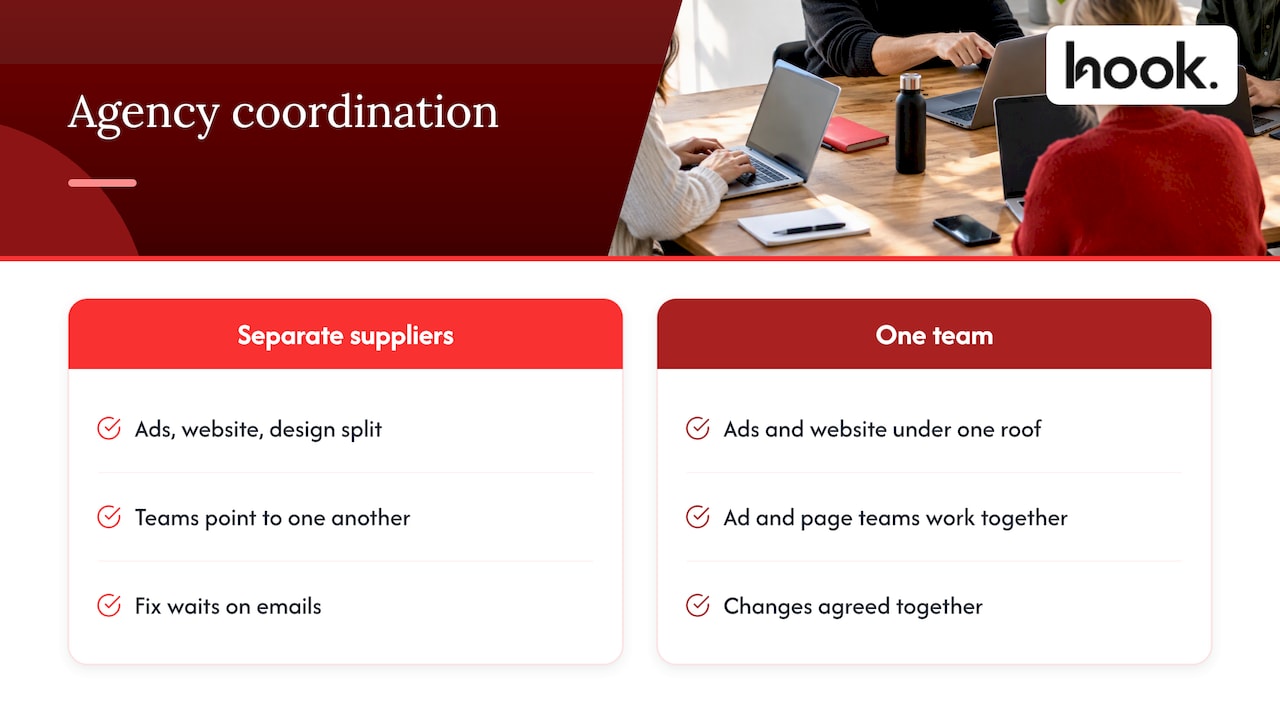
Quality Score pulls together keywords, ad copy and website experience. In many businesses those sit with different suppliers: one for the ad account, one for the website, one for design or copy. When a rating is Below average, each can reasonably point at another, and the fix waits while emails go back and forth.
Our reason for building Hook Digital as a single agency is to remove that coordination. You deal with one team, and the person adjusting the ads can sit alongside the people who build the landing pages. If you are weighing up whether the ad platform suits you at all, our guide on Meta Ads versus Google Ads is a good place to start, and our 5 step PPC audit checklist gives marketing managers a way to prioritise fixes.
Our view: treat Quality Score as a health check
We read Quality Score the way Google intends it: as a diagnostic, not a target. When a client’s rating is Below average, the useful question is which of the three components is dragging it down, and who needs to act. Often the answer spans more than one discipline: ad copy and keyword structure on one side, page content and speed on the other.
That is why we built Hook Digital so you only have to talk to one agency. Our services cover Google Ads and PPC management, website design and development, SEO and design under one roof, so a landing page change and an ad change can be agreed together. Our projects are scoped to what you need, with no forced packages, and our clients get a personalised portal for direct communication and updates. We also work to a 48-hour turnaround on content and website amends, which matters when a page fix is holding back an ad rating.
For Oxfordshire businesses spending real budget on search, we think the best Quality Score is the by-product of a joined-up campaign: tight keywords, honest ads and pages that deliver on the promise.
Hook
Let us look after the whole chain
If your Google Ads ratings are stuck, or you would rather hand the whole job to one team, our Social Media & PPC service covers Google Ads and PPC management, and our website design and development team can build the landing pages that your ads point to. If you want everything coordinated, Full Service Marketing brings it together under one agency.

We are based in Oxford and work with businesses across Oxfordshire. Tell us what you are running now and we will tell you where we would start.
FAQ
What affects Quality Score in Google Ads?
Three things: expected click-through rate, ad relevance and landing page experience. Each is rated Above average, Average or Below average against other advertisers’ ads for the same search over the last 90 days. Improving the weakest component is usually the quickest way to lift the overall score.
Is a Quality Score of 7 good?
A score of 7 or above is generally seen as healthy, but Google treats the number as a diagnostic, not a goal. The three component ratings tell you more about account health. A keyword with a 7 and one Below average component still has an obvious fix waiting.
Does Quality Score change what I pay?
Indirectly. Google says high-quality ads can earn a higher Ad Rank, which can mean lower costs per click and better positions. The 1 to 10 score itself is not an input in the auction, so use it to spot where quality signals are weak.
How long does it take to improve Quality Score?
It depends on how much traffic the keyword gets. Google compares your ads with others over the last 90 days, and new keywords start from information about related ads and pages before relying on their own data. Make your changes, then allow impressions to accumulate before judging the result.
Sources
- About Quality Score for Search campaigns, Google Ads Help
- Settling the (Quality) Score, Google whitepaper
- Clickthrough rate (CTR): Definition, Google Ads Help
- Expected clickthrough rate, Search Ads 360 Help
- What matters (and what doesn’t) when it comes to ads quality, Google Ads Help
- What is quality score and how to use it in PPC, Search Engine Land
- Monitor your ads and keywords, Google Ads Help
- Optimise your ads and landing pages, Google Ads Help (UK)


