
.webp)

.svg)
Role of creative director in campaigns: 2026 guide
A creative director is defined as the strategic creative lead responsible for translating business objectives into campaign vision, quality standards, and measurable outcomes. The role of creative director in campaigns extends far beyond aesthetic decisions. It sits at the intersection of brand strategy, team leadership, and commercial performance. McKinsey research connects strong design leadership directly to business outperformance, which means the creative director is not a luxury role. It is a primary driver of campaign results.
What is the role of creative director in campaigns?
A creative director shapes every layer of a campaign, from the opening brief to the final asset approval. The role operates on three levels simultaneously: architectural (setting the overall creative vision), immediate (making daily judgement calls on work in progress), and cultural (maintaining the team’s standards and creative ambition).
The most visible responsibility is translating strategy into a creative brief. A well-written brief distils a client’s marketing problem into a single, focused creative proposition that guides art directors, copywriters, and designers throughout execution. Creative briefs align teams and codify campaign vision so that every output, from a social post to a TV spot, pulls in the same direction.
Beyond the brief, a creative director sets and upholds quality standards across every output. This means reviewing work not just for visual appeal, but for strategic fit. Does this ad say the right thing to the right person? Does it reflect the brand’s voice accurately? These are the questions a creative director answers dozens of times each week.
- Vision setting: Defining the campaign’s creative territory before a single asset is produced
- Standard setting: Establishing the quality bar that every piece of work must meet
- Team management: Guiding art directors, copywriters, and designers toward a cohesive output
- Voice consistency: Ensuring the campaign speaks with one persuasive, recognisable tone
Pro Tip: When briefing your creative team, include one sentence that describes what you want the audience to feel, not just what you want them to know. Emotion drives recall.
What judgement calls does a creative director make?
The creative director’s most underrated skill is knowing what to kill. Creative directors act as traffic controllers, decisively removing off-brief or distracting ideas before they consume team energy. This is not about being negative. It is about protecting the campaign’s focus.
The decision-making process follows a clear hierarchy:
- Does the concept answer the brief? If not, it is discarded regardless of how clever it is.
- Does it serve the business goal? Creative work that wins awards but fails to convert is a poor investment.
- Does it stay within brand guidelines? Consistency across touchpoints builds recognition and trust.
- Is the risk proportionate to the potential reward? Bold creative choices require evidence-based reasoning, not gut feeling alone.
- What does the client feedback actually mean? Not all client feedback improves the work. A creative director must decide which input sharpens the campaign and which dilutes it.
Client presentations are where this judgement becomes most visible. Presenting with strategic clarity means telling the story of why a particular idea is right for the brief, not just showing what looks good. A creative director who cannot defend their choices with commercial reasoning will lose client confidence quickly.
Pro Tip: When pushing back on client feedback, frame your response around the campaign objective, not personal preference. “This change would move us away from the audience insight we agreed on” lands better than “I don’t think that works creatively.”

How has AI changed the creative director’s role?
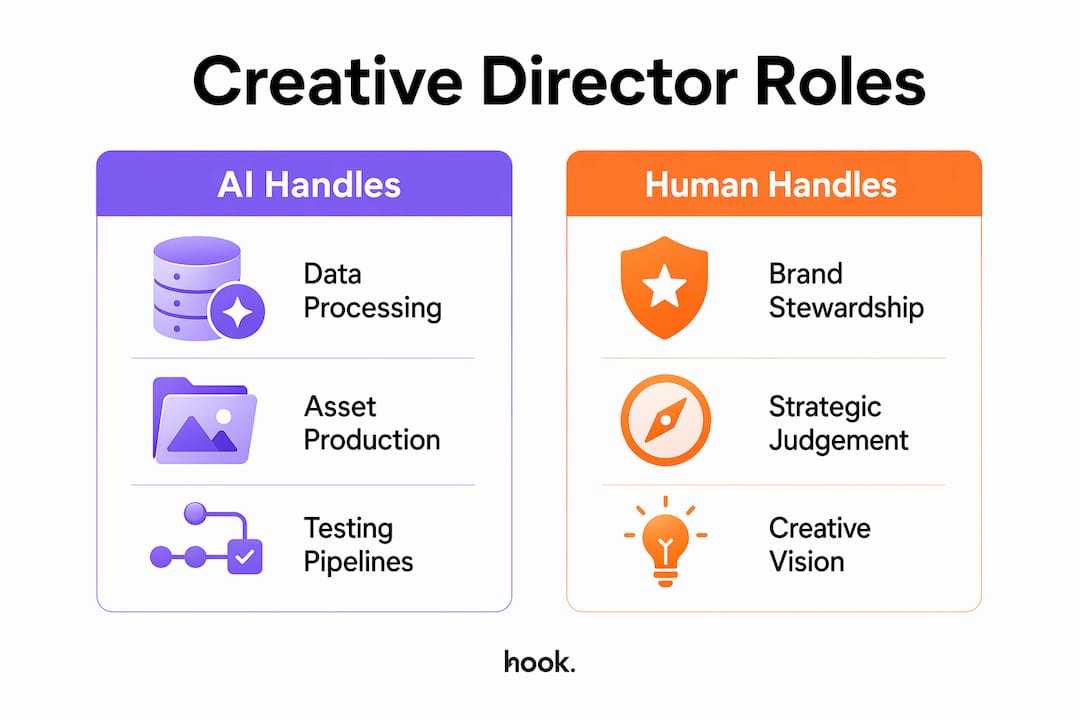
AI has shifted the creative director’s day-to-day work significantly. Routine tasks that once consumed hours, including creative analysis, asset testing, fatigue detection, and budget rebalancing, are now handled by AI agents. AI executes these production tasks while human judgement remains the deciding factor for strategic and brand-level decisions.
This shift does not reduce the creative director’s importance. It concentrates it. With AI handling the volume work, the creative director’s attention moves to the decisions that machines cannot make: whether a campaign concept reflects genuine cultural understanding, whether a brand voice feels authentic, and whether a creative risk is worth taking.
The practical implications for creative leadership in advertising are significant:
- AI fatigue detection flags when audiences stop responding to an ad, but the creative director decides what replaces it
- Automated testing pipelines generate performance data, but human judgement interprets what the data means for brand health
- AI content generation produces volume, but the creative director sets the quality filter and brand guardrails
- Audit trails become a new responsibility, as creative directors must document decisions made alongside AI systems
| Task | AI handles | Creative director handles |
|---|---|---|
| Creative analysis | Automated data processing | Interpreting strategic implications |
| Asset production | Volume generation | Quality approval and brand fit |
| Performance testing | Running A/B tests | Deciding what to test and why |
| Budget rebalancing | Real-time allocation | Setting priorities and campaign goals |
The integration of AI with human creative leadership is not a replacement story. It is a redefinition of where human expertise adds the most value.
What frameworks do creative directors use to run campaigns?
A creative director runs multiple campaigns at once without letting quality slip on any of them. Managing simultaneous campaigns requires clear processes, not just talent. The most effective creative directors build repeatable frameworks that their teams can follow independently.
The creative brief is the foundation. It answers six questions: Who is the audience? What is the single message? What do we want them to feel? What is the call to action? What are the constraints? What does success look like? Every team member, from the junior designer to the account lead, should be able to read the brief and understand the campaign’s purpose without a follow-up meeting.
Stakeholder alignment is the second framework. Creative directors translate across brand, product, finance, and legal teams to keep everyone speaking the same language. Misalignment at this stage is the most common reason campaigns stall or produce inconsistent outputs. A creative director who can run a tight alignment session early saves weeks of revision later.
| Framework | Purpose | Outcome |
|---|---|---|
| Creative brief | Aligns team on vision and objectives | Fewer revisions, faster execution |
| Stakeholder alignment session | Reduces cross-functional miscommunication | Consistent campaign voice |
| Quality review cadence | Maintains standards across all outputs | On-brand, high-quality assets |
| Concept sequencing | Prioritises bets by risk and potential | Focused budget allocation |
Pro Tip: Run a 30-minute alignment session with all stakeholders before creative work begins. Ask each person to describe the campaign’s goal in one sentence. Disagreements at this stage are far cheaper to resolve than disagreements at final approval.
For a broader view of how agency structures support this kind of coordination, the agency account management guide from Hook-digital is worth reading alongside this.
What measurable impact does a creative director have on campaign performance?
The numbers are clear. 70–80% of paid social performance is directly attributed to creative quality. As platform targeting and automated bidding have reduced the manual advantage that media buyers once held, creative quality has become the primary lever for campaign success.
Strong design leadership directly correlates with business outperformance. McKinsey research links rigorous creative oversight to both marketing effectiveness and financial results, confirming that the creative director’s role is a commercial function, not a support function.
This means the creative director is not just the person who makes campaigns look good. They are the person most responsible for whether a campaign generates a return. When creative direction connects to business value, the entire marketing investment performs better.
The implication for marketing professionals and business leaders is direct. Underinvesting in creative leadership, whether by hiring a junior creative lead, limiting their authority, or overriding their judgement with untested client preferences, reduces campaign performance at the most fundamental level. The creative director is the primary quality control mechanism in any campaign.
Using an AI-driven content strategy platform alongside strong creative direction can help teams surface performance data faster, but the creative director remains the person who decides what to do with that data.
Hook-digital’s view: creative direction is a business function, not a finishing touch
The biggest mistake I see marketing leaders make is treating creative direction as the last step in a campaign, the part where someone makes everything look polished before it goes live. That framing costs businesses real money.
Creative direction is a business function. It belongs at the table when campaign objectives are set, not when assets are being finalised. The creative director who joins a project after the strategy is locked cannot do their best work. They are decorating a house they did not help design.
The rise of AI has made this clearer, not murkier. When AI handles production volume, the creative director’s judgement becomes the single most valuable input in the process. That judgement needs authority, access to the brief from day one, and the ability to push back on decisions that compromise the campaign’s effectiveness.
If you are a marketing leader, the question to ask is not “do we need a creative director?” The question is “are we giving our creative director the authority and the information they need to do the job properly?” The answer to that question determines your campaign’s ceiling.
— Hook
Creative direction for your campaigns, handled by Hook-digital
Creative direction requires more than talent. It requires the right infrastructure, the right team, and a clear process from brief to final asset.

Hook-digital is a full-service marketing agency based in Oxford, built to handle every part of your campaign under one roof. Our branding and design services are built around the same principles that define strong creative direction: clear vision, consistent standards, and outputs that serve your business goals. You work with one team, not five separate suppliers. That means your campaign speaks with one voice, from the first brief to the final post. If you want creative leadership that connects directly to commercial results, get in touch with Hook-digital.
FAQ
What does a creative director do in a marketing campaign?
A creative director leads the campaign’s creative vision, translates strategy into briefs, sets quality standards, and makes judgement calls on every major creative decision. They are the primary quality control mechanism from concept to final delivery.
How does creative direction affect campaign performance?
Creative quality drives 70–80% of paid social performance, making the creative director the most influential role in determining campaign ROI, particularly as automated targeting reduces the advantage of media buying alone.
What is the difference between a creative director and an art director?
An art director focuses on the visual execution of specific assets. A creative director oversees the entire campaign’s creative output, manages the team, aligns stakeholders, and connects creative decisions to business objectives.
How has AI changed what creative directors do day to day?
AI now handles analysis, asset production, and testing pipelines, freeing creative directors to focus on brand stewardship, strategic judgement, and supervising AI-driven workflows rather than managing production volume manually.
What skills should you look for when hiring a creative director?
The most important skills are strategic thinking, the ability to write and interpret a creative brief, stakeholder communication, and the commercial judgement to connect creative decisions to business outcomes. Technical design skills matter less than leadership and decision-making ability.
Key takeaways
The creative director is the primary driver of campaign performance, responsible for vision, quality, and the judgement calls that connect creativity to commercial results.
| Point | Details |
|---|---|
| Creative direction drives ROI | Creative quality accounts for 70–80% of paid social performance, making the role commercially critical. |
| The brief is the foundation | A strong creative brief aligns every team member and reduces costly revisions throughout the campaign. |
| Judgement is the core skill | Knowing what to kill, what to defend, and what to refine is more valuable than any technical ability. |
| AI expands, not replaces, the role | Creative directors now supervise AI-driven production, focusing their energy on brand alignment and strategic decisions. |
| Authority determines outcomes | Creative directors need early access to strategy and the authority to push back on decisions that compromise the campaign. |
Recommended
- What is a creative agency model? A clear guide | Hook Digital - Oxford’s Premier Full-Service Marketing Agency
- Marketing agency evaluation checklist: 2026 guide | Hook Digital - Oxford’s Premier Full-Service Marketing Agency
- How to brief a design agency: a practical guide | Hook Digital - Oxford’s Premier Full-Service Marketing Agency
- Human vs AI: The Creative Edge of Hook Digital | Hook Digital - Oxford’s Premier Full-Service Marketing Agency
.png)


