

.webp)

.svg)
What does CPA mean in digital marketing?
Cost Per Acquisition (CPA) is defined as the average advertising spend required to generate one completed conversion event, making it the metric that connects your marketing budget directly to real business outcomes. If you’ve ever wondered what does CPA mean in digital marketing, the short answer is this: it tells you exactly what you’re paying for each sale, lead, or sign-up your campaigns produce. Platforms like Google Ads and Meta Ads use CPA as a core performance signal, and analytics tools like Triple Whale and Klaviyo surface it alongside revenue data so you can see the full picture. Unlike clicks or impressions, CPA measures what actually matters: the cost of a result.
How is CPA calculated and what does it tell you about campaign performance?
CPA is calculated using a straightforward formula: total ad spend divided by the number of conversions. Spend £2,000 and generate 100 purchases, and your CPA is £20. That single number tells you the efficiency of your campaign at the point where money changes hands.
A conversion can be almost anything you define: a product purchase, a form submission, a free trial sign-up, or an app download. The key is that you choose the conversion event before you run the campaign, not after. Changing the definition mid-campaign distorts your data and makes comparison impossible.

CPA vs CPC vs CPM: what’s the difference?
| Metric | What it measures | Typical use case |
|---|---|---|
| CPA (Cost Per Acquisition) | Cost per completed conversion | Sales, leads, sign-ups |
| CPC (Cost Per Click) | Cost per ad click | Traffic generation |
| CPM (Cost Per Mille) | Cost per 1,000 impressions | Brand awareness |
CPA is mathematically higher than CPC because not every click results in a conversion. If your CPC is £0.50 and your conversion rate is 2%, your CPA will be around £25. That gap is your conversion rate doing its job, or failing to.
CPA is also distinct from Customer Acquisition Cost (CAC). CPA is a campaign-level metric that only accounts for direct ad spend within a specific channel. CAC is a business-wide figure that includes salaries, software subscriptions, agency fees, and every other cost involved in winning a customer. Mixing the two leads to flawed decisions.
Pro Tip: Set your conversion event to the action with the highest business value before you launch. Optimising for a micro-conversion like a page view will produce a low CPA that means very little.
What are common mistakes and misconceptions about CPA?
The most damaging mistake is confusing CPA with CAC. A campaign might show a CPA of £15, which looks healthy. But if your CAC, once you factor in staff time and tools, is £60, the campaign is far less profitable than the dashboard suggests. These are two different numbers serving two different purposes.
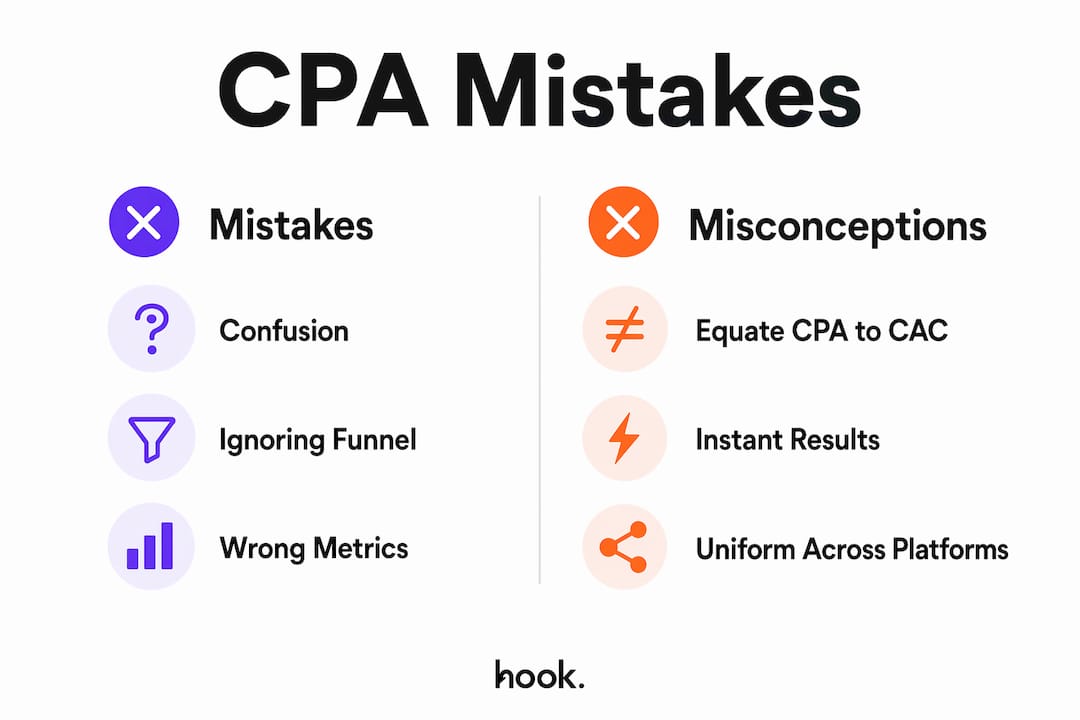
A second common error is optimising for the wrong conversion. Mis-optimising for lower-value actions, such as newsletter sign-ups instead of purchases, produces a low CPA that flatters your report while delivering poor revenue. Always align your tracked conversion with your most valuable business outcome.
Attribution is another area where CPA figures can mislead. Attribution windows significantly alter reported CPA values. A 7-day click window will show a different CPA than a 1-day click window for the same campaign. If you’re comparing CPA across platforms without checking their attribution settings, you’re comparing apples with oranges.
- Confusing CPA with CAC and drawing the wrong conclusions about profitability
- Tracking low-value conversions and celebrating a CPA that doesn’t reflect revenue
- Ignoring attribution model differences when comparing CPA across Google Ads and Meta
- Reacting to a CPA spike by changing bids, when the real issue is a broken landing page
- Treating CPA as a final verdict rather than a signal to investigate further
Pro Tip: When your CPA rises suddenly, audit your full funnel before touching your bids. Check your landing page load speed, your ad creative, and your checkout flow. The problem is rarely the bid itself.
How does CPA relate to customer lifetime value and profitability?
CPA must be compared with customer lifetime value (LTV) to determine whether a campaign is actually profitable. A CPA of £50 looks expensive in isolation. If your average customer spends £300 over their lifetime with you, that £50 is a sound investment. If they spend £40, you’re losing money on every acquisition.
LTV and Average Order Value (AOV) are the benchmarks that give CPA its meaning. Without them, CPA is just a number. Here’s how to think about the relationship in practical terms:
- Calculate your AOV. Divide total revenue by the number of orders in a given period. This is your baseline for what a single transaction is worth.
- Estimate your LTV. Multiply AOV by the average number of purchases a customer makes over their relationship with your business.
- Set a target CPA. Your CPA should sit comfortably below your LTV, with enough margin to cover product costs, fulfilment, and overheads.
- Factor in your gross margin. If your margin is 40%, a £100 LTV means you have £40 to work with. Your CPA must stay below that figure for the campaign to be profitable.
Scaling a campaign with a CPA above your margin is a fast route to spending more and earning less. The maths is unforgiving, and many businesses discover this only after significant ad spend.
What practical strategies can lower CPA and improve ROI?
CPA is a function of two variables: how much you pay for impressions (CPM) and how well your funnel converts those impressions into customers. The full formula is CPA = (CPM ÷ 1,000) ÷ (CTR × CVR). That means you have two levers to pull.
Improving your conversion rate is often more cost-effective than chasing cheaper ad inventory. A 1% improvement in your landing page conversion rate can reduce CPA more dramatically than weeks of bid adjustments.
Here are the most effective tactics for reducing CPA:
- Use Target CPA bidding. Both Google Ads and Meta Ads offer Target CPA (tCPA) bidding, where you set a desired CPA and the platform adjusts bids in real time to hit it. This shifts the optimisation burden to the algorithm, which has access to far more signal data than manual bidding.
- Improve your ad creative. Stronger creative improves click-through rate (CTR), which directly lowers your effective CPA. Test multiple formats, including video, carousel, and static images, to find what stops the scroll for your audience.
- Optimise your landing page. A slow, cluttered, or confusing landing page kills conversion rate. Prioritise page speed, a clear headline, and a single call to action. Tools like Google PageSpeed Insights and Hotjar can identify where users drop off.
- Segment your audiences. Retargeting audiences typically convert at higher rates than cold traffic. Running separate campaigns with separate CPA targets for warm and cold audiences gives you cleaner data and better control.
- Audit your funnel regularly. A spike in CPA signals a need to audit the entire funnel, from the ad creative through to the checkout page. Treat a rising CPA as a diagnostic prompt, not just a bidding problem.
Pro Tip: Before increasing your ad budget to chase more conversions, fix your conversion rate first. Scaling a leaky funnel just means spending more to lose more.
How does CPA differ across platforms and bidding models?
CPA works differently depending on where you’re advertising, and understanding those differences helps you set realistic targets. If you’re comparing Meta Ads vs Google Ads performance, CPA is one of the most telling metrics to examine side by side.
Google Ads and Meta both use Target CPA bidding, but their algorithms operate differently. Google Ads tCPA works best with a minimum of 30–50 conversions per month to give the algorithm enough data to learn. Meta’s Advantage+ campaigns use a similar approach, optimising delivery towards users most likely to convert at your target cost.
| Platform | CPA bidding model | Attribution default | Best suited for |
|---|---|---|---|
| Google Ads | Target CPA (tCPA) | Last click, 30-day window | High-intent search traffic |
| Meta Ads | Cost cap / Advantage+ | 7-day click, 1-day view | Awareness and retargeting |
| Affiliate marketing | Fixed CPA per lead or sale | Last click | Performance-based partnerships |
In affiliate marketing, CPA takes on a slightly different form. Advertisers agree to pay a fixed fee for each lead or sale generated by a publisher. This removes the bidding complexity but requires careful vetting of traffic quality, since low-quality affiliates can inflate conversion numbers without delivering genuine customers.
Attribution windows are the hidden variable that makes cross-platform CPA comparison tricky. A 7-day click window on Meta will claim more conversions than a 1-day window. Always standardise your attribution settings before drawing conclusions from platform-level CPA data. For a broader view of choosing the right platform, consider how each channel’s audience intent affects the CPA you can realistically achieve.
Key takeaways
CPA is the most direct measure of advertising efficiency available to digital marketers, and it only becomes meaningful when compared against LTV, margin, and funnel performance.
| Point | Details |
|---|---|
| CPA formula | Divide total ad spend by number of conversions to get your cost per acquisition. |
| CPA vs CAC | CPA covers direct ad spend only; CAC includes all business-wide acquisition costs. |
| LTV comparison | Your CPA must sit below your gross margin per customer for campaigns to be profitable. |
| Conversion rate first | Improving CVR reduces CPA more effectively than seeking cheaper impressions alone. |
| Platform attribution | Standardise attribution windows before comparing CPA figures across Google Ads and Meta. |
Hook-digital’s take on CPA: the metric most businesses misread
After working with businesses across a wide range of sectors, the pattern I see most often is this: a business owner looks at their CPA, decides it’s too high, and immediately asks to reduce the ad budget or change the bid strategy. Rarely do they look at the landing page. Rarely do they check whether the conversion event they’re tracking is actually the one that drives revenue.
CPA is one of the most useful numbers in digital marketing, but only if you treat it as a question rather than an answer. A rising CPA is asking you something. It might be asking why your landing page isn’t converting. It might be asking whether your creative has gone stale. It might be asking whether you’re targeting the right audience at all.
The businesses that get the most from their ad spend are the ones that read CPA alongside LTV, margin, and funnel data. They don’t panic at a £5 increase in CPA if their LTV has also grown. They don’t celebrate a low CPA if it’s being driven by sign-ups that never convert to paying customers.
My honest advice: before you touch your bids, look at your funnel. Before you cut your budget, look at your creative. CPA is a diagnostic tool, and the best marketers use it that way. If you’re not sure what your CPA is telling you, that’s usually the first problem worth solving.
— Hook
Want to lower your CPA? Hook-digital can help
If your CPA is climbing and you’re not sure why, or if you’ve never had a clear picture of what your ads are actually costing you per customer, Hook-digital is here to help. We’re an Oxford-based full-service marketing agency with hands-on experience running paid campaigns across Google Ads and Meta, building conversion-led websites that turn clicks into customers, and managing paid social and PPC for businesses that want results they can measure.

We look at your CPA in the context of your margins, your funnel, and your business goals. That means you get a strategy built around profitability, not just traffic. Get in touch with the Hook-digital team and let’s talk about what your numbers are really telling you.
FAQ
What does CPA stand for in digital marketing?
CPA stands for Cost Per Acquisition, sometimes called Cost Per Action. It measures the average ad spend required to generate one conversion, such as a sale, lead, or sign-up.
How is CPA different from CPC?
CPC (Cost Per Click) measures the cost of each ad click, while CPA measures the cost of each completed conversion. CPA is always higher than CPC because not every click results in a conversion.
What is a good CPA for digital advertising?
A good CPA depends entirely on your product margin and customer lifetime value. Your CPA must sit below your gross profit per customer for a campaign to be profitable.
Why does my CPA vary between Google Ads and Meta?
CPA varies across platforms due to differences in audience intent, bidding algorithms, and attribution windows. A 7-day click attribution window on Meta will typically claim more conversions than a shorter window, making direct comparison unreliable without standardising settings first.
How can I reduce my CPA quickly?
The fastest way to reduce CPA is to improve your landing page conversion rate, since CVR improvements reduce CPA more effectively than chasing cheaper ad inventory. Audit your funnel before adjusting bids.
Recommended
- What is Full Service Digital Marketing? | Hook Digital - Oxford’s Premier Full-Service Marketing Agency
- Unlocking Success: The Benefits of PPC/Google Ads for Marketing Your Business | Hook Digital - Oxford’s Premier Full-Service Marketing Agency
- Marketing | Hook Digital - Oxford’s Premier Full-Service Marketing Agency
- Free Marketing Consultation | Hook Digital - Book Your Strategy Call
.png)


