
.webp)

.svg)
What is a creative agency model? A clear guide
A creative agency model is the client-service framework that defines how an agency organises its teams, generates revenue, and delivers branding and marketing solutions to clients. Understanding what is a creative agency model matters whether you are hiring your first agency or reassessing a current partnership. The model shapes everything from how you are billed to how quickly work gets done. Get it wrong and you pay for overhead you do not need. Get it right and you gain a partner who thinks and acts like an extension of your own team.
What is a creative agency model and how does it generate revenue?
Creative agencies derive revenue through five primary mechanisms: project fees, monthly retainers, hourly billing, value-based pricing, and performance-based arrangements. Each model suits a different type of client relationship and project scope.
- Project fees cover a defined deliverable, such as a brand identity or a website build. You pay a fixed sum for an agreed output, which makes budgeting straightforward.
- Monthly retainers provide the agency with recurring income stability and give you ongoing access to creative support without renegotiating terms each month. Established agencies favour this model because it improves their financial predictability and long-term planning.
- Hourly billing suits short, unpredictable engagements. The risk is that costs can escalate if scope is not tightly managed from the outset.
- Value-based pricing links fees to the business impact of the work rather than the time spent. A rebrand that doubles your conversion rate, for example, commands a higher fee than one measured purely in hours.
- Performance-based models tie agency compensation directly to agreed KPIs such as leads generated or revenue attributed to a campaign. This aligns agency incentives with your outcomes, though it requires clear measurement frameworks.
The best agencies blend project-driven and relationship-driven work. That balance keeps revenue stable while allowing them to take on new clients and grow. When you evaluate an agency, ask how they structure their fees and whether the model matches the type of work you need.
Pro Tip: Ask any agency you are considering to show you a sample scope of work and invoice. The way they present costs tells you a great deal about how they manage client relationships.
How do creative agencies organise their teams?
Internal organisation is key to agency success. Three models dominate how creative agencies structure their people and workflows: the Foundry, the Studio, and the Hive.

The Foundry model
The Foundry is mechanistic and production-focused. It suits repetitive, high-volume creative tasks such as social media asset production or templated advertising. Teams follow defined processes, which keeps costs low and turnaround fast. The trade-off is limited creative flexibility. If your brief changes frequently or requires original thinking, a Foundry structure can feel rigid.
The Studio model
The Studio adopts classic departmental collaboration. Copywriters, designers, strategists, and account managers work in separate disciplines but come together on briefs. This is the most familiar agency structure for clients who have worked with mid-sized agencies. Communication is clear and accountability is well defined. The Studio works well for campaigns that require consistent quality across multiple channels.
The Hive model
The Hive uses pod-based, organic teams assigned per brand or project. A small group of specialists works together exclusively on your account, which builds deep familiarity with your brand over time. This model suits clients who want continuity and creative coherence across a long-term relationship. The challenge is that scaling up quickly can be difficult if the agency’s pods are already committed to other clients.
Pro Tip: When you visit an agency for the first time, ask how your account would be staffed. The answer reveals which organisational model they use and whether it fits the pace and complexity of your projects.
Top creative agency types compared: full-service, studio, and independent
Three distinct agency types operate in the market, and understanding their differences helps you match the right partner to your brief.
| Agency type | Scope | Strategic involvement | Typical cost | Best for |
|---|---|---|---|---|
| Full-service agency | End-to-end creative and marketing | High | Higher | Large, complex, multi-channel campaigns |
| Creative studio | Execution and visual delivery | Low to medium | Mid-range | Mid-sized projects with clear briefs |
| Independent creator | Niche, specific tasks | Low | Lower | Small, well-defined projects |
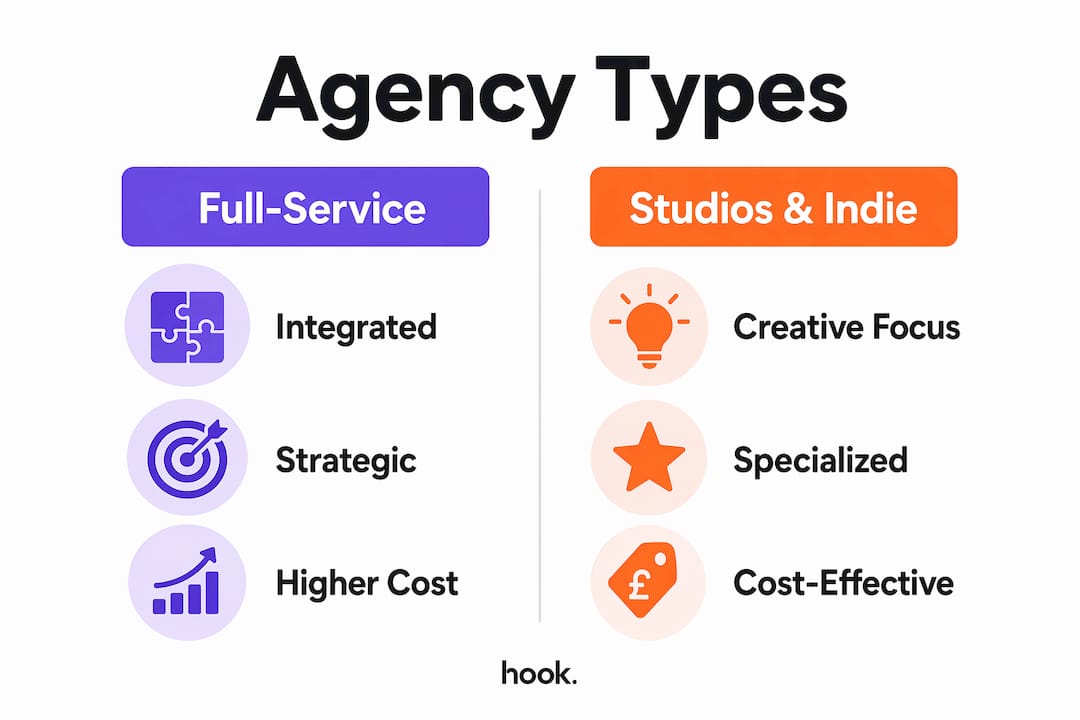
Full-service agencies provide integrated marketing and creative strategies using specialist teams. They manage complex, multi-channel campaigns and absorb the coordination risk on your behalf. That breadth comes with larger overhead and, at times, slower communication. They are the right choice when your project requires simultaneous delivery across brand, digital, paid media, and content.
Creative studios concentrate on high-quality creative execution and visual delivery. They are cost-effective for mid-sized projects when you can supply the strategic direction yourself. A product launch with a defined brief, for example, suits a studio well. You get excellent craft without paying for strategic overhead you do not need.
Independent creators focus on niche, specific tasks with a lower budget impact. They are best suited to small projects with clearly defined scope and low complexity, such as a single illustration or a short video edit. The limitation is that you manage the workflow and strategy yourself. For anything requiring coordination across multiple disciplines, an independent creator adds friction rather than removing it.
Knowing which type fits your situation is one of the most practical benefits of understanding the creative agency business model before you start conversations with potential partners.
How to choose the right agency model for your business
Choosing the right creative agency structure comes down to three factors: your project complexity, your internal marketing capacity, and your budget.
- Project complexity: A multi-channel rebrand with website, social, and advertising components needs a full-service agency. A single brand identity refresh may suit a studio.
- Internal capacity: If your team can handle strategy and project management, a studio or independent creator delivers strong value. If you need the agency to lead thinking as well as execution, a full-service model is worth the investment.
- Budget and risk: Agencies that specialise and maintain clear positioning can charge premium prices and deliver measurable business growth through focused expertise. A generalist agency at a lower day rate may cost more in the long run if the work requires multiple rounds of revision.
A common pitfall is choosing a large, full-service agency for a small project. You end up paying for account management layers and strategic overhead that your brief simply does not require. Equally, hiring an independent creator for a campaign that spans six channels creates coordination problems that eat into your time and budget.
Use a structured agency evaluation checklist before you commit. It forces you to define your needs clearly before any agency conversation begins, which puts you in a much stronger negotiating position.
Pro Tip: Ask the agency for two or three case studies from clients of a similar size to yours. If they cannot produce them, the agency may not have genuine experience at your scale.
For a deeper look at when comprehensive agency support makes sense, the guide on full-service agencies at Hook-digital covers the practical differences in detail.
Key takeaways
The right creative agency model aligns your project complexity, budget, and internal capacity with an agency’s organisational structure and pricing approach.
| Point | Details |
|---|---|
| Revenue model variety | Agencies use project fees, retainers, hourly billing, value-based, and performance pricing. |
| Organisational structure matters | Foundry, Studio, and Hive models each suit different speeds and creative demands. |
| Three agency types exist | Full-service, creative studio, and independent creator serve different project scales. |
| Specialisation commands premium fees | Agencies with clear positioning deliver focused expertise and measurable results. |
| Match model to your needs | Align agency type with your project complexity, internal capacity, and budget before committing. |
My honest view on where agency models are heading
The shift from traditional departmental agencies to pod-based, Hive-style structures is real and accelerating. Smaller businesses benefit most from this change. A tight pod of three or four specialists who know your brand deeply outperforms a large team where your account is one of fifty.
What concerns me more is the trend among large holding companies toward principal trading models. These agencies act as media wholesalers, buying inventory in bulk and reselling it with a markup. The conflict of interest is significant. The agency’s incentive becomes margin on media, not efficiency for the client. If you are working with a large network agency, ask directly whether they trade media as a principal. The answer matters more than most clients realise.
For most growing businesses, the right answer is a focused agency with a clear service offer, transparent pricing, and a team structure that keeps the same people on your account month after month. Complexity in agency structure rarely benefits the client. It benefits the agency’s ability to upsell. The best partnerships I have seen are built on simplicity: a clear brief, a defined model, and a team that genuinely cares about your results.
— Hook
Work with an agency model that fits your ambitions
Hook-digital is a full-service marketing agency based in Oxford, built so you only ever need to talk to one team. Whether you need branding, design, websites, social media, or paid advertising, the same people handle it all. That means no coordination headaches, no briefing the same project to three different suppliers, and no gaps between disciplines. If you are ready to work with a team that combines creative excellence with clear, transparent pricing, explore Hook-digital’s branding and design services or book a free strategy consultation to talk through your needs.
FAQ
What is a creative agency model in simple terms?
A creative agency model is the framework that defines how an agency structures its teams, prices its services, and delivers creative work to clients. It covers everything from billing methods to how staff are organised internally.
What is the difference between a creative agency and a media agency model?
A creative agency model focuses on producing brand and marketing content such as design, copy, and campaigns. A media agency model centres on planning and buying advertising space across channels, often acting as an intermediary between brands and publishers.
What do creative agencies do day to day?
Creative agencies develop brand identities, design marketing materials, produce digital content, build websites, and manage campaigns across channels. The specific services depend on whether the agency is full-service, a studio, or a specialist outfit.
Which creative agency model suits a small business best?
A creative studio or a focused full-service agency with transparent retainer pricing suits most small businesses. Independent creators work for single, well-defined tasks but require you to manage strategy and coordination yourself.
How does a creative agency make money?
Creative agencies generate revenue through project fees, monthly retainers, hourly billing, value-based pricing, and performance-based arrangements. Most established agencies combine retainers with project work to balance income stability with new client growth.
Recommended
- Marketing agency evaluation checklist: 2026 guide | Hook Digital - Oxford’s Premier Full-Service Marketing Agency
- What is a full service agency? a clear guide | Hook Digital - Oxford’s Premier Full-Service Marketing Agency
- How to brief a video production agency effectively | Hook Digital - Oxford’s Premier Full-Service Marketing Agency
- Free Marketing Consultation | Hook Digital - Book Your Strategy Call
.png)


