

.webp)

.svg)
What is a digital PR strategy? A guide for businesses
A digital PR strategy is a planned approach to building brand visibility and online reputation through digital media, earned coverage, and targeted content. Unlike traditional PR, which relies on print and broadcast, digital public relations uses online channels to generate backlinks, media mentions, and branded search visibility. The result is measurable: stronger domain authority, more referral traffic, and a brand that journalists and customers recognise. If you want your business to be found, trusted, and talked about online, a well-built digital PR plan is one of the most effective tools available.
What is a digital PR strategy and why does it matter?
A digital PR strategy is the coordinated use of online public relations tactics to raise brand awareness, generate media coverage, and improve search engine visibility. It sits at the intersection of content marketing, SEO, and communications. Done well, it earns your brand coverage in publications your audience already reads, and those placements drive both traffic and trust.
Digital PR extends traditional PR with storytelling, influencer marketing, and measurable online engagement. That distinction matters. Traditional PR measures column inches. Digital PR measures backlinks, referral traffic, branded search volume, and domain authority. The shift means you can tie PR activity directly to business outcomes, which is something most marketing professionals have wanted for years.

The benefits of digital PR go beyond SEO. A well-placed feature in a respected publication builds credibility that paid advertising simply cannot replicate. Readers trust editorial coverage. When your brand appears in that context, the association sticks.
What are the core components of a digital PR strategy?
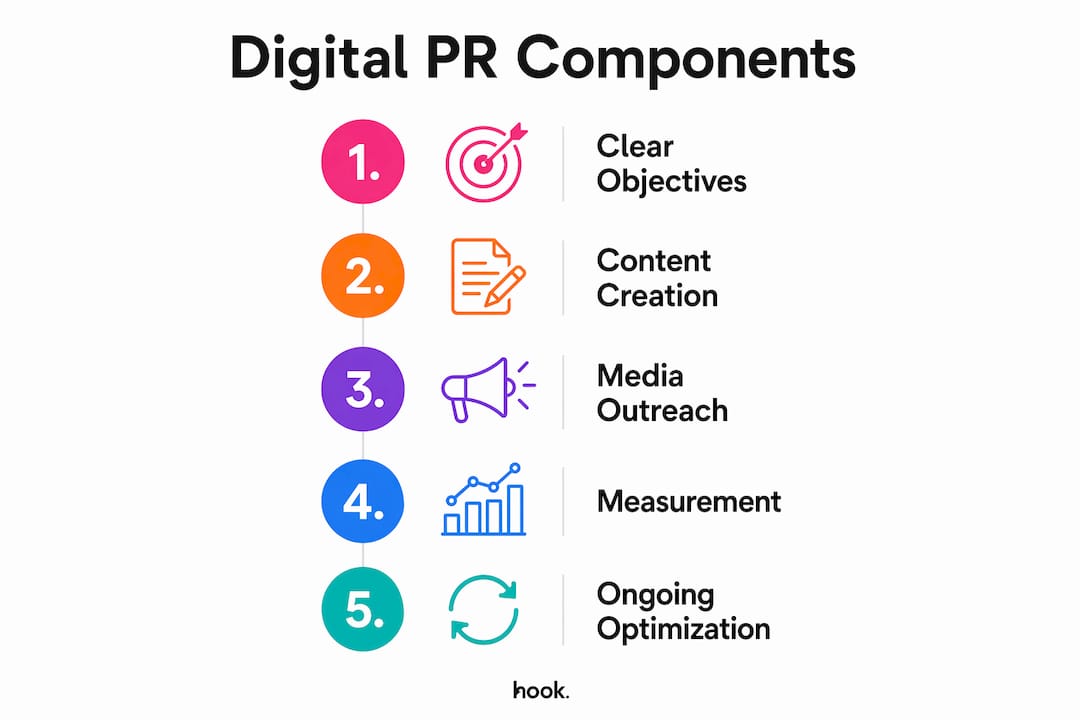
A practical digital PR campaign starts with clear objectives and measurable goals tied to tactics and timelines. Without that foundation, activity becomes scattered and results become impossible to attribute. Every component of the strategy should connect back to those goals.
The table below summarises the core components and what each one involves in practice.
| Component | What it involves |
|---|---|
| Clear objectives | Defined goals such as backlink targets, coverage volume, or branded search growth |
| Audience and competitor analysis | Understanding who you are reaching and what stories resonate in your sector |
| Content creation | Newsworthy, data-driven assets such as surveys, reports, or original research |
| Distribution and pitching | Targeted outreach to journalists, editors, and relevant online publications |
| Monitoring and measurement | Tracking backlinks, mentions, referral traffic, and branded search over time |
Each component depends on the one before it. Pitching without a strong content asset wastes your time and the journalist’s. Measuring without defined objectives leaves you with data but no conclusions. The sequence matters as much as the individual steps.
Content creation deserves particular attention. Generic press releases rarely earn coverage. Journalists prefer original research, clear data, and stories with a genuine angle. Building your content around a specific finding or insight gives editors a reason to publish and gives readers a reason to share.
Which digital PR tactics deliver the best results?
Successful campaigns mix newsworthy stories, data-driven content, targeted pitching, and active monitoring. No single tactic works in isolation. The strongest results come from combining several approaches within a single campaign.
The tactics that consistently perform well include:
- Data-led research campaigns. Commission a survey or analyse publicly available data to produce an original finding. Journalists value exclusivity and verifiable sources above almost everything else.
- Strategic media outreach. Build relationships with journalists and editors before you need coverage. A warm contact is far more likely to open your pitch than a cold email.
- Newsjacking. React quickly to breaking news with a relevant expert comment or data point. Speed is the advantage here. A response sent within two hours of a story breaking can earn coverage that a planned campaign never would.
- Influencer and creator partnerships. Collaborating with credible voices in your sector extends reach to audiences who may not encounter your brand through traditional media.
- Reputation monitoring. Track brand mentions across the web using tools such as Google Alerts or dedicated media monitoring platforms. Unlinked mentions are an opportunity to request a backlink and to catch negative coverage early.
Pro Tip: Package your research on a single landing page with visuals, methodology notes, and downloadable assets. Press kits with accessible content reduce journalist effort and improve the likelihood of coverage significantly.
Because digital PR is earned media, journalists prefer stories with data and verifiable sources above generic press releases. That preference shapes everything from how you structure a pitch to how you present your findings. Make the journalist’s job easier and your coverage rate rises.
How do you measure the success of a digital PR strategy?
Digital PR reports should track SEO and brand signals together for a full picture of campaign impact. Focusing only on backlink counts misses the broader value that earned coverage creates. A placement in a high-authority publication may drive referral traffic, branded search volume, and social sharing even if the link itself is no-follow.
The key metrics to track are:
- Backlink quality and volume. Count links, but weight them by the domain authority of the referring site. Ten links from respected national publications outperform a hundred from low-quality directories.
- Referral traffic. Monitor how many visitors arrive via coverage placements. High-quality placements drive referral traffic and brand visibility even without direct links.
- Branded search volume. An increase in people searching your brand name directly signals growing awareness. This is one of the clearest indicators that PR activity is working.
- Unlinked mentions. Coverage that names your brand without linking still builds recognition. Track these separately and follow up to request links where appropriate.
- Domain authority growth. Over time, consistent earned coverage raises your site’s authority in search engines. This compounds: higher authority means better organic rankings, which means more visibility.
Evaluating digital PR performance involves combining SEO metrics like domain authority with brand metrics such as branded search visibility and referral traffic. Neither set of metrics tells the full story alone. Together, they show whether your PR activity is building something durable.
Your website’s role in digital PR is also worth measuring. Coverage that drives visitors to a weak or slow site wastes the opportunity. The landing page receiving that traffic needs to convert interest into action.
How to create and implement an effective digital PR plan
Building an effective digital PR plan follows a clear sequence. Skipping steps early on creates problems later, particularly at the measurement stage.
- Set specific objectives. Define what success looks like before you start. Examples include earning 20 backlinks from publications with a domain authority above 50, or increasing branded search volume by a measurable percentage over six months.
- Research your audience and media landscape. Identify which publications your audience reads, which journalists cover your sector, and what stories have performed well recently. This shapes both your content and your pitch list.
- Create a content asset. Commission original research, build a data-led report, or develop a genuinely newsworthy story. The asset is the foundation of the campaign. Without it, you have nothing to pitch.
- Build your press kit. Packaging content in digital press kits with visuals and methodology improves citation rates. Include a summary, key findings, supporting data, and high-resolution images on a single, shareable URL.
- Pitch and distribute. Send personalised pitches to relevant journalists. Generic mass emails perform poorly. A short, specific email that explains why the story matters to that journalist’s audience will always outperform a broadcast approach.
- Monitor and respond. Track coverage as it appears. Respond to journalist queries quickly. Follow up on unlinked mentions. Adjust your pitch angle if early responses are low.
- Report and iterate. Measure results against your original objectives. Identify what worked and what did not. Apply those lessons to the next campaign.
Pro Tip: Align your digital PR plan with your broader SEO and content marketing goals from the start. Campaigns that reinforce your existing keyword strategy and link to relevant site pages deliver compounding returns over time.
Full-service digital marketing integrates digital PR with SEO, social media, and paid channels. When those disciplines share the same objectives and messaging, each one amplifies the others. That integration is where the real efficiency gains appear.
Key takeaways
A digital PR strategy delivers lasting brand value when it combines clear objectives, data-driven content, targeted media outreach, and integrated measurement of both SEO and brand signals.
| Point | Details |
|---|---|
| Define objectives first | Set specific, measurable goals before creating any content or pitching any journalist. |
| Content quality drives coverage | Original research and data-led assets earn far more coverage than generic press releases. |
| Measure beyond backlinks | Track referral traffic, branded search volume, and unlinked mentions alongside link counts. |
| Integrate with SEO | Align digital PR campaigns with your keyword strategy to compound organic search gains. |
| Consistency builds authority | Ongoing campaigns raise domain authority over time in a way that one-off efforts cannot. |
Hook-digital’s perspective: why most digital PR fails before it starts
The most common mistake I see from businesses attempting digital PR is treating it as a one-off activity. A single press release, a single campaign, a single burst of outreach. Then silence. That approach rarely works, and when it does, the results fade quickly.
Digital PR builds authority the way a savings account builds interest. The value compounds over time, but only if you keep contributing. Brands that commit to a consistent programme of content creation and media outreach see their domain authority rise steadily, their branded search volume grow, and their media relationships deepen. Brands that dip in and out see none of that.
The other pattern I notice is an obsession with backlink counts at the expense of everything else. A link from a low-quality site costs you nothing and earns you nothing. A mention in a respected trade publication, even without a link, can shift how your audience perceives you. Measuring digital PR impact requires looking beyond links to brand and audience engagement indicators for a full picture. That shift in thinking changes the campaigns you build and the results you achieve.
Authenticity matters more than it ever has. Journalists receive hundreds of pitches each week. The ones that cut through are grounded in genuine data, told with a clear point of view, and sent by someone who has taken the time to understand the publication. There is no shortcut to that. Building real media relationships takes time, but those relationships become one of your most valuable marketing assets.
Finally, digital PR does not exist in isolation. The best results come when it connects directly to your social media activity, your SEO strategy, and your brand identity. When all of those elements point in the same direction, the impact multiplies.
— Hook
How Hook-digital can support your digital PR and brand strategy
Building a credible brand online takes more than good content. It takes consistent visual identity, a website that earns trust on arrival, and a marketing strategy where every channel reinforces the others.
Hook-digital is an Oxford-based full-service marketing agency that handles branding, design, SEO, social media, and more. If you want your digital PR efforts to land on a brand that looks the part, our branding and design services give you the foundation to make every piece of coverage count. You only need to talk to one agency. We take care of the rest.
FAQ
What is a digital PR strategy in simple terms?
A digital PR strategy is a planned approach to earning online media coverage, backlinks, and brand mentions through targeted content and journalist outreach. It combines communications, SEO, and content marketing to build brand visibility and reputation.
How does digital PR differ from traditional PR?
Traditional PR focuses on print, broadcast, and events. Digital PR targets online publications, blogs, and digital media to generate backlinks, referral traffic, and branded search visibility alongside editorial coverage.
What are the most effective digital PR tactics?
Data-led research campaigns, strategic media outreach, newsjacking, and reputation monitoring consistently deliver strong results. Journalists prefer stories with original data and verifiable sources over generic press releases.
How do you measure digital PR success?
Track backlink quality, referral traffic, branded search volume, unlinked mentions, and domain authority growth. Comprehensive measurement combines SEO signals with brand awareness metrics for a complete view of campaign impact.
How long does it take to see results from digital PR?
Results vary by campaign and sector, but domain authority and branded search gains typically build over several months of consistent activity. One-off campaigns rarely produce lasting impact.
Recommended
- What is digital marketing? a guide for business owners | Hook Digital - Oxford’s Premier Full-Service Marketing Agency
- A Practical Guide for Businesses and Brands Considering Google Ads | Hook Digital - Oxford’s Premier Full-Service Marketing Agency
- How Can Businesses Use Social Media for Marketing | Hook Digital - Oxford’s Premier Full-Service Marketing Agency
- What is Full Service Digital Marketing? | Hook Digital - Oxford’s Premier Full-Service Marketing Agency
.png)


