

.webp)

.svg)
What is a full service agency? a clear guide
A full service agency is defined as a single marketing partner that delivers strategy, creative, paid media, SEO, content, and analytics under one roof. Unlike hiring separate specialists for each discipline, you work with one team that manages your entire marketing output. This model, sometimes called an integrated agency, removes the coordination burden from your plate and keeps your brand messaging consistent across every channel. Hook-digital, based in Oxford, operates exactly this way, covering everything from branding and web design to Google Ads and social media.
What is a full service agency and what does it cover?
A full service marketing agency provides both traditional and digital marketing disciplines within a single firm, including strategic planning, media planning, content creation, PR, and analytics. This is the defining characteristic that separates it from a specialist provider. You get one team responsible for the whole picture, not a collection of vendors each managing their own corner.
The core disciplines inside a genuine full service agency include brand strategy, creative development, paid media, earned media, SEO, web and digital experience, and measurement. Unified offerings replace separate specialist engagements, which means your SEO team and your paid media team are talking to each other daily rather than working in silos.

Beyond the core, many agencies now include influencer marketing, CRM integration, video production, and event management. These are not always recommended to every client. A reputable full service agency recommends only what fits client needs and budgets rather than pushing every service it offers. That distinction matters when you are evaluating proposals.
| Service Area | Full Service Agency | Specialist Agency |
|---|---|---|
| Brand Strategy | Included | Rarely offered |
| SEO | Included | Core focus (SEO specialists) |
| Paid Media | Included | Core focus (PPC specialists) |
| Social Media Management | Included | Sometimes offered |
| Content Marketing | Included | Sometimes offered |
| Analytics and Reporting | Unified across channels | Channel-specific only |
| Web Design and Development | Included | Rarely offered |
What are the benefits of hiring a full service agency?
The primary benefit of a full service agency is the removal of fragmentation. One team manages your website, content, ads, SEO, and reporting, producing a unified brand message and fewer vendor relationships to maintain. That reduction in complexity is not a minor convenience. For a business owner managing operations, finance, and sales simultaneously, cutting five agency relationships down to one is a significant relief.

Integrated strategy is the second major advantage. When your SEO team, your paid media team, and your creative team share the same brief, campaigns reinforce each other rather than pulling in different directions. A full service agency coordinates messaging across TV, digital campaigns, social media, and PR, maintaining consistent brand positioning throughout. This eliminates message drift, which is the slow erosion of brand clarity that happens when multiple agencies interpret your brand independently.
The benefits of hiring one marketing agency also show up in performance measurement. Because all channels feed into one reporting structure, you get a clearer view of what is actually driving results. Companies benefit from quicker campaign execution, better return on investment, and clearer measurable outcomes when working with a single agency. That clarity makes budget decisions far easier.
Here is a summary of the core benefits:
- Fewer vendor relationships to manage and fewer invoices to process each month
- Consistent brand voice across every channel, from your website copy to your paid social ads
- Faster campaign execution because briefing, approvals, and revisions happen within one team
- Holistic reporting that shows how channels interact rather than reporting each in isolation
- Strategic alignment between creative, media, and digital teams from day one
Pro Tip: Set a shared monthly review with your agency covering all channels together, not separate calls per discipline. This single meeting reveals cross-channel patterns that individual channel reports will never show you.
Full service agency vs. boutique or specialist agency
A specialist agency focuses deeply on one or two channels. An SEO agency, for example, will have deeper technical expertise in search than most full service agencies can match. A boutique agency offers a more personalised service but typically has limited scale and a narrower range of capabilities. Understanding the difference helps you choose the right model for your situation.
Full service agencies outperform specialist agencies in multi-channel contexts by providing integrated campaigns and cohesive strategies. The trade-off is depth. If paid search is your single most important growth channel and you have the internal resource to manage everything else, a specialist PPC agency may serve you better. If you need multiple channels working together and lack the internal team to coordinate them, a full service model wins.
| Factor | Full Service Agency | Specialist Agency | Boutique Agency |
|---|---|---|---|
| Service Breadth | High | Narrow | Moderate |
| Channel Depth | Moderate | Very High | Moderate |
| Team Size | Large | Small to Medium | Small |
| Accountability | Single point of contact | Per channel | Single point of contact |
| Best For | Multi-channel growth | Dominant channel focus | Personalised, focused work |
| Scalability | High | Limited | Limited |
The honest answer is that neither model is universally superior. The right choice depends on your current marketing maturity, your internal resource, and how many channels you need to activate simultaneously.
How to choose a full service agency: key questions to ask
The label “full service” tells you very little on its own. Two agencies labelled full service can differ substantially in actual capability. What matters is their operational model and how they assign team responsibilities to client accounts. Ask the right questions before you sign anything.
Here is a practical checklist for your agency evaluation process:
- Map their actual capabilities. Ask for a breakdown of which services are delivered in-house and which are outsourced to third parties. Outsourcing is not automatically a problem, but you should know.
- Clarify outcome ownership. Senior teams must clarify who is responsible for business outcomes, not just task delivery. Ask directly: “Who is accountable if results fall short of targets?”
- Question the recommendations. Ask why each service is being recommended for your business. A trustworthy agency will tell you when a service is not right for you yet.
- Understand the pricing model. Some agencies use retainer models, others use project-based fees. Confirm whether the package is fixed or whether services can be added and removed as your needs change.
- Review their reporting structure. Ask to see an example report. It should show performance across all channels in one document, not separate reports per service.
Pro Tip: Before your first agency meeting, write down three specific business outcomes you want to achieve in the next 12 months. Not marketing outputs like “more social posts,” but business results like “20% more enquiries from organic search.” This forces the agency to respond with strategy rather than a service list.
How to get the most from a full service agency relationship
Treating your agency as an extension of your marketing department, rather than an external supplier, is the single biggest factor in getting strong results. Agencies perform better when they understand your business deeply, and that understanding only comes when you share context freely.
Practical steps to maximise the value of the relationship:
- Share your business goals upfront, including revenue targets, seasonal pressures, and competitive context. The more the agency knows, the better their strategy.
- Engage actively in campaign reviews. Do not simply receive reports. Ask questions, challenge assumptions, and bring your own observations from the sales floor.
- Leverage cross-channel thinking. Ask your agency how your SEO content can support your paid media campaigns, or how your social media activity can feed your email list. This is where integrated agency value becomes tangible.
- Avoid micromanaging creative decisions. You hired experts. Give them a clear brief, approve the strategy, and let them execute. Constant creative interference slows everything down.
- Maintain a clear feedback loop. Agree on how feedback is given, by whom, and within what timeframe. Unclear feedback processes are one of the most common causes of delayed campaigns.
The pitfalls to avoid are equally clear. Do not withhold budget information, as agencies cannot plan properly without knowing your constraints. Do not change strategic direction mid-campaign without discussion. And do not judge results after four weeks on channels like SEO that require six months or more to show meaningful movement.
Key takeaways
A full service agency delivers the most value when multiple marketing disciplines must work together and you lack the internal resource to coordinate them independently.
| Point | Details |
|---|---|
| Single point of accountability | One team owns strategy, creative, and performance across all channels. |
| Integration beats fragmentation | Unified campaigns produce consistent messaging and clearer performance data. |
| The label alone means little | Evaluate actual capabilities and outcome ownership, not just the “full service” claim. |
| Ask the right questions | Clarify who owns results, which services are in-house, and how reporting works before signing. |
| Active client involvement matters | Agencies perform better when clients share goals, engage in reviews, and give clear briefs. |
What we have learned working as a full service agency
The most common mistake we see businesses make is treating a full service agency like a vending machine. They select services from a list, pay the invoice, and wait for results. That approach rarely works well. The businesses that get the strongest results are the ones that treat the agency relationship as a genuine partnership, with shared goals and honest conversations about what is and is not working.
We have also noticed a shift in what clients prioritise. A few years ago, the conversation was almost entirely about outputs: how many posts, how many ads, how many blog articles. Now, the best clients come to us asking about outcomes. They want to know how their marketing investment connects to revenue, and they want to see that connection clearly in their reports. That shift is healthy, and it pushes agencies to be more accountable.
The “full service” label has been stretched thin by the industry. Some agencies use it to mean they have a broad service menu. Genuine integration means something different. It means your SEO strategy informs your content calendar, your content calendar feeds your paid media, and your paid media data shapes your next SEO priority. That loop only closes when one team holds all the threads. If you are evaluating agencies, ask them to show you how that loop works in practice, not just in a pitch deck.
The future of this model is not about offering more services. It is about owning more of the outcome. Clients are right to demand that, and the agencies that rise to it will be the ones worth working with.
— Hook
Work with Hook-digital: oxford’s full service marketing team
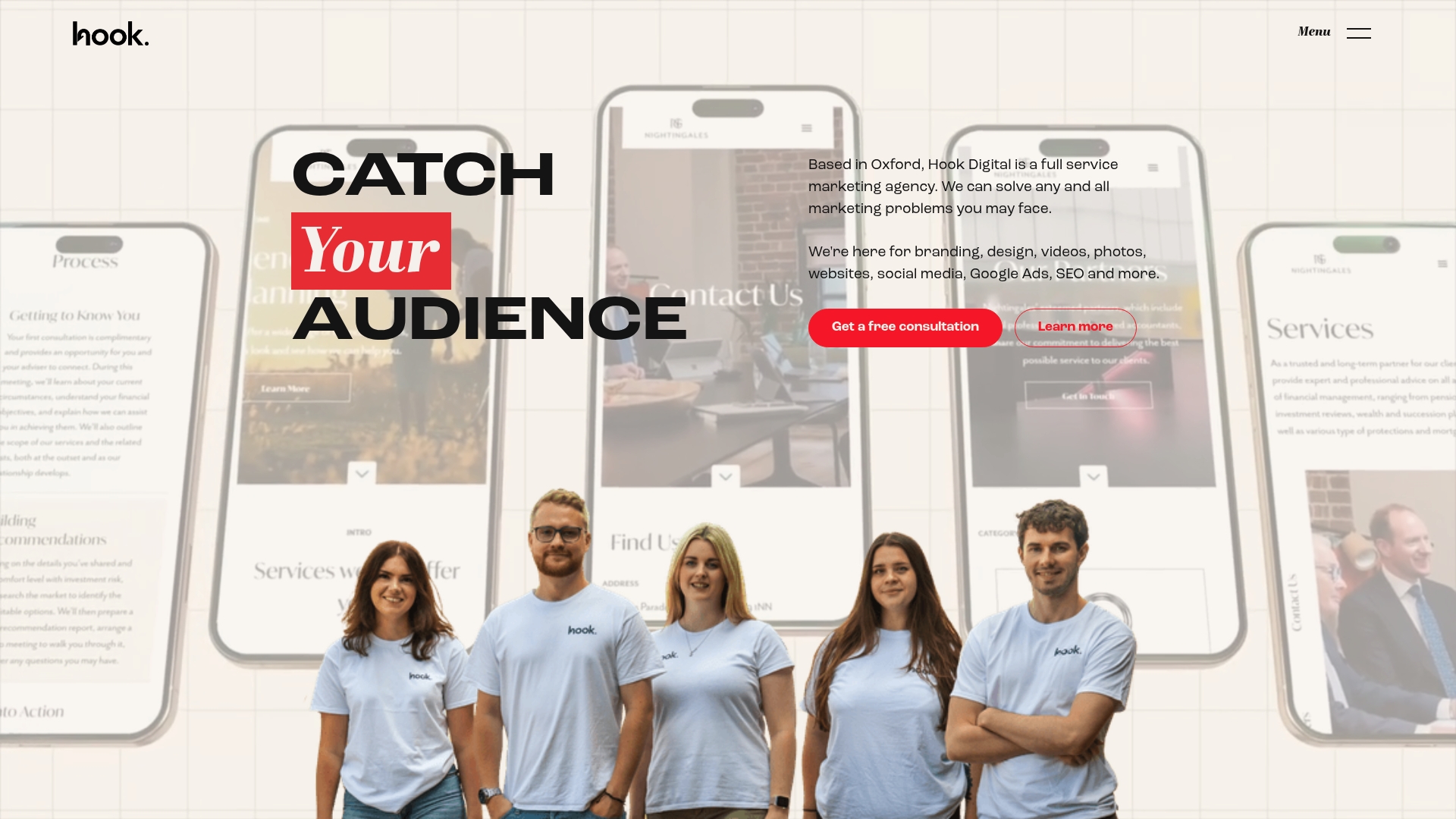
Hook-digital is a full service marketing agency based in Oxford, built so you only have to talk to one team. Whether you need branding and design, a new website, social media management, Google Ads, SEO, or video production, we handle it all under one roof.
You will not spend your time chasing five different agencies for updates or trying to reconcile five different reports. You get one team, one strategy, and one clear view of your results. If you are ready to find out what an integrated approach could do for your business, book a free consultation and we will map out exactly where to start. No pressure, no jargon. Just a straight conversation about your marketing.
FAQ
What is a full service agency in simple terms?
A full service agency is a marketing partner that handles multiple disciplines, including strategy, creative, SEO, paid media, social media, and analytics, within a single team. You work with one agency rather than coordinating several specialists.
What services do full service agencies typically offer?
Full service agencies provide brand strategy, creative development, content marketing, SEO, paid media, social media management, web design, PR, and performance reporting. The exact mix varies by agency, so always confirm which services are delivered in-house.
When should i choose a full service agency over a specialist?
A full service agency suits businesses that need multiple channels working together and lack the internal resource to manage separate agencies. If one channel dominates your growth and you have internal support for everything else, a specialist agency may deliver greater depth.
How do i know if an agency is genuinely full service?
Ask for a breakdown of which services are in-house versus outsourced, and ask who is accountable for business outcomes. The full service label alone is not sufficient. The operational model and team structure reveal the true scope of their capabilities.
How much does a full service agency typically cost?
Pricing varies widely depending on the services included, the agency’s size, and your business needs. Most full service agencies offer retainer-based pricing. Hook-digital publishes transparent service pricing so you can assess fit before committing to a conversation.
Recommended
- What is Full Service Digital Marketing? | Hook Digital - Oxford’s Premier Full-Service Marketing Agency
- Full Service Marketing Agency Oxford | End-to-End Strategy | Hook Digital
- Pricing | Hook Digital - Affordable Marketing Services in Oxford
- Free Marketing Consultation | Hook Digital - Book Your Strategy Call
.png)


