

.webp)

.svg)
What is a marketing strategy? A clear guide for businesses

A marketing strategy is a documented, long-term plan that defines how a business reaches and engages its target audience to achieve growth. It is the foundational compass that directs every marketing decision you make, from brand positioning to channel selection. Businesses that plan marketing in advance consistently outperform those running disconnected campaigns. A well-built strategy aligns your business objectives with your audience’s needs, your unique value proposition, and your market positioning. Without it, even generous budgets get wasted on tactics that pull in different directions.
What is a marketing strategy and why does it matter?
A marketing strategy is defined as the high-level framework that answers why your business markets itself and what it is trying to achieve. The industry also refers to this as your “go-to-market positioning framework,” though “marketing strategy” is the term most widely used in practice. It sits above everything else: above your campaigns, above your content calendar, and above your channel choices.
Documented marketing strategies prevent scattered experiments that waste budget and fail to move the needle. That matters because without a formal strategy, businesses cannot fully exploit their marketing resources, and stagnation follows. A strategy also builds brand equity and sustainable customer connections that competitors find hard to copy. That kind of advantage compounds over time in a way that one-off campaigns simply cannot replicate.

Think of your marketing strategy as the blueprint for a building. Your campaigns and social posts are the bricks. Without the blueprint, you end up with a pile of bricks rather than a structure that stands.
What are the essential components of an effective marketing strategy?
An effective marketing strategy contains six core components. Each one builds on the last, so skipping any of them creates gaps that show up later as wasted spend or missed targets.
- Clear business objectives. Your marketing goals must connect directly to your wider business goals, whether that is growing revenue, entering a new market, or retaining existing customers.
- Target audience segmentation and buyer personas. Segmentation divides your market by demographics, behaviour, or need. Buyer personas give those segments a human face, making it easier to write messaging that resonates.
- Unique value proposition (UVP). Your UVP states clearly why a customer should choose you over anyone else. It is the single most important sentence in your strategy. Getting this right before anything else is non-negotiable. Strong branding starts here.
- Marketing mix (the 5 Ps). Product, Price, Place, Promotion, and People form the 5 Ps framework. Essential components of a marketing strategy include this mix alongside buyer personas and KPIs to measure return on investment.
- KPIs and measurement metrics. Key performance indicators tell you whether the strategy is working. Common examples include cost per acquisition, customer lifetime value, and organic search traffic growth.
- Environmental scanning. This is a continuous, broad evaluation of external factors such as technological shifts, economic changes, and regulations that could affect your strategy. Environmental scanning differs from market research by examining broader trends beyond your immediate customer base.
Pro Tip: Write your UVP before you choose a single marketing channel. If you cannot state clearly who you serve and why they should care, no channel will perform well for you.
How does a marketing strategy differ from a marketing plan and a marketing campaign?
These three terms get used interchangeably, but they describe very different things. Mixing them up leads to poor resource allocation and confused teams.
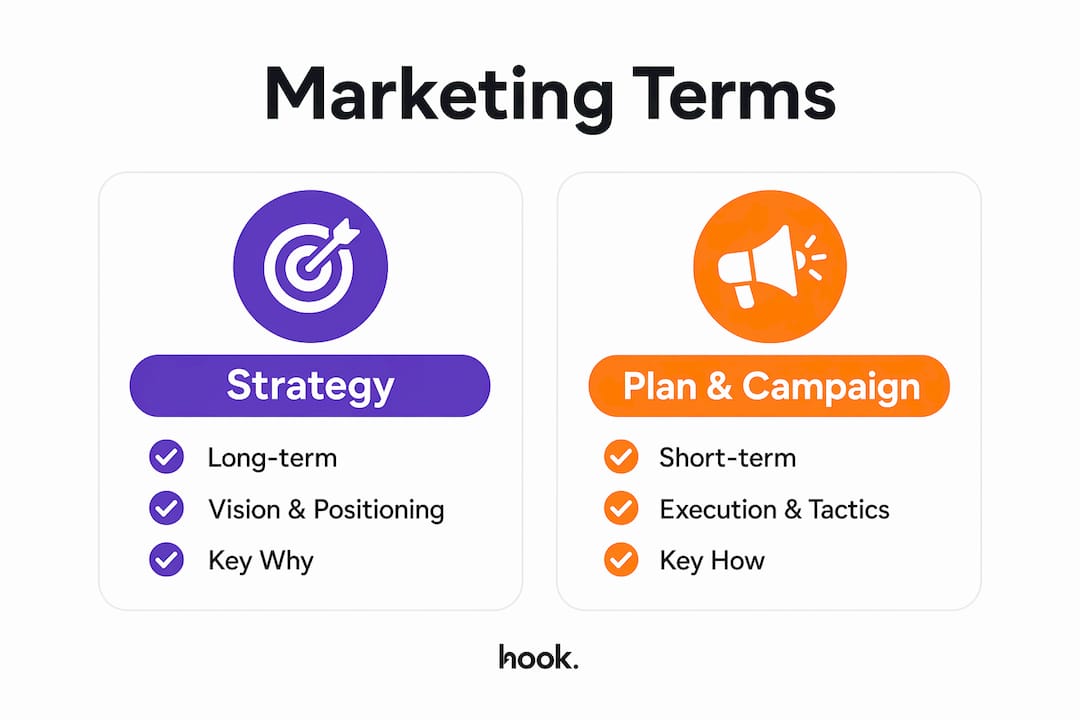
A marketing strategy defines the “why” and “what”: your long-term vision, your positioning, and your target audience. A marketing plan is the “how” and “when”: it translates the strategy into specific timelines, budgets, and responsibilities. A marketing campaign is a time-bound initiative targeting a single concrete objective, such as launching a product or promoting a seasonal offer. Campaigns sit inside plans, and plans sit inside the strategy.
| Element | Focus | Time horizon | Key question answered |
|---|---|---|---|
| Marketing strategy | Vision and positioning | Long term (1–3 years) | Why are we marketing and to whom? |
| Marketing plan | Tactics and timelines | Medium term (annual) | How and when will we execute? |
| Marketing campaign | Single objective | Short term (weeks to months) | What specific result do we want right now? |
A useful analogy: the strategy is the destination, the plan is the route, and each campaign is a single leg of the journey. Confusing a campaign with a strategy is like mistaking one motorway junction for the whole road trip.
Businesses often confuse business plans with marketing strategies too. A business plan covers overall company structure and operations. A marketing strategy focuses specifically on reaching and engaging customers. Keeping these separate helps you allocate resources with much greater clarity.
Pro Tip: When someone asks you to “run a campaign,” ask first whether a strategy and plan are already in place. Campaigns without strategy are expensive guesses.
How to create a marketing strategy that actually works
Building a marketing strategy is not a one-afternoon exercise. It requires honest research, clear thinking, and a willingness to challenge your assumptions. Follow these steps in order.
-
Conduct a market and competitive analysis. Gather data on your market size, customer segments, and the external environment. Use environmental scanning to identify technological, economic, and regulatory trends that could affect your position over the next 12–24 months.
-
Define your business goals and marketing objectives. Start with where the business needs to go. Then set marketing objectives that directly support those goals. Vague goals produce vague results. “Increase brand awareness” is not an objective. “Grow organic website traffic by 30% within 12 months” is.
-
Develop detailed buyer personas. Base these on real data: customer interviews, sales team feedback, and website analytics. A persona built on assumptions is a liability. One built on evidence is an asset.
-
Craft your value proposition and positioning. Effective strategies begin with segmentation and positioning before channel selection. This is the step most businesses skip, and it is the reason their tactics feel scattered.
-
Choose your marketing channels and tactics. Only after completing steps 1–4 should you decide where to show up. Your audience research tells you which channels they use. Your budget tells you how many you can do well. Doing three channels well beats doing seven channels poorly.
-
Set measurable KPIs and build a review process. Assign a metric to every objective. Schedule a review date. A strategy without measurement is a wish list. Marketing can transform your business only when you track what is and is not working.
Pro Tip: Document your strategy in a single, shared file that your whole team can access. A strategy that lives only in someone’s head stops working the moment that person leaves the room.
How often should you review and update your marketing strategy?
A marketing strategy is a living document, not a one-time deliverable. Markets shift, customer behaviour changes, and new technologies emerge. A strategy written two years ago and never revisited is almost certainly out of date.
Marketing strategies should be reviewed every 6–12 months, or sooner if your core business goals change significantly. That review cadence keeps your positioning aligned with market realities rather than assumptions from a previous year. The risks of ignoring this are real:
- Outdated messaging that no longer resonates with your audience
- Channel investments in platforms your customers have moved away from
- Missed opportunities created by new technology or regulatory changes
- Competitive disadvantage as rivals adapt faster than you do
Environmental scanning makes these reviews more productive. By continuously monitoring external trends, you arrive at each review with evidence rather than guesswork. The review itself then becomes a refinement exercise rather than a full rebuild.
Key takeaways
A marketing strategy is the documented, long-term framework that aligns your business objectives with your audience’s needs, and every campaign, plan, and tactic must flow from it.
| Point | Details |
|---|---|
| Strategy before tactics | Define your audience and value proposition before selecting any marketing channel. |
| Three distinct layers | Strategy sets direction, the plan sets timelines, and campaigns deliver single objectives. |
| The 5 Ps framework | Product, Price, Place, Promotion, and People form the core of any marketing mix. |
| Review every 6–12 months | Treat your strategy as a living document and update it when goals or market conditions shift. |
| Measure everything | Assign a KPI to every objective so you can tell what is working and what needs to change. |
Why most businesses get their marketing strategy wrong
The most common mistake I see is businesses jumping straight to channel selection. They ask “should we be on Instagram or LinkedIn?” before they have answered “who exactly are we trying to reach and why should they care about us?” That ordering problem is the root cause of most wasted marketing spend.
A documented strategy forces you to answer the hard questions first. It makes you articulate your value proposition clearly, understand your audience deeply, and set goals that are actually measurable. Without that foundation, every campaign you run is built on sand.
The second mistake is treating the strategy as a document you write once and file away. Markets move. Customer expectations shift. What worked in 2023 may actively harm you in 2026. The businesses that win are the ones that treat their strategy as a framework they return to regularly, challenge honestly, and update with evidence.
The third mistake is confusing activity with progress. Running three campaigns a month feels productive. But if none of them connect to a clear strategic objective, you are generating noise rather than results. Strategy is what turns activity into momentum.
— Hook
How Hook-digital can help you build a strategy that works
A clear marketing strategy is the difference between marketing that builds your business and marketing that burns your budget. Hook-digital is a full-service marketing agency based in Oxford, and we work with business owners who want both the strategy and the execution handled in one place.

From branding and design to SEO, Google Ads, social media, and web development, Hook-digital covers every element that a strong marketing strategy requires. You get one team, one point of contact, and a joined-up approach that keeps your messaging consistent across every channel. If you are ready to build a strategy that actually moves your business forward, get in touch with Hook-digital today.
FAQ
What is a marketing strategy in simple terms?
A marketing strategy is a documented plan that defines who your business is targeting, what you are offering them, and how you will reach them to achieve your long-term business goals.
What is the difference between a marketing strategy and a marketing plan?
A marketing strategy sets the long-term direction and positioning, while a marketing plan translates that direction into specific tactics, timelines, and budgets for execution.
What is a marketing campaign?
A marketing campaign is a time-bound initiative designed to achieve a single, specific objective, such as a product launch or a seasonal promotion. It sits within the broader marketing plan and strategy.
What makes a good marketing strategy?
A good marketing strategy includes clear business objectives, detailed buyer personas, a compelling value proposition, a defined marketing mix using the 5 Ps, and measurable KPIs that are reviewed regularly.
How often should a marketing strategy be updated?
Marketing strategies should be reviewed every 6–12 months, or whenever significant changes occur in your business goals, competitive environment, or customer behaviour.
Recommended
- How Marketing Can Transform Your Business | Hook Digital - Oxford’s Premier Full-Service Marketing Agency
- What is digital marketing? a guide for business owners | Hook Digital - Oxford’s Premier Full-Service Marketing Agency
- Develop a social media strategy that actually works | Hook Digital - Oxford’s Premier Full-Service Marketing Agency
- Why Your Website Is the Heart of Your Marketing Strategy | Hook Digital - Oxford’s Premier Full-Service Marketing Agency
.png)


