
.webp)

.svg)
Brand identity explained: a practical guide for businesses

Brand identity is the set of deliberate, recognisable elements — visual, verbal and experiential — that a business uses to shape how customers perceive it. Think of it as the personality your business wears every day, expressed through everything from your logo to the way your team answers the phone. Harvard Business School describes it as the collection of visible, tangible and symbolic elements a company uses to shape customer perception and experience.
Three quick clarifiers to make that concrete:
- Visual: your logo, colour palette, typography and imagery — the things people see
- Verbal: your brand name, tagline, tone of voice and key messages — the things people read and hear
- Experiential: your customer service style, packaging, website feel and in-store atmosphere — the things people feel when they interact with you
Table of Contents
- What does brand identity actually include?
- How does brand identity differ from brand image and brand equity?
- Why a clear brand identity matters for your business
- What are the core elements of brand identity?
- How do you build a brand identity from scratch?
- UK brand examples and the lessons they offer
- Your copy-ready brand brief and rollout checklist
- Key takeaways
- When should you hire an agency, and when can you do it yourself?
- Hook-digital’s branding and design services
- Useful sources
- FAQ
What does brand identity actually include?
Brand identity goes well beyond a logo. It is the full system of deliberate choices that, taken together, tell the world what your business stands for. NielsenIQ positions it as the “moment of truth” where strategy and market research become tangible assets — the point where your positioning becomes something customers can actually see, hear and touch.
The major categories break down like this:
- Visual identity: logo (all versions), colour palette (with exact hex or Pantone codes), typography (primary and secondary typefaces), photography style and illustration guidelines
- Verbal identity: brand name, tagline, tone of voice, key messages, naming conventions for products and services
- Sensory and experiential: packaging design, scent, sound (jingles or audio branding), in-store or on-site atmosphere
- Behavioural: how staff communicate, complaint-handling style, response times, customer service scripts
- System and process: brand guidelines document, asset library, approval workflows, templates for recurring materials
Each category feeds the others. A warm, conversational tone of voice will feel inconsistent if your visual identity is cold and corporate — so the whole system needs to pull in the same direction.
How does brand identity differ from brand image and brand equity?
These three terms get mixed up constantly, and the confusion costs businesses real money. Here is the clearest way to separate them.
Brand identity is what you put out. It is the deliberate set of assets and messages you design and control. Brand image is what the public takes in — the perception that forms in customers’ minds as a result of every interaction they have with you. Brand equity is the measurable value that perception creates: the premium customers will pay, the loyalty they show, and the financial worth attributed to the brand itself.
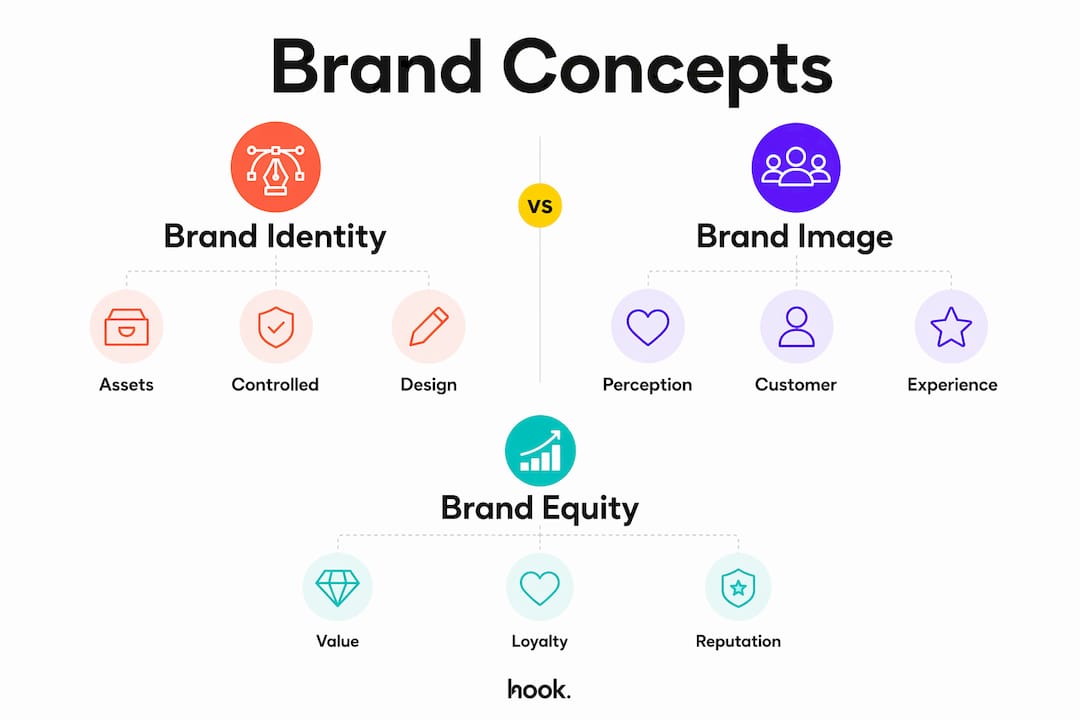
The relationship runs in one direction: identity shapes experience, experience shapes image, image builds (or erodes) equity. Get the identity wrong and the whole chain suffers.
| Term | What it is | Who controls it | How you measure it |
|---|---|---|---|
| Brand identity | The deliberate assets and messages you create | You (the business) | Brand audits, consistency scores |
| Brand image | Public perception of your brand | Customers and the market | Surveys, sentiment analysis, NPS |
| Brand equity | The financial and strategic value of that perception | Market forces | Brand valuation, price premium, loyalty data |
A practical formula to keep in mind: identity → experience → image → equity. Every decision you make about your identity is, ultimately, a decision about your long-term business value.
Why a clear brand identity matters for your business
A well-built identity does several things at once, and most of them affect your bottom line directly.
- Recognition: consistent visual and verbal cues make your business easier to spot and remember across channels — social media, packaging, email, and in person
- Differentiation: in crowded markets, a distinct identity is often the only thing separating you from a competitor with a similar product or price point
- Trust: Investopedia notes that a brand identity can be a strategic asset that affects the bottom line, precisely because consistent presentation builds the credibility customers need before they buy
- Marketing efficiency: when your identity is clearly defined, every piece of content, every ad, and every campaign starts from a shared foundation — reducing briefing time and rework
- Employee alignment: a clear identity gives your team a shared sense of purpose and makes it easier to hire people who fit the culture
There is also a subtler benefit. A coherent identity reduces friction at every touchpoint. When your website, your social posts, your invoices and your packaging all feel like they come from the same place, customers do not have to work to trust you. That ease of recognition is worth building into your business strategy from day one.
What are the core elements of brand identity?
Understanding the components in detail is what separates a brand that looks polished from one that just has a nice logo. Here is a practical breakdown, grouped by category, with the decisions and deliverables to request when briefing a designer or agency.

Visual elements
Logo: you need at least three versions — primary (full colour), reversed (white on dark), and a simplified mark or icon for small applications. Specify file formats (SVG, PNG, EPS) and minimum size rules.
Colour palette: a primary colour, one or two secondary colours, and a neutral. Always specify hex codes for digital use and Pantone references for print. Colour does more work than most people realise — it triggers associations before a word is read.
Typography: a primary typeface for headlines and a secondary for body copy. Request the actual font files or licences, not just the name. Specify size ratios and line-spacing rules.
Imagery and photography: define the style (candid vs. staged, bright vs. muted, people-led vs. product-led) and provide reference images. This is often overlooked in briefs and leads to inconsistency later.
Verbal elements
Tone of voice: three to five adjectives that describe how your brand sounds, plus examples of on-brand and off-brand copy. The American Marketing Association recommends turning brand personality into clear content standards the whole team can follow.
Tagline and key messages: a short, memorable line that captures your positioning, plus two or three supporting messages for different audiences or channels.
Naming conventions: how you refer to your products, services and internal teams in public-facing materials.
Experiential elements
Packaging and physical touchpoints: if you sell physical products, packaging is often the most powerful brand moment. Specify materials, finishes and structural requirements alongside visual guidelines.
Customer experience cues: response time standards, greeting scripts, complaint-handling tone. These are brand identity elements that most small businesses never write down — and then wonder why the experience feels inconsistent.

Pro Tip: Before you brief a designer, write down your audience, your positioning and your three core values. Every visual and verbal choice should be traceable back to those three things. Without that foundation, you end up with a logo that looks good but says nothing.
How do you build a brand identity from scratch?
The process has five stages. Each one produces something tangible you can hand to the next person in the chain.
-
Discover: research your audience, competitors and market position. Deliverables: audience personas, competitor audit, positioning gaps report. Timeline: a few weeks. Rough cost for a UK small business using an agency varies depending on scope and complexity.
-
Strategy: define your mission, values, positioning statement and personality. Deliverables: brand strategy document, positioning statement, tone of voice principles. Timeline: a few weeks. Cost varies by project scope and agency.
-
Design: create the visual system (logo, colour, typography, imagery guidelines). Deliverables: logo suite, brand style guide, core templates. Timeline: several weeks. Cost depends on business size and complexity of needs.
-
Rollout: apply the identity across all touchpoints — website, social profiles, email signatures, printed materials, signage. Deliverables: updated digital assets, print-ready files, rollout checklist. Timeline: 2–4 weeks. Cost varies widely depending on the number of channels.
-
Governance: put systems in place to protect consistency. Deliverables: brand guidelines (accessible to all staff), asset library, approval workflow for new materials. Ongoing.
A few governance essentials worth noting:
- Store master files in a shared, version-controlled location (Google Drive, Dropbox, or a dedicated digital asset management tool)
- Create a simple approval process for any new external-facing material
- Schedule a quarterly brand audit to catch drift before it becomes a problem
- For UK businesses, consider registering your brand name and logo as a trade mark with the Intellectual Property Office. It is worth consulting a solicitor before filing if your name is in a competitive category
Pro Tip: Consistency across apparently minor touchpoints — email signatures, receipts, out-of-office messages — is what separates brands that feel polished from those that feel patchy. Write it into your guidelines, not just your instincts.
UK brand examples and the lessons they offer
Real examples make abstract principles stick. Here are three UK-relevant snapshots.
-
Innocent Drinks built its identity on a conversational, slightly playful tone of voice that extended from packaging copy to social media to job adverts. The lesson: verbal identity is not just a tagline — it is every word your brand publishes, and consistency across those words compounds over time.
-
Monzo used a distinctive coral card colour and a clear, jargon-free tone to differentiate itself in a sector (banking) where most brands defaulted to navy and formality. The lesson: a single bold visual choice, applied consistently, can do more for recognition than a complex visual system applied inconsistently.
-
Brewdog (Scottish, but widely recognised across the UK) built early equity on a deliberately provocative verbal identity that attracted a specific audience and repelled others — by design. The lesson: a strong identity does not try to appeal to everyone. Knowing who you are not for is as useful as knowing who you are for.
For practical branding tips that build real trust, the principle across all three examples is the same: make a deliberate choice and apply it everywhere.
Your copy-ready brand brief and rollout checklist
Use this template as a starting point. Fill in each field before you brief a designer or agency.
| Field | What to include |
|---|---|
| Business purpose | One sentence: what you do and who you do it for |
| Target audience | Demographics, behaviours, key motivations |
| Positioning | How you are different from the alternatives |
| Brand personality | 3–5 adjectives; on-brand and off-brand examples |
| Key messages | Core message + 2–3 supporting messages by audience |
| Visual references | 3–5 brands whose look you admire (and why) |
| Mandatory assets | Logo, colour palette, typography, templates needed |
| Channels | Where the identity will be applied (web, print, social, etc.) |
| Timeline and budget | Realistic dates and cost range |
Pre-rollout checklist:
- [ ] All logo versions exported in correct formats and stored centrally
- [ ] Colour codes and font files documented in the brand guidelines
- [ ] Website updated to reflect new identity (favicon, fonts, colours, imagery)
- [ ] Social media profiles updated (profile images, cover photos, bios)
- [ ] Email signatures updated across the team
- [ ] Printed materials (business cards, letterheads) reprinted or scheduled
- [ ] Accessibility checked: colour contrast meets WCAG 2.1 AA standard
- [ ] Trade mark status confirmed or application filed with the IPO
- [ ] Team briefed on tone of voice and key messages
- [ ] Baseline metrics recorded (brand awareness survey, website traffic, social engagement) so you can measure change
Pro Tip: Record your baseline metrics before you launch. Without a before-and-after comparison, you cannot tell whether your new identity is moving the needle — and you will not know which elements to adjust.
Key takeaways
A strong brand identity requires deliberate design, consistent application, and a governance system that protects it across every touchpoint.
| Point | Details |
|---|---|
| Define before you design | Strategy — audience, positioning, values — must come before any visual decisions. |
| Identity, image and equity are linked | Your identity shapes perception; perception builds the measurable value of your brand. |
| Consistency is the work | Applying identity across minor touchpoints (email signatures, receipts) is what protects brand equity over time. |
| Use the brief template | A completed brand brief reduces ambiguity, speeds up agency handoffs, and creates measurable checkpoints. |
| Hook-digital can help | Hook-digital’s Oxford-based team handles branding, design and rollout so you only need to talk to one agency. |
When should you hire an agency, and when can you do it yourself?
There is no universal answer here, and any agency that tells you otherwise is not being straight with you. The honest version is this: the right choice depends on your scale, your internal capability, and how much the outcome matters to your business.
For a sole trader or very early-stage business with a tight budget, a well-researched DIY approach using the brief template above can get you a workable identity. The risk is not incompetence — it is the gap between what you intend to communicate and what customers actually perceive. That gap is one of the most common pitfalls in brand work, and it is harder to spot from the inside.
Hire professional help when: you are entering a competitive market and differentiation is critical; you are rebranding an established business with existing customer expectations; you need research (audience interviews, competitor analysis) to inform the strategy; or you simply do not have the time to do it properly.
Do it in-house when: you are refreshing secondary materials (social templates, email signatures) within an existing system; your team includes a skilled designer who understands the strategy; or you are testing a new sub-brand before committing to a full build.
The middle path — doing the strategy yourself and hiring a specialist for the design execution — often delivers the best value for growing UK businesses.
Hook-digital’s branding and design services

Building a brand identity from scratch takes time, skill, and a clear process. Hook-digital is an Oxford-based full-service marketing agency that handles the whole build for you — from the initial discovery and strategy through to design, rollout across your website and social channels, and the governance systems that keep everything consistent. You get one team, one conversation, and no admin headache from coordinating multiple suppliers.
If you are ready to build something that genuinely reflects your business, see how Hook-digital approaches branding and design and get in touch to book a call.
Useful sources
- Harvard Business School — What Is Brand Identity?: a practitioner-focused explainer covering definition, components and common pitfalls; the primary academic source for this article.
- NielsenIQ — Brand Identity: covers the role of identity in quality control and consistent application across media and channels.
- Investopedia — Brand Identity: clear overview of identity as a strategic business asset with notes on measurement and equity.
- Shopify — What Is Brand Identity? 6 Key Elements: practical, process-oriented guide covering discovery, design and governance for small businesses.
- American Marketing Association — Branding: industry-standard resource on positioning, content standards and long-term brand management.
FAQ
What is brand identity in simple terms?
Brand identity is the deliberate set of visual, verbal and experiential elements a business designs to shape how customers perceive it — including the logo, colours, tone of voice and customer experience.
How is brand identity different from brand image?
Brand identity is what you create and control; brand image is the perception that forms in customers’ minds as a result of their interactions with you. You own the identity; the market owns the image.
How long does it take to build a brand identity?
For a UK small business working with an agency, the full process — from discovery through to rollout — typically takes six to ten weeks, depending on complexity and the number of channels involved.
Can Hook-digital help with brand identity?
Yes. Hook-digital’s Oxford-based team covers the full process: strategy, design, website build and rollout across digital channels, all under one roof.
How do you measure whether a brand identity is working?
Record baseline metrics before launch — brand awareness surveys, website traffic, social engagement — then track changes periodically. Qualitative customer feedback and net promoter scores are also useful early signals.
Recommended
- Why Branding is Crucial for Your Business | Hook Digital - Oxford’s Premier Full-Service Marketing Agency
- Why branding is important for business growth | Hook Digital - Oxford’s Premier Full-Service Marketing Agency
- A Practical Guide for Businesses and Brands Considering Google Ads | Hook Digital - Oxford’s Premier Full-Service Marketing Agency
- What Are the Most Important Elements of Branding? | Hook Digital - Oxford’s Premier Full-Service Marketing Agency
.png)


