

.webp)

.svg)
What is content marketing? A guide for business owners
Content marketing is defined as the strategic creation and distribution of valuable, relevant, and consistent content to attract, engage, and retain a clearly defined audience. Unlike traditional advertising, it builds trust before asking for a sale. The goal is not to interrupt your audience with a pitch but to earn their attention by giving them something genuinely useful. For business owners and marketing professionals, understanding this distinction is the foundation of any effective long-term brand strategy.
What is content marketing and why does it matter?
Content marketing is a pull strategy that connects with audiences by delivering value before asking for anything in return. Traditional advertising pushes a message at people whether they want it or not. Content marketing draws people in by answering their questions, solving their problems, or entertaining them. The result is an audience that comes to you, rather than one you have to chase.
The importance of this approach lies in what it builds over time. Every blog post, video, or guide you publish becomes a permanent asset that continues working for your business long after it goes live. Content marketing builds a cumulative asset that attracts traffic and leads over time, unlike paid advertising, which stops delivering results the moment your budget runs out. That is a fundamentally different relationship with your marketing spend.

For business owners, the practical implication is clear. Content marketing is not a quick win. It is a long-term investment in your brand’s credibility and visibility, and the returns compound the longer you commit to it.
What are the primary types of content marketing formats?
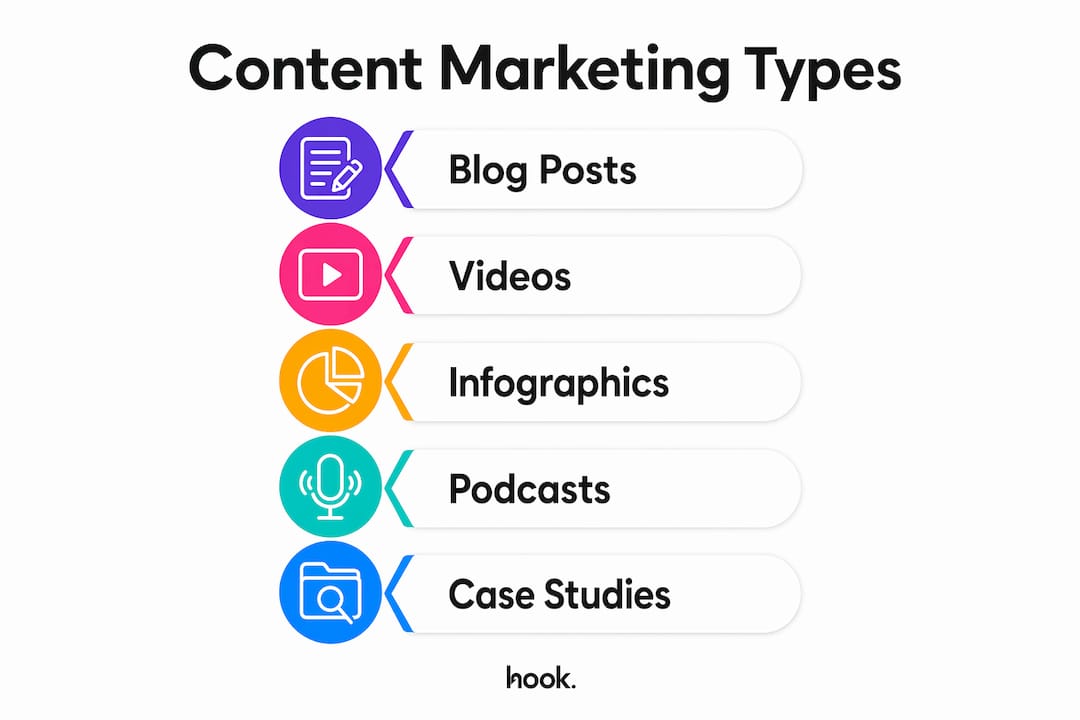
Over 15 primary content formats exist within content marketing, each suited to specific goals. Choosing the right format depends on your audience, your business objectives, and where your customers spend their time.
| Format | Primary purpose |
|---|---|
| Blog posts | SEO, education, and organic traffic |
| Videos | Storytelling, product demos, and brand awareness |
| Infographics | Simplifying complex data for quick consumption |
| Case studies | Building credibility and demonstrating results |
| Whitepapers | Lead generation and in-depth thought leadership |
| Podcasts | Building community and long-form engagement |
| Webinars | Lead qualification and live audience interaction |
| User-generated content | Social proof and community trust |
Each format serves a different stage of the buyer journey. Blog posts tend to attract people at the awareness stage, when they are searching for answers. Case studies and whitepapers work better for prospects who are already considering a purchase and need proof. Videos sit comfortably across all stages, from sparking curiosity to closing a sale.
The most effective content marketing strategies blend multiple formats across multiple channels, including social media, email, and your website. A single idea can become a blog post, a short video, an infographic, and a social media series. That kind of multi-channel thinking stretches your content further and reaches more of your audience.
Pro Tip: Start with one or two formats you can produce consistently, then expand. A well-maintained blog outperforms a neglected podcast every time.
How does the content marketing cycle work?
Content marketing operates as a continuous cycle of research, creation, distribution, measurement, and refinement. It is not a one-off campaign. It is an ongoing engine that builds momentum over time.
- Audience research. Understand who your audience is, what questions they ask, and what problems they need solved. This shapes every content decision that follows.
- Content creation. Produce content that directly addresses those needs. Quality and relevance matter more than volume.
- Distribution. Publish across the channels your audience actually uses. That might be LinkedIn, email newsletters, your website, or YouTube.
- Performance tracking. Monitor metrics like time on page, engagement rate, and conversion rate to understand what is working.
- Refinement. Use what you learn to improve existing content and inform future topics.
Post-publishing analysis of metrics like time on page and conversion rates is the most critical phase of the cycle. Many businesses skip this step and wonder why their content does not perform. The data tells you exactly what to fix.
A full-funnel mindset is also necessary here. Content aimed at awareness looks different from content aimed at conversion. Tailoring your output to each stage of the buyer journey is what separates a content strategy from a content calendar.
Pro Tip: Review your top-performing content every quarter. Updating and republishing strong articles is often faster and more effective than writing new ones from scratch.
How does content marketing differ from traditional advertising?
The clearest way to understand content marketing is to compare it with what it is not. Traditional advertising is a push strategy. You pay to place a message in front of people, whether they want to see it or not. Content marketing is the opposite. You create something worth finding, and people come to you.
| Dimension | Content marketing | Traditional advertising |
|---|---|---|
| Approach | Pull: audience seeks you out | Push: message is placed in front of audience |
| Primary goal | Build trust and long-term relationships | Drive immediate awareness or sales |
| Longevity | Assets compound in value over time | Stops working when budget stops |
| Tone | Educational, helpful, or entertaining | Promotional and sales-focused |
| Cost model | Higher upfront, lower long-term | Ongoing spend required |
Content marketing prioritises building customer relationships and brand loyalty, focusing on value delivery before sales. This is not just a philosophical difference. It has real commercial consequences. A business that has built a library of trusted content has an audience that returns, shares, and converts without needing to be paid for every visit.
Traditional advertising still has its place, particularly for launching new products or reaching cold audiences quickly. But it works best when paired with content that gives people a reason to trust you once they arrive. The two approaches are not mutually exclusive. They are most powerful when used together.
How can businesses implement content marketing effectively?
Effective implementation starts with clarity. You need to know what your business goals are, who your audience is, and what problems your content will solve for them. Without that foundation, even well-produced content misses the mark.
- Align content with business goals. Every piece of content should serve a purpose, whether that is generating leads, building brand awareness, or retaining existing customers.
- Prioritise quality over quantity. One well-researched, genuinely useful article outperforms ten thin posts every time.
- Be consistent. A publishing schedule you can maintain beats an ambitious one you abandon after six weeks.
- Distribute across multiple channels. Multi-channel distribution across social media, email, and websites gives content the best chance of reaching your audience.
- Invest in the right skills. Effective content marketing requires people who combine creativity with data-driven decision-making. That means writers, designers, analysts, and strategists working together.
The most common pitfall is treating content marketing as a short-term tactic. Businesses often publish consistently for two months, see limited results, and stop. Content marketing rewards patience. The businesses that commit to it for 12 months or more are the ones that see compounding returns in organic traffic, leads, and brand recognition.
You can learn more about managing content challenges and how to keep your marketing output consistent without burning out your team.
Pro Tip: Map every piece of content to a specific stage of the buyer journey before you create it. If you cannot explain who it is for and what it should make them do next, it is not ready to publish.
Key takeaways
Content marketing builds lasting brand value by consistently delivering useful content that earns audience trust, generates leads, and compounds in impact over time.
| Point | Details |
|---|---|
| Definition of content marketing | It is the strategic creation and sharing of valuable content to attract and retain a defined audience. |
| Format selection matters | Choose formats based on your goals: blogs for SEO, videos for storytelling, case studies for credibility. |
| It is a long-term investment | Unlike paid ads, content assets grow in value over time and keep working after publication. |
| The cycle never stops | Research, create, distribute, measure, and refine. Skipping the analysis phase wastes the effort of the rest. |
| Consistency beats volume | A reliable publishing schedule and high-quality output outperform bursts of thin content every time. |
Why most businesses misunderstand content marketing
The most persistent misunderstanding I see is that businesses treat content marketing as a department, not a discipline. They hire one person, give them a blog to manage, and expect leads to follow. That is not content marketing. That is content production without strategy.
Real content marketing is woven into how a business thinks about its audience. It asks: what does our customer need to know before they trust us enough to buy? Then it answers that question, repeatedly, across every channel and format that reaches them. The businesses I have seen get this right are not the ones with the biggest budgets. They are the ones with the clearest point of view and the patience to express it consistently.
The other thing that gets overlooked is the relationship between branding and content. Content without a strong brand identity is forgettable. Your visual style, tone of voice, and values need to show up in every piece you publish. Otherwise, you are just adding to the noise.
If I had one piece of advice for a business owner starting out with content marketing, it would be this: pick one channel, commit to it for six months, and measure everything. You will learn more from that than from any guide.
— Hook
How Hook-digital can support your content marketing
Building a content marketing engine takes more than good ideas. It takes strong visuals, compelling video, and a brand identity that makes every piece of content instantly recognisable.

Hook-digital is a full-service marketing agency based in Oxford, and we handle the full picture. From branding and design that gives your content a consistent, professional identity, to video production that brings your brand story to life, we work across every format your content strategy needs. You only need to talk to one agency, and we take care of the rest. Get in touch with Hook-digital to find out how we can help you build a content presence that actually grows your business.
FAQ
What is the definition of content marketing?
Content marketing is the strategic creation and distribution of valuable, relevant, and consistent content to attract and retain a clearly defined audience. Its goal is to build trust and long-term relationships rather than make an immediate sale.
How does content marketing differ from advertising?
Content marketing is a pull strategy that draws audiences in with useful or entertaining material. Traditional advertising is a push strategy that places promotional messages in front of people regardless of their interest.
What are the most common types of content marketing formats?
The most widely used formats include blog posts, videos, infographics, case studies, whitepapers, podcasts, webinars, and user-generated content. Each format serves a different stage of the buyer journey and a different business goal.
How long does content marketing take to show results?
Content marketing is a long-term investment. Most businesses begin to see meaningful results after six to twelve months of consistent effort, as content assets accumulate and search visibility grows.
Do small businesses benefit from content marketing?
Content marketing is particularly well-suited to small businesses because it builds organic visibility without requiring a large ongoing advertising budget. Consistent, quality content compounds in value over time and continues attracting leads long after it is published.
Recommended
- What is digital marketing? a guide for business owners | Hook Digital - Oxford’s Premier Full-Service Marketing Agency
- A Practical Guide for Businesses and Brands Considering Google Ads | Hook Digital - Oxford’s Premier Full-Service Marketing Agency
- How Can Businesses Use Social Media for Marketing | Hook Digital - Oxford’s Premier Full-Service Marketing Agency
- How Marketing Can Transform Your Business | Hook Digital - Oxford’s Premier Full-Service Marketing Agency
.png)


