

.webp)

.svg)
What is paid search, and how does it work for your business?
Paid search is advertising you buy on search engines like Google, so your business appears above organic results when someone searches a relevant term. Most advertisers pay through a pay-per-click (PPC) model, meaning you’re charged only when someone clicks your ad, not simply for it being seen.
The immediate benefit is guaranteed visibility for the exact keywords your customers are typing. You don’t wait months for rankings to climb. You bid, you set a budget, and your ad can appear within hours.
Here’s why business owners lean on it:
- Instant placement on page one for chosen search terms
- Spend is controlled and measurable, down to the pound per click (CPC)
- Works alongside slower organic strategies rather than replacing them
We’ll walk through the auction mechanics, bidding strategy, and a full setup checklist later. First, let’s cover exactly what paid search includes.
Key Takeaways
Paid search wins on speed and control, but it only pays off when Ad Rank, Quality Score, and conversion tracking are managed together, not treated as separate boxes to tick.
| Point | Details |
|---|---|
| Paid search means PPC ads | You pay per click on search results, with cost driven by Ad Rank rather than bid alone. |
| Quality Score lowers cost | Better ad relevance and landing pages can cut your actual CPC well below your maximum bid. |
| Start bidding manually if data is thin | Switch to Smart Bidding strategies like Target CPA once conversion volume is steady. |
| Track conversions, not clicks | CPA and ROAS reveal real performance; clicks alone can mask wasted spend. |
| Pair paid search with SEO | Running both together lifts combined click-through rate beyond either channel alone. |
| Hook Digital manages end to end | Google Ads, landing pages, and tracking are handled together from onboarding through monthly reporting. |
Table of Contents
- What does paid search cover: ad types and formats?
- How does the paid search auction actually work?
- Setting up a search campaign: a practical checklist
- Manual CPC or Smart Bidding: which strategy fits your budget?
- Which KPIs actually tell you if paid search is working?
- Paid search or SEO: which one should you invest in first?
- How does an agency actually run a paid search account?
- Should you start paid search now, or wait?
- Hook Digital’s paid search services and next steps
- Sources
- FAQ
What does paid search cover: ad types and formats?
“Paid search” isn’t one product. It’s a family of ad formats that all share one trait: they appear because you paid for placement against a search query, not because an algorithm ranked you organically.
The main formats you’ll encounter:
- Search ads – text ads on the search engine results page, triggered by keywords you bid on
- Shopping ads – product listings with images and prices, pulled from a product feed, ideal for retailers
- Local ads – map-based placements that push nearby customers towards a physical location
- Call ads – mobile-only formats built around a phone number rather than a landing page
Payment models vary too, and mixing them up causes real budgeting mistakes. CPC (cost-per-click) charges per click and dominates search campaigns. CPM (cost-per-thousand-impressions) charges for visibility regardless of clicks, more common in display and video. CPA (cost-per-action) ties spend to a completed conversion, which some automated bidding strategies target directly.
Ad extensions (Google now calls many of these “assets”) add sitelinks, call buttons, prices, and location details to your ad, increasing its size on the page without extra bidding. A well-built ad with four sitelinks and a call extension can occupy triple the space of a plain text ad, for the same click cost.

How does the paid search auction actually work?
Every single search triggers a fresh auction. Nothing is booked in advance. When someone types a query, Google’s system instantly evaluates every advertiser bidding on that term (or a close match) and decides who appears, in what order, and what they’ll pay.
Three things shape the outcome:
- Your maximum bid — the ceiling you’ve set for that click
- Your Quality Score — Google’s assessment of expected click-through rate, ad relevance, and landing page experience
- Auction context — the searcher’s device, location, time of day, and even their search history
These combine into what Google calls Ad Rank, and it’s the real currency of paid search, not your bid alone. A £2 bid with excellent relevance and a fast, useful landing page can outrank a £4 bid attached to a generic ad and a slow website.
A £4 bidder with poor Quality Score can lose the top spot to a £2.50 bidder with strong relevance signals — this is the single most misunderstood fact about how paid search pricing works.
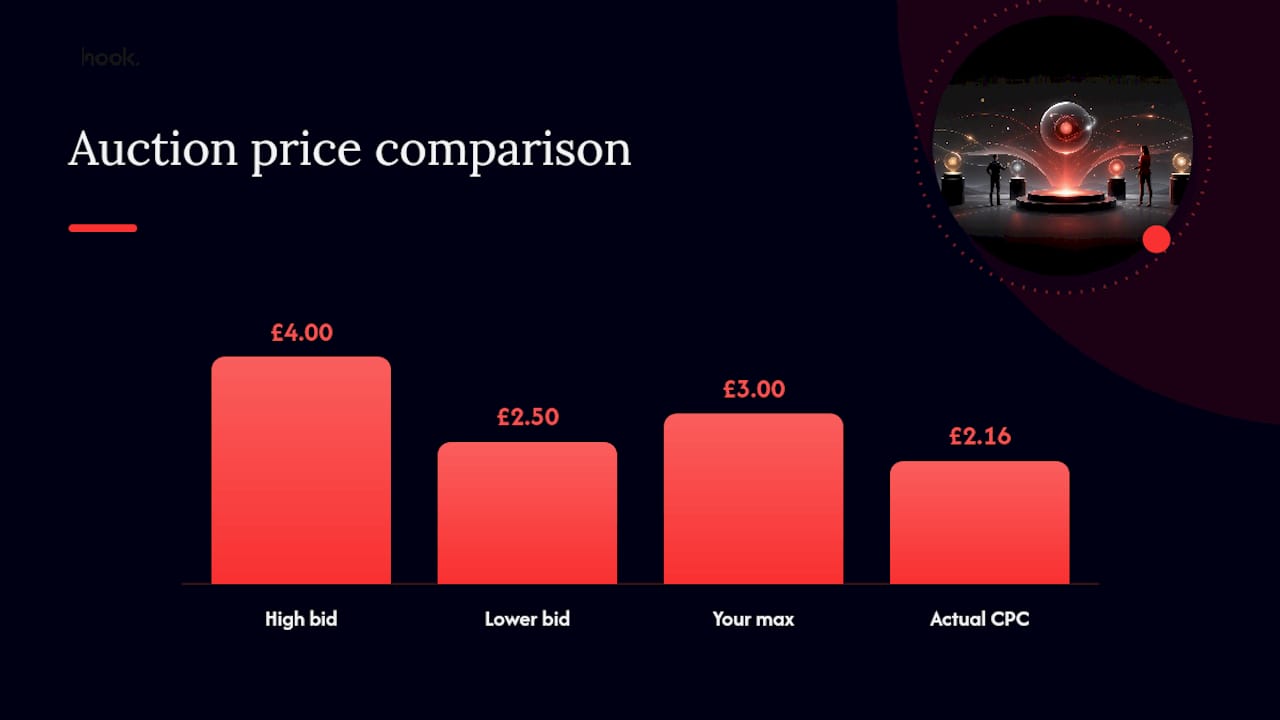
Here’s a simplified example. Say your max CPC is £3.00 and the advertiser ranked just below you has an Ad Rank that would need a bid of £2.15 to match yours. You typically won’t pay £3.00. Google charges just enough to beat that competitor, often landing your actual CPC around £2.16, a full 28% below your ceiling. This is why Quality Score improvements often lower your average cost per click rather than just improving your ranking position.
Setting up a search campaign: a practical checklist
Skipping steps here is where most first campaigns waste money. Work through this in order.
- Set one clear objective and KPI — leads, sales, or phone calls, not “more traffic”
- Define your geography, language, and ad schedule — don’t advertise nationally if you only serve three counties
- Research keywords and choose match types deliberately — phrase and exact match give tighter control than broad match early on
- Build tightly themed ad groups — one topic per group, with ad copy that mirrors the keywords inside it
- Align every ad with a matching landing page — sending search traffic to your homepage is a conversion killer
- Install conversion tracking before you spend a penny — you can’t optimise what you can’t measure
- Set an initial budget and bidding approach, then name campaigns consistently — future-you will thank present-you
Our own PPC advertising primer covers keyword research and match types in more depth if you want to go further before launch.
Pro Tip: Build a dedicated landing page for your top three ad groups rather than linking everything to one generic page. Even a simple headline swap that echoes the search term can lift conversion rates noticeably.
Manual CPC or Smart Bidding: which strategy fits your budget?
Bidding strategy decisions come down to one question: how much reliable conversion data do you have?
- Manual CPC gives full control over each keyword’s bid, useful when you’re just starting and have no conversion history to feed an algorithm
- Maximise Conversions hands bidding to Google’s system, aiming to get the most conversions from your budget
- Target CPA sets a cost-per-acquisition goal and lets Smart Bidding adjust bids in real time to hit it
- Target ROAS works the same way but optimises for revenue return, better suited to ecommerce with varied order values
Smart Bidding uses machine learning and auction-time signals, including device, location, and time of day, to set a unique bid for every auction. It performs best with steady conversion volume; feed it inconsistent or inaccurate data and it makes poor decisions. Accounts with fewer than roughly 30 conversions a month often do better starting manual, then switching once data builds.
Whichever you choose, expect a “learning phase” of a week or two after any major change, where performance can wobble while the system recalibrates. Avoid adjusting bids daily during this window.
Which KPIs actually tell you if paid search is working?
Clicks feel satisfying, but they’re rarely the metric that matters. For most campaigns, conversions, cost-per-acquisition (CPA), and return on ad spend (ROAS) tell you whether the money is working.
Build your measurement routine around these:
- Confirm conversion tracking fires correctly before trusting any report
- Review the search terms report weekly and add negative keywords to cut wasted spend
- Test two ad variations against each other continuously, not just once
- Run landing page tests alongside ad tests, since a better page often outperforms a better ad
- Report on CPA and ROAS monthly, not just clicks and impressions
Pro Tip: Set a recurring 20-minute slot every Monday just for the search terms report. Catching one irrelevant keyword early can save more budget than a week of bid tweaking.
Paid search or SEO: which one should you invest in first?
Paid search delivers visibility within hours. SEO can take months to show meaningful ranking movement, but the traffic it earns keeps arriving without ongoing spend. That’s the fundamental trade-off, and it shapes when each channel earns its place in your marketing plan.
Cost profiles differ sharply too. Paid search cost scales directly with clicks; SEO cost is mostly upfront content and technical work, with a longer payoff curve.
Running both together tends to outperform either alone. Search marketers have observed a “1+1=3” effect, where appearing in both paid and organic results on the same page lifts overall click-through rate beyond what either listing achieves solo, likely because dual presence signals credibility to the searcher.
Practical coordination matters more than picking a winner:
- Share keyword research between both teams to avoid duplicated effort
- Use paid search data to validate which landing pages convert before investing in SEO content around them
- Test headlines and offers in paid ads first, then apply the winners to organic content
Our guide on SEO’s role in demand generation covers how to sequence the two channels over a full year.
How does an agency actually run a paid search account?
A first-90-day plan should prioritise tracking accuracy, a small batch of high-intent keyword tests, one landing page A/B test, and a dashboard that ties clicks directly to leads or revenue, not just impressions.
Clients should expect weekly check-ins on spend pacing in month one, then a shift to monthly strategic reporting once the account stabilises. The real work is the ongoing refinement between those reports, not the reports themselves.
At Hook Digital, paid search rarely sits in isolation. Campaign performance depends heavily on landing page quality and creative that actually matches search intent, which is why we pair PPC management with web build work and design from day one. Expect ongoing keyword refinement and testing, not a “set it and walk away” account.
Common early milestones worth watching for:
- Tracking verified and firing correctly within week one
- First A/B test launched by week three or four
- Budget reallocated towards top-performing ad groups by month two
Should you start paid search now, or wait?
Three rules cut through most of the indecision. First, only start if you can commit to a budget that survives a genuine learning phase, not just a token trial. Second, don’t launch without a way to measure conversions. Third, make sure your product or service actually suits high-intent search demand.

If your budget is tight, start narrow: a handful of exact-match, high-intent keywords beats a broad campaign spread thin. The biggest mistake we see, whether run in-house or handed to an agency, is treating paid search as a one-off setup task rather than a channel that needs weekly attention.
Hook Digital’s paid search services and next steps
If you’ve read this far, you already understand more about paid search than most people who hire an agency. That’s exactly the point, because the businesses that get the most from Google Ads are the ones asking sharper questions from day one, not handing over a blank cheque and hoping.
Hook Digital manages Google Ads campaigns end to end from our Oxford base: keyword strategy, bid management, conversion tracking setup, and the landing pages those clicks actually land on. Ads without a fast, relevant landing page waste budget, which is why our website design and development service works hand in hand with every campaign we run, rather than as a separate add-on you have to coordinate yourself.
Onboarding follows the same 90-day structure outlined above: tracking verified first, test campaigns launched within weeks, then a dashboard reporting clicks against actual leads or sales, not vanity metrics. If you’re weighing up whether to run paid search in-house or bring in support, get in touch with our Oxford team for an account audit and a straight answer on where your budget would work hardest.
Sources
FAQ
What’s the difference between SEO and paid search?
Paid search gives immediate visibility through paid ads on results pages, while SEO builds organic rankings over time without ongoing per-click cost. The two work best run together rather than as alternatives.
Is paid search worth it for a small business?
It usually is, provided you have a converting landing page and can commit to at least a short learning phase. Small businesses often see solid results starting with a modest budget focused on narrow, high-intent keywords.
What are the disadvantages of paid search?
The main drawback is dependency on ongoing spend. Traffic and visibility stop the moment you pause your budget, unlike organic rankings that can persist without continued investment.
How much does Google paid search cost?
Cost varies enormously by industry and keyword competitiveness, and your actual CPC is often lower than your maximum bid because you only pay enough to beat the next competitor’s Ad Rank. There’s no fixed rate; it depends entirely on your market and Quality Score.
How does paid search bidding actually decide who wins?
Ad Rank combines your bid with quality signals like expected click-through rate, ad relevance, and landing page experience, meaning a lower bid with strong quality can beat a higher bid with weak signals.
Recommended
- PPC advertising explained for small business owners | Hook Digital - Oxford’s Premier Full-Service Marketing Agency
- Paid social advertising explained for business owners | Hook Digital - Oxford’s Premier Full-Service Marketing Agency
- Unlocking Success: The Benefits of PPC/Google Ads for Marketing Your Business | Hook Digital - Oxford’s Premier Full-Service Marketing Agency
- Meta Ads vs. Google Ads: Which One Is Right for Your Business? | Hook Digital - Oxford’s Premier Full-Service Marketing Agency
.png)


