

.webp)

.svg)
Why branding is important for business growth
Branding is the system through which a business becomes memorable, trusted, and easy to choose. Understanding why branding is important goes well beyond picking a logo or a colour palette. The Ehrenberg-Bass Institute defines branding as a mechanism for building two things simultaneously: mental availability, meaning the ability to be thought of in buying situations, and physical availability, meaning the ease with which customers can actually purchase from you. The 2026 Edelman Trust Barometer adds another layer, showing that value alignment now directly shapes whether customers engage with a brand at all. Together, these forces make branding one of the most practical levers a business owner can pull.
Why branding is important for customer trust
Trust is the single most measurable driver of purchase decisions. The 2026 Edelman Trust Barometer found that 70% of respondents hesitate to trust businesses whose values differ from their own. That figure tells you something direct: if your brand does not communicate its values clearly, a large share of potential customers will walk away before you even make your case.
Consistent branding reduces perceived risk. When a customer sees the same tone, visual identity, and message across your website, social media, and packaging, familiarity builds. Repeated, consistent brand signals accumulate trust over multiple interactions, converting hesitant browsers into paying customers. Think of how a business like a local accountancy firm with a clear, professional identity feels safer to approach than one with a patchy, inconsistent online presence.
The Edelman data also shows that 42% of respondents avoid investing in companies not aligned with their values. This is not a soft, feel-good metric. It is a hard purchasing barrier. Branding is the tool that signals your values before a customer ever speaks to your team.
“Brands inconsistent with customer values face increased engagement resistance before purchase.” — 2026 Edelman Trust Barometer
The role of branding in customer loyalty is therefore not just about repeat purchases. It is about removing the friction that stops first purchases from happening at all. A brand that communicates trust clearly spends less on convincing customers and more on serving them.
Pro Tip: Audit your brand touchpoints, your website, email footer, social profiles, and printed materials, and check whether your values are visible and consistent across all of them. Inconsistency is the fastest way to erode trust.
How mental and physical availability drive market growth
The Ehrenberg-Bass Institute’s research reframes how branding works at a fundamental level. Brand growth is driven by two parallel forces: mental availability and physical availability. Neither works without the other.
Mental availability is the likelihood that a buyer thinks of your brand when a purchase situation arises. It is built through distinctive memory cues: your logo, your brand colours, a recognisable tone of voice, or even a sound. These cues do not need your brand name attached to trigger recall. A well-built brand identity fires automatically in a buyer’s mind at the right moment.
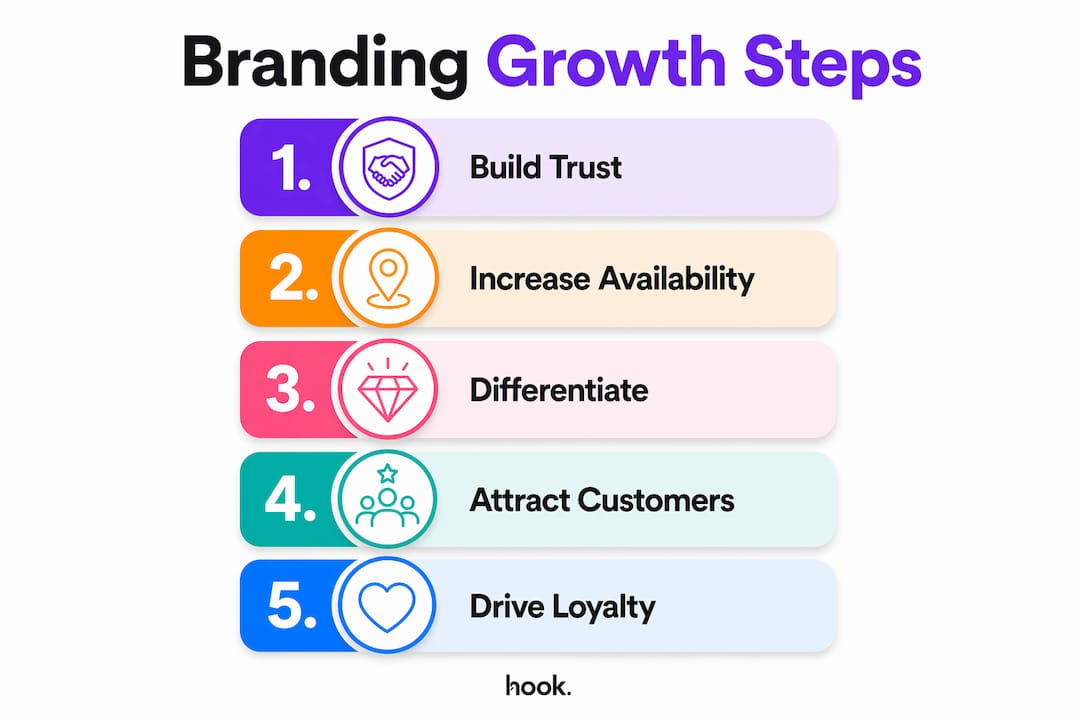
Physical availability is the ease with which a customer can actually buy from you. This covers distribution channels, stock levels, website usability, and presence on the platforms where buyers search. A brand can have strong mental availability and still lose sales because the purchase path is too difficult.
The Ehrenberg-Bass Double Jeopardy law shows a consistent empirical pattern: brands with fewer customers also have lower loyalty rates. The implication is direct. Sustainable growth comes from reaching more buyers, not from squeezing more loyalty out of the ones you already have. This matters enormously for how you allocate your branding budget.
Here is how the two types of availability compare in practice:
| Availability type | What it means | How to build it |
|---|---|---|
| Mental availability | Being thought of at the moment of purchase | Consistent use of distinctive brand assets across media |
| Physical availability | Being easy to find and buy from | Presence across relevant sales channels and platforms |
The practical steps to build both are straightforward:
- Develop a small set of distinctive brand assets, a logo, a primary colour, a tone of voice, and use them consistently across every channel.
- Map every place your customers buy or search, and make sure your brand is present there.
- Measure how often new customers find you versus returning customers. If new customer acquisition is stalling, your mental or physical availability needs attention.
- Use paid placements, marketplaces, and advertising spaces to build presence in environments you do not own. The Ehrenberg-Bass Institute calls this a “rent to buy” approach to prominence.
Pro Tip: Do not confuse brand loyalty with brand growth. The Double Jeopardy law shows that loyalty follows penetration, not the other way around. Focus first on being found by more people.
How branding differentiates your business and attracts better customers
Clear branding acts as a filter. Brands with a clear identity attract customers who are already aligned with their values, which reduces acquisition costs and improves retention. You spend less time convincing the wrong people and more time serving the right ones.

This filtering effect shows up in pricing power too. When a brand communicates quality, ethics, and reliability consistently, customers are willing to pay more. They are not just buying a product. They are buying the confidence that comes with a recognisable, trustworthy name. Apple, for example, commands a significant price premium not because its hardware is always the cheapest option, but because its brand signals a particular standard of experience.
The role of branding in business also extends to word-of-mouth referrals. Customers who feel an emotional connection to a brand are far more likely to recommend it. That referral behaviour is not accidental. It is the direct result of a brand that has communicated its personality clearly enough for customers to identify with it and share it.
Here is a comparison of how branded and unbranded businesses typically perform across key metrics:
| Metric | Strong brand | Weak or absent brand |
|---|---|---|
| Customer acquisition cost | Lower, due to recognition and referrals | Higher, requires more convincing |
| Pricing power | Greater, customers pay for perceived quality | Limited, competes mainly on price |
| Customer retention | Higher, emotional connection drives loyalty | Lower, customers switch easily |
| Word-of-mouth referrals | Frequent, customers identify with the brand | Rare, no identity to share |
The businesses that struggle most with differentiation are usually those that have not defined what they stand for. Without a clear brand personality, every sales conversation starts from scratch. With one, your reputation arrives before you do.
- A clear brand position reduces the time spent explaining your value to new customers.
- Emotional connection built through consistent branding generates repeat business without additional spend.
- Visible values attract customers who share them, creating a self-selecting loyal base.
- Pricing power grows when customers associate your brand with quality rather than just cost.
Practical steps to build effective branding for your business
Effective branding starts with your most important brand elements: a distinctive logo, a defined colour palette, a consistent tone of voice, and a clear statement of what you stand for. These are not decorative choices. They are the memory cues that make your brand retrievable at the moment a customer is ready to buy.
- Define your brand values explicitly. Write them down. Make sure they appear visibly on your website, in your communications, and in how your team speaks to customers. Values that live only in a document do not build trust.
- Audit your physical availability. List every channel where your customers search for what you sell. Check whether your brand is present, consistent, and easy to engage with on each one. Gaps here cost you sales regardless of how strong your mental availability is.
- Use your distinctive assets every time. Every social post, email, proposal, and advertisement should carry your brand’s visual and verbal identity. Consistency is what turns exposure into familiarity, and familiarity into trust.
- Track new customer acquisition separately from repeat purchases. If new buyers are not growing, your brand is not reaching enough people. The importance of branding for penetration is as significant as its role in retention.
- Align your brand with your customers’ values visibly. Given that the 2026 Edelman Trust Barometer shows rising insularity and value-based purchasing decisions, brands that communicate their ethics and community commitments clearly will face less resistance at the point of engagement.
Pro Tip: Avoid over-investing in loyalty programmes before you have built sufficient penetration. Focusing too heavily on loyalty at the expense of reaching new buyers limits your growth ceiling.
Key takeaways
Branding drives growth by making your business easier to think of and easier to buy from, which builds trust, attracts aligned customers, and creates sustainable competitive advantage.
| Point | Details |
|---|---|
| Branding builds trust | Consistent brand signals reduce perceived risk and convert hesitant buyers into customers. |
| Mental availability drives recall | Distinctive assets like logos and colours trigger brand memory at the moment of purchase. |
| Physical availability closes sales | Being present across all relevant channels ensures customers can act on their intent. |
| Values alignment matters | 42% of consumers avoid brands not aligned with their values, making visible ethics a commercial necessity. |
| Growth needs penetration | Reaching new buyers matters more than deepening loyalty with existing ones for sustainable growth. |
What I have learned about branding after years of working with businesses
Most business owners I speak with think of branding as the visual layer on top of their business. They want a new logo, a refreshed website, or a cleaner colour scheme. Those things matter, but they are outputs of a brand, not the brand itself.
The businesses that grow consistently are the ones that treat branding as an availability system. They ask: “Are we easy to think of? Are we easy to buy from?” Those two questions cut through a lot of noise. A beautiful logo on a website that nobody can find does nothing. A clear, consistent message delivered across every channel your customers actually use does a great deal.
The 2026 Edelman Trust Barometer data on insularity and value alignment is something I find genuinely important for UK businesses right now. Customers are becoming more selective. They are not just comparing prices. They are checking whether a business shares their outlook. That means your brand needs to say something real, not just something polished.
The businesses I see struggle most are those that chase loyalty before they have built reach. They invest in retention programmes and customer rewards while their brand remains invisible to the majority of their potential market. The Ehrenberg-Bass research on the Double Jeopardy law is clear on this: loyalty follows penetration. Build your audience first, then deepen the relationship.
Branding is not a one-time project. It is an ongoing commitment to showing up consistently, communicating clearly, and being present where your customers are. That is what marketing can do for your business when it is built on a solid brand foundation.
— Hook
How Hook-digital can help you build a brand that works
Hook-digital is a full-service marketing agency based in Oxford, and branding is at the centre of what we do. We work with business owners to build distinctive brand identities that create real mental and physical availability, not just attractive visuals.
Whether you are starting from scratch or refreshing an existing identity, our branding and design services cover everything from logo and visual identity through to brand strategy and messaging. We make sure your brand is consistent, values-led, and built to be found. You only need to talk to one agency. We handle the rest.
FAQ
Why is branding important for small businesses?
Branding helps small businesses build trust and recognition with customers who have never heard of them before. Consistent brand signals reduce perceived risk and make it easier for new customers to choose you over an unfamiliar competitor.
How does branding attract customers?
Branding attracts customers by building mental availability, the likelihood of being thought of when a purchase decision arises. Distinctive assets like logos, colours, and tone of voice trigger automatic recall at the moment a buyer is ready to act.
What is the role of branding in customer loyalty?
Branding builds the emotional connection and trust that keeps customers returning. However, the Ehrenberg-Bass Institute’s research shows that loyalty follows penetration, so reaching new customers through strong branding is what creates a loyal base over time.
How does branding affect pricing power?
A strong brand signals quality, reliability, and values, which allows businesses to charge more than unbranded competitors. Customers pay a premium when they trust a brand and identify with what it stands for.
How do I know if my branding is working?
Track new customer acquisition rates alongside repeat purchase rates. If new buyers are not growing, your brand is not reaching enough people. Measuring brand salience, how often customers think of you unprompted, is the clearest indicator of branding effectiveness.
Recommended
- Why Branding is Crucial for Your Business | Hook Digital - Oxford’s Premier Full-Service Marketing Agency
- What Are the Most Important Elements of Branding? | Hook Digital - Oxford’s Premier Full-Service Marketing Agency
- Branding & Design | Hook Digital - Elevate Your Business Identity
- How Marketing Can Transform Your Business | Hook Digital - Oxford’s Premier Full-Service Marketing Agency
.png)


