

.webp)

.svg)
Why consistent branding builds trust: a practical guide
Consistent branding builds trust by making your business predictable. When customers see the same visual identity, hear the same tone of voice, and receive the same quality of experience across every interaction, their brain registers reliability. That reliability is the foundation of trust. The psychological mechanism is well-documented: consistent visual and verbal cues lower cognitive load and act as trust heuristics, meaning customers use brand consistency as a shortcut to judge whether a business is competent and dependable. A systematic literature review confirms that brand image positively influences customer satisfaction and loyalty, with emotional and experiential dimensions driving the strongest effects.
The three elements that deliver this trust signal are:
- Visual identity — logo, colour palette, typography, and imagery used consistently across every channel
- Messaging and tone — a stable value proposition, consistent language, and a recognisable voice that sounds the same whether you are writing a social post or a proposal
- Experience alignment — the way your team behaves, responds, and delivers, matching the promise your brand makes
Get all three right and you are not just recognisable. You are trusted.
Key takeaways
Consistent branding builds trust by creating predictability across visuals, messaging, and experience, and that trust translates directly into measurable business outcomes including higher retention and faster conversion.
| Point | Details |
|---|---|
| Consistency is a management issue | Assign a single brand owner and approval workflow to prevent drift across teams. |
| Visual and operational elements both matter | Surface consistency (logo, colour) and experience consistency (service, tone) must align to build trust. |
| Cognitive fluency drives trust | Consistent cues lower cognitive load, making your brand feel reliable before customers consciously decide. |
| Measure what matters | Track NPS, retention rate, and time-to-conversion to see the commercial impact of brand consistency. |
| Hook-digital can help | Hook-digital’s branding service covers audit, guidelines, and governance for Oxfordshire businesses. |
Table of Contents
- What does brand consistency actually mean for your business?
- How visual identity creates recognition and builds credibility
- How a unified message and tone shape what customers believe about you
- Where inconsistency actually happens: the customer touchpoint map
- How consistent branding produces trust and measurable business outcomes
- Common branding inconsistencies that quietly erode customer trust
- How to maintain brand consistency: governance, tools, and an annual checklist
- Hook-digital’s 6-step approach for UK SMEs
- Hook-digital’s perspective: what we see when brands lose trust
- How Hook-digital can help you build a consistent brand
- Sources
- FAQ
What does brand consistency actually mean for your business?
Brand consistency is the practice of presenting the same core identity across every channel, format, and customer interaction. It covers the most important elements of branding — from the surface-level visual signals to the operational behaviours that customers experience directly.
There is a useful distinction between surface elements and operational elements:
- Surface elements: logo, colour palette, typography, photography style, iconography
- Operational elements: service delivery standards, response times, tone in customer communications, onboarding quality, complaint handling
Most businesses focus on the surface. The ones that build lasting trust focus on both. A beautifully consistent logo means little if your sales team communicates in a completely different register to your marketing team.
The core control points a marketing manager should own or directly influence are:
- A written brand guidelines document covering visuals, tone of voice, and messaging
- Content templates for social, email, and external communications
- Customer experience scripts or frameworks for common scenarios
- A centralised asset library accessible to every team that produces content
Think of brand consistency less as a design rule and more as a brand identity commitment. It is a decision to show up the same way, every time, regardless of channel or team.
How visual identity creates recognition and builds credibility
Your visual identity is the fastest trust signal you have. Colour, typography, and layout create pattern recognition before a customer reads a single word. When those patterns repeat reliably across your website, social channels, printed materials, and packaging, familiarity builds. Familiarity, in turn, lowers the perceived risk of doing business with you.
Design plays a central role in recognition and trust — not because good design is decorative, but because it signals that someone is paying attention. A business that maintains consistent visual standards communicates, without saying so, that it is organised and reliable. Inconsistent visuals send the opposite message: something is off, even if the customer cannot articulate what.
Practically, maintaining visual consistency requires three things:
- A design system — a single source of truth for all visual rules, including spacing, colour codes, and type scales
- An approved asset library — a centralised folder or digital asset management (DAM) platform where every approved logo, image, and template lives
- Asset naming conventions — clear file naming so teams can find and use the right version without guessing
Consistent brand print matters just as much as digital output. Brochures, business cards, and signage that deviate from your digital identity create a jarring disconnect for customers who encounter both.
Pro Tip: Set your brand colours as named swatches in every tool your team uses — Canva, Adobe, PowerPoint, Google Slides. One wrong hex code used across a hundred assets compounds quickly.
How a unified message and tone shape what customers believe about you
Visual consistency gets customers to recognise you. Messaging consistency gets them to trust you. The two work together, but they operate differently.
Your messaging is the set of claims, promises, and values your brand makes. Your tone of voice is the personality those claims are delivered in. When both stay stable across channels, customers build a coherent mental model of what your business stands for. When they shift, perceived authenticity drops and buyer uncertainty rises.
Repetition is not redundancy. For trust, it is responsibility. Leaders who repeat the same core beliefs across internal and external communications build alignment that shows up externally as credibility. A customer who hears the same value proposition from your website, your sales team, and your account manager is far more likely to believe it.
Practical steps to lock in messaging consistency:
- Define three to five messaging pillars — the core claims your brand always makes, regardless of format
- Write canned responses for the ten most common customer scenarios (enquiries, complaints, proposals, follow-ups)
- Create templates for external communications: email signatures, proposal intros, social captions, press statements
Pro Tip: Run a quick audit: pull five recent customer-facing communications from different channels and read them aloud. If they sound like they came from different companies, your tone of voice guide needs work.
Authenticity in branding is closely tied to how consistently you deliver on your promises. A brand that says one thing and does another loses trust faster than a brand that simply says less.
Where inconsistency actually happens: the customer touchpoint map
Trust is built or broken at touchpoints, not in brand guidelines documents. A touchpoint is any moment a customer interacts with your business, and the cumulative experience across all of them is what determines whether they trust you enough to buy, return, or refer.
The touchpoints where inconsistency most commonly appears are:
- Website — outdated copy, old logos, or a tone that no longer matches the brand
- Social media — different visual styles across platforms, or a posting voice that shifts depending on who is managing the account
- Sales conversations — messaging that contradicts what marketing has published
- Onboarding — a polished sales experience followed by a disorganised handover
- Customer support — response times and tone that vary depending on the channel (email vs. live chat vs. phone)
Misalignment between channels erodes trust even when your visuals are correct. A customer who sees a confident, professional brand on your website and then receives a poorly formatted email with a different logo does not think “the email team made a mistake.” They think “something is off about this company.”
Internal clarity is the foundation of external credibility. When your teams are aligned on what the brand stands for and how to communicate it, that alignment shows up in every customer interaction.
A quick touchpoint audit checklist:
| Touchpoint | Consistency check | Suggested owner |
|---|---|---|
| Website | Copy, visuals, and tone match current brand guidelines | Marketing manager |
| Social media | Visual templates and caption style are consistent | Social media lead |
| Sales collateral | Messaging aligns with marketing claims | Sales and marketing together |
| Onboarding materials | Tone and design match the brand | Operations or account management |
| Customer support | Response templates are on-brand and up to date | Customer service lead |
Aligning your marketing and sales teams is one of the highest-leverage steps you can take to close the gap between what your brand promises and what customers actually experience.
How consistent branding produces trust and measurable business outcomes
The psychological mechanism behind trust through consistent branding is cognitive fluency. When your brand is easy to recognise and process, customers experience less friction. Less friction feels like reliability. Reliability feels like trustworthiness. The effect is not subtle: consistent brands are perceived as substantially more trustworthy in both academic studies and practitioner reports.
The business outcomes that follow from that trust are concrete. Brand image drives customer satisfaction and loyalty, which translates directly into retention, repeat purchase, and referral. HBR research on customer surplus value shows that the perceived value customers associate with a brand predicts both their likelihood of staying and how much they spend — linking brand associations directly to revenue metrics.
Faster decisions, higher retention, lower acquisition costs, and greater willingness to pay are all downstream effects of a brand that customers trust. The KPIs to track this are:
- Brand recognition rate — tested via prompted and unprompted recall surveys
- Net Promoter Score (NPS) — a direct measure of trust and loyalty
- Customer retention rate — the clearest commercial signal of sustained trust
- Time-to-conversion — consistent brands typically shorten the decision cycle
- Cost per acquisition — trusted brands spend less to convert the same volume
Brand consistency also supports retention-focused marketing, where the goal is to be the brand customers save, share, and return to, rather than simply the one they saw most recently.
Common branding inconsistencies that quietly erode customer trust
Most branding failures are not dramatic. They are small, repeated inconsistencies that accumulate until a customer’s confidence quietly drops. Knowing which errors are most costly helps you prioritise where to fix first.
- Fragmented logos and colour use — multiple logo versions in circulation, off-brand hex codes used in presentations, or photography styles that shift between campaigns. The fix: a single approved asset library with access controls.
- Conflicting messaging across teams — marketing says one thing, sales says another, and the website says a third. Customers notice. The fix: shared messaging pillars and a brief onboarding session for anyone who communicates externally.
- Inconsistent tone of voice — formal on the website, casual on Instagram, and robotic in customer service emails. The fix: a tone of voice guide with examples for each channel.
- Variable service delivery — the experience of buying from you differs depending on which team member handles the interaction. The fix: service scripts and quality checks tied to brand standards, not just operational KPIs.
- Outdated assets still in use — old logos on email signatures, last year’s brand colours in a partner’s materials, or a stale “About Us” page. The fix: a scheduled quarterly asset review with a named owner.
Consistent branding reduces confusion and supports loyalty by reinforcing the same values and expectations at every touchpoint. Each inconsistency you remove is a small friction point eliminated from the customer’s experience.
How to maintain brand consistency: governance, tools, and an annual checklist
Consistency does not happen by accident. It requires a governance model, the right tools, and a regular audit rhythm. Operational reliability underpins external trust: when internal processes are predictable, customers perceive the brand as dependable.
Governance model
- Assign a brand owner — the single person accountable for brand standards. In a small business, this is often the marketing manager or agency partner.
- Appoint content gatekeepers for each channel — people who approve assets before they go live.
- Set an approval workflow for new assets: brief, create, review against guidelines, approve, publish.
- Define an SLA for asset updates — for example, all brand assets updated within 30 days of a brand refresh.
Recommended tools and processes
- A design system (Figma, Adobe XD, or similar) as the single source of truth for visual rules
- A digital asset management (DAM) platform (such as Bynder or Brandfolder) for centralised asset storage
- A tone of voice guide with channel-specific examples
- A training cadence — at minimum, a brief annual session for anyone who produces external content
Centralising tools and processes reduces the cognitive friction that leads to off-brand decisions. When the right asset is easy to find, teams use it. When it is buried in a shared drive, they improvise.
Tactical discipline in brand execution reduces re-education costs and marketing friction. Strict brand rules and centralised assets speed production and lower cost per lead over time.
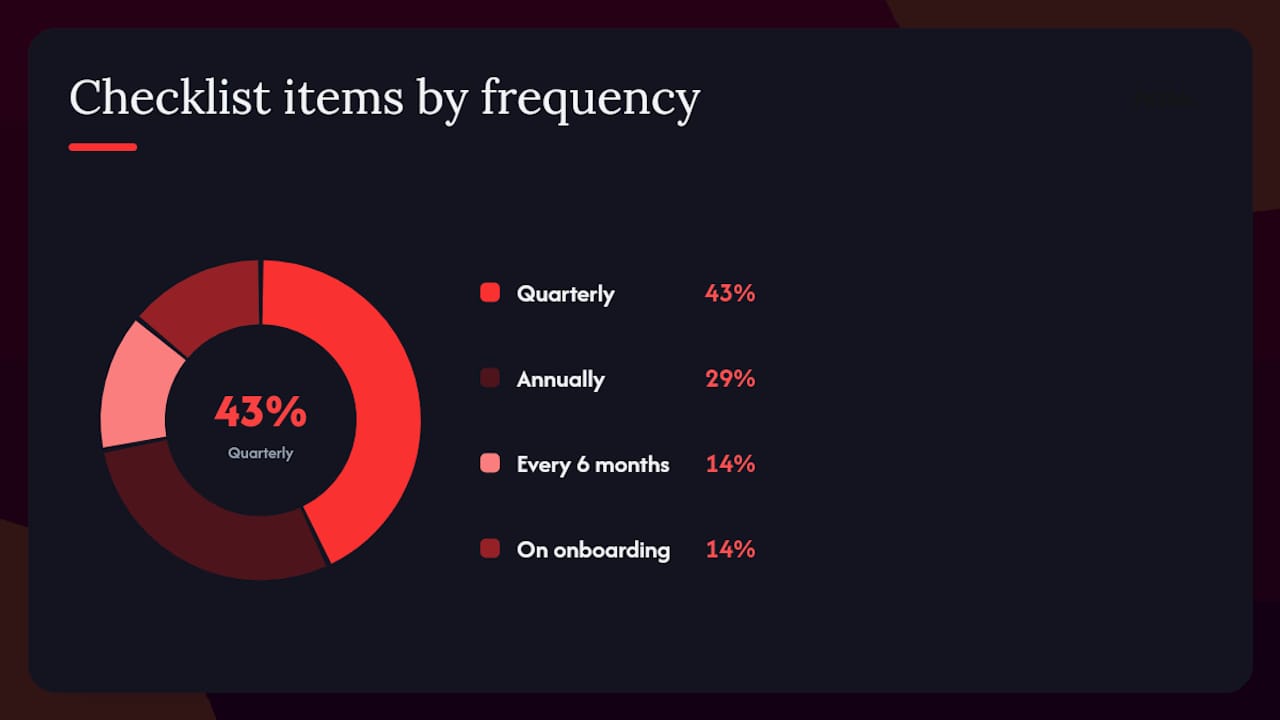
Annual brand audit checklist
| Check | Frequency | Owner |
|---|---|---|
| Visual assets reviewed and updated | Annually (or post-refresh) | Brand owner |
| Tone of voice guide reviewed | Annually | Marketing manager |
| Website copy and imagery audit | Every six months | Marketing manager |
| Social media template review | Quarterly | Social media lead |
| Customer communications audit | Quarterly | Customer service lead |
| Brand training for new starters | On onboarding | HR or marketing |
| Analytics review (NPS, retention, recognition) | Quarterly | Marketing manager |
Pro Tip: Schedule your brand audit at the same time each year — many UK businesses tie it to the start of the financial year in April. Pairing it with a budget review means you can act on what you find.
Keeping your brand fresh without breaking consistency is a balance. Evolve the expression of your brand gradually; never overhaul the core identity without a structured transition plan.
Hook-digital’s 6-step approach for UK SMEs
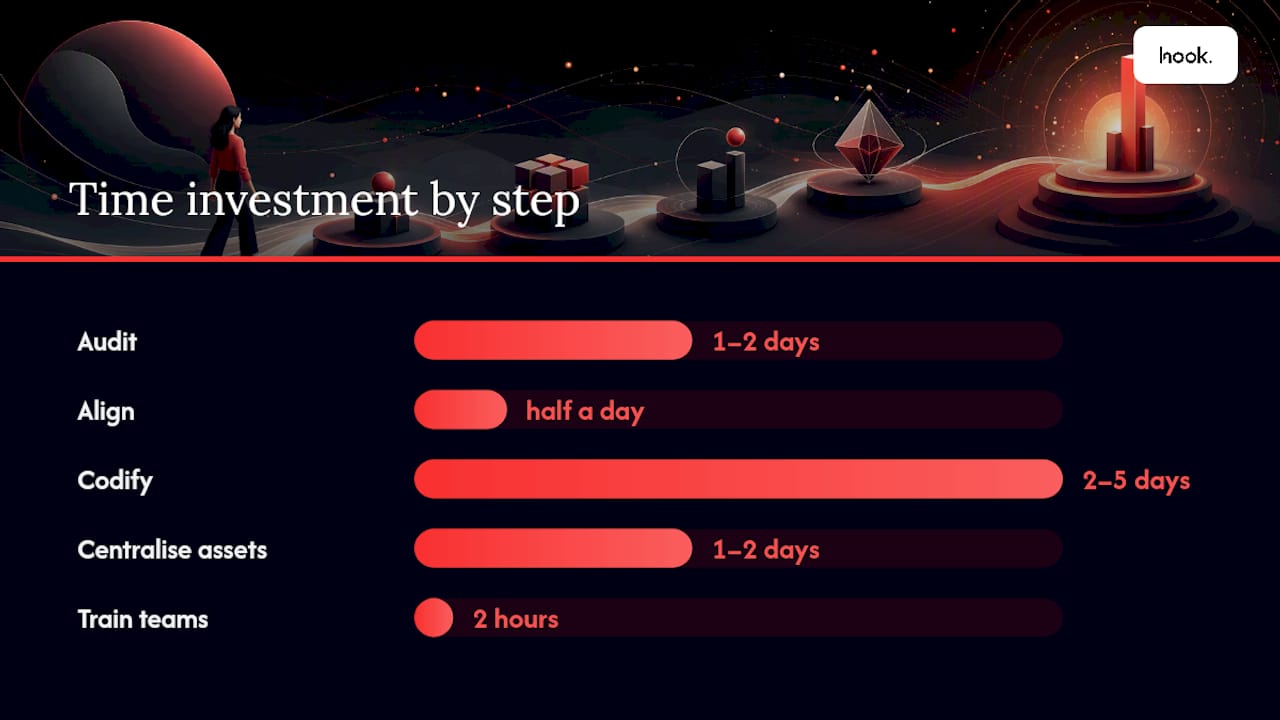
This checklist is designed for UK small and medium-sized businesses that want to build or tighten brand consistency without a lengthy agency engagement. Each step has a clear owner and a realistic time investment.
-
Audit — Review all current brand assets and customer-facing communications. Identify where visuals, messaging, or experience deviate from your intended brand. Time: 1–2 days. Owner: marketing manager or agency partner.
-
Align — Bring key stakeholders together (marketing, sales, customer service) to agree on the brand’s core values, messaging pillars, and tone of voice. Time: half a day. Owner: marketing director or MD.
-
Codify — Document everything in a brand guidelines document. Cover logo usage, colour palette, typography, tone of voice, and messaging pillars. Time: 2–5 days. Owner: brand designer or agency.
-
Centralise assets — Move all approved assets into a single, accessible location. Archive old versions. Brief every team on where to find approved materials. Time: 1–2 days. Owner: marketing manager.
-
Train teams — Run a short briefing for anyone who produces or approves external content. Cover the guidelines, the tools, and the approval process. Under GDPR, also confirm that any customer communications templates comply with your data and consent obligations. Time: 2 hours. Owner: marketing manager.
-
Monitor — Set quarterly check-ins to review brand consistency across key touchpoints. Track NPS, retention, and recognition metrics to measure progress. Time: ongoing. Owner: marketing manager.
| Step | Immediate outcome |
|---|---|
| Audit | Clear picture of where inconsistencies exist |
| Align | Shared understanding of brand values across teams |
| Codify | A single reference document everyone can use |
| Centralise assets | Faster, on-brand production with fewer errors |
| Train teams | Consistent output regardless of who creates the content |
| Monitor | Early warning system for drift and measurable proof of improvement |
Hook-digital works with Oxfordshire businesses at any stage of this process, from a first audit to a full brand refresh and governance rollout.
Hook-digital’s perspective: what we see when brands lose trust
The most common mistake we see UK SMEs make is treating brand consistency as a design problem. It is not. It is a management problem. The businesses that struggle most with inconsistency are not the ones with bad designers. They are the ones where no single person owns the brand across all the teams that touch it.
What actually works is deceptively simple: a short, clear brand guidelines document that everyone has read, a centralised asset folder that everyone uses, and one person who is accountable for both. That combination, applied consistently, outperforms elaborate brand systems that nobody follows.
There is also a tendency to over-invest in the visual refresh and under-invest in the operational alignment. A new logo does not fix a sales team that contradicts your marketing. A new website does not repair an onboarding experience that feels nothing like the brand promise. The importance of brand consistency lies in the whole system, not the surface layer.
The businesses we work with that see the clearest trust gains are the ones willing to do the less glamorous work: writing the tone of voice guide, briefing the customer service team, auditing the email signatures. That is where trust is actually built, one interaction at a time.
How Hook-digital can help you build a consistent brand
If your brand is sending mixed signals, the fastest way to fix it is a structured audit followed by a clear set of guidelines your whole team can use. Hook-digital offers exactly that, as part of a branding and design service built for Oxfordshire businesses that want to stop managing multiple suppliers and start seeing consistent results.

From brand audits and guidelines creation to full visual identity design and governance rollout, the Hook-digital team handles the process end to end. You get one point of contact, one coherent brand, and a clear next step at every stage. Whether you need a first set of brand guidelines or a complete refresh, the starting point is a discovery conversation where we map where your brand currently stands and what it would take to get it consistent.
Get in touch with Hook-digital to book a discovery call and take the first step towards a brand your customers can trust.
Sources
- The effect of brand image on customer satisfaction and loyalty (systematic literature review)
- New research on how brand associations drive customer spending
- Consistency builds stronger brands than creativity
- The importance of consistency in branding
- Consistent branding builds customer trust through reliability
- Branding and emotional connection (conference/journal paper)
FAQ
How does brand consistency build trust?
Consistent branding creates predictability, and predictability is the basis of trust. When customers encounter the same visual identity, tone, and quality of experience repeatedly, their brain registers the brand as reliable, which lowers the perceived risk of buying.
Why does branding matter for customer loyalty?
A systematic literature review found that brand image positively influences both customer satisfaction and long-term loyalty, with emotional and experiential dimensions driving the strongest effects. Customers who trust a brand return to it and spend more over time.
How does a business build trust through its brand?
Trust builds through repeated, aligned experiences across every touchpoint: website, social media, sales, onboarding, and support. Misalignment between any of these channels erodes confidence even when the visual identity is correct.
Why is consistency more important than creativity in branding?
Creativity attracts attention; consistency builds trust. Research suggests that leaders who repeat the same core messages and behaviours over time create internal alignment that shows up externally as credibility, which has a greater long-term commercial impact than novelty alone.
Recommended
- Why branding is important for business growth | Hook Digital - Oxford’s Premier Full-Service Marketing Agency
- Brand identity explained: a practical guide for businesses | Hook Digital - Oxford’s Premier Full-Service Marketing Agency
- Why Branding is Crucial for Your Business | Hook Digital - Oxford’s Premier Full-Service Marketing Agency
.png)


