

.webp)

.svg)
Stop ranking drops: hybrid AI & SEO workflow for marketers
AI-generated content can rank well, but only when it carries real human oversight, verified facts and demonstrable expertise behind it. Google’s own guidance rewards quality regardless of how content is produced, yet it penalises material made chiefly to game rankings. The practical rule for marketing teams is simple: treat AI as a drafting tool inside a hybrid editorial workflow, never as a publishing shortcut.
TL;DR:
- AI-assisted content speeds up drafting and optimization but requires human verification, sourcing, and expertise to meet Google’s quality standards.
- Fast indexing of AI-generated pages does not guarantee long-term rankings, as authority signals and original insights are essential for durability.
- Structured HTML, clear headings, author attributions, and schema markup significantly improve the chances of generative systems citing your content.
- Monitoring should include impressions, dwell time, and citations over time, as rankings alone do not reflect true content performance.
- Implementing a strict editorial process with source checks, staged publishing, and defined KPIs prevents quality loss and mitigates SEO risks.
Table of Contents
- What Google says about AI-generated content and why it matters
- Does AI content work for SEO? Benefits and risks for marketers
- Practical AI-assisted editorial workflow for SEO
- E-E-A-T, credibility and structural formatting for generative search visibility
- Measuring performance and avoiding common failure modes
- Editorial checklist: controls to use every time you publish AI-assisted content
- Comparison of AI content tools and their SEO effectiveness
- How we apply these principles day to day
- How we help you build AI-safe SEO workflows
- FAQ
- Sources
What Google says about AI-generated content and why it matters
Google’s public guidance has been consistent on one point: it rewards quality over origin. Search’s own documentation states that automation is not disallowed as long as the content is high-quality and not primarily intended to manipulate rankings. That distinction matters more than the production method itself.
For marketing teams, this changes how we think about authorship and accountability. A byline, a named editor and a visible fact-check trail all signal that a human has taken responsibility for what is published, which is exactly what separates acceptable automation from manipulative content farming.
In practice, this guidance translates into a few operational habits:
- Treat every AI draft as unpublished until a named editor has verified claims, sources and tone.
- Disclose where content has been AI-assisted if your audience or industry expects transparency.
- Hold new AI-assisted pages in staging or behind a noindex tag until editorial sign-off is complete.
These aren’t bureaucratic extras. They are the mechanism that keeps a hybrid workflow on the right side of Google’s own standards.
Does AI content work for SEO? Benefits and risks for marketers
AI genuinely speeds up parts of the content process: ideation, outlining, first drafts, meta descriptions and on-page optimisation all benefit from automation. Teams that once spent days briefing and drafting can compress that into hours, freeing editors to focus on judgement rather than typing.
The risks sit on the other side of that same coin:
- Thin or templated content that reads the same as thousands of competing pages.
- A lack of demonstrable authority or first-hand insight that readers and algorithms both notice.
- Ranking gains that appear fast but fade just as quickly once the novelty wears off.
A 16-month controlled experiment found that AI-only pages on new domains were indexed quickly, but rankings declined sharply once the initial visibility window closed, because the pages lacked authority signals and original insight. That single finding should shape how every marketing team plans AI content: fast indexing is not the same as durable visibility, and the gap between the two is exactly where unmanaged AI publishing fails.
Practical AI-assisted editorial workflow for SEO
A workable hybrid workflow has clear stages, clear owners and clear gates. Here’s a sequence that holds up under real publishing pressure:
- Brief the topic with target keywords, search intent, required sources and any schema or structural requirements.
- Generate a draft using AI, with prompts that explicitly require cited sources, forbid unverifiable claims and specify the target reading level.
- Fact-check and edit the draft against named sources, removing anything that cannot be verified.
- Add expertise through named author input, original data, quotes or examples that an AI model could not produce on its own.
- Stage the page behind noindex or in a draft environment for internal review.
- Publish and monitor indexation, impressions and engagement over a defined window before treating the page as finished.
Good prompts do more work than people expect. Ask for sources, specify the keyword and schema requirements, and state the tone you want. Never ask a model to “write confidently” about a fact it cannot verify, that instruction almost guarantees a hallucinated claim.
Roles matter as much as steps. One person owns factual accuracy, another owns editorial voice, and a third signs off on publication. When those three roles collapse into one person working quickly, quality control usually collapses with them.
Pro Tip: Build your AI prompts around a fixed template that always requests sources and flags any claim it cannot support, so your editor’s job becomes verification rather than detective work.
E-E-A-T, credibility and structural formatting for generative search visibility
Search no longer just ranks pages, it increasingly extracts and cites specific passages inside AI Overviews and other generative summaries. Content that wants to be trusted and cited needs both credibility signals and a structure that machines can parse easily.
On credibility, a few actions carry real weight:
- Attach a named byline and a short author bio that establishes relevant expertise.
- Cite primary sources rather than paraphrasing secondary summaries.
- Include original data, examples or expert commentary that cannot be found verbatim elsewhere.
On structure, well-anchored HTML answer units materially increase the probability that generative systems will extract and cite a page, according to controlled research on generative engine optimisation. In practice that means short, direct answer paragraphs under clear headings, definition-style lists where appropriate, and header-answer pairs that mirror the way a reader would phrase a question.
Schema markup reinforces this further. FAQ schema, Article schema with author and publisher fields, and clear heading hierarchies all help both traditional search and generative systems understand what a page is and who stands behind it. A well-structured website makes this far easier to maintain consistently across a growing content library.
Measuring performance and avoiding common failure modes
Rankings alone tell an incomplete story. Indexation stability, organic impressions, click-through rate, dwell time and citation inside AI Overviews all matter more than a single position check.
Generative search often draws on a different and broader set of sources than organic results, appearing for a large share of representative queries and favouring well-structured content for citation. That means a page can rank respectably in organic results while being invisible inside AI Overviews, or the reverse, so tracking both separately has become necessary.
The same 16-month experiment referenced earlier showed a pattern worth watching for directly: quick indexing followed by a visibility collapse once authority signals failed to materialise. Watch for these red flags:
- Indexation that arrives fast but impressions plateau or fall within weeks.
- Dwell time well below similar pages, suggesting the content doesn’t satisfy intent.
- No inbound links or citations appearing months after publication.
When these appear, the remediation path is straightforward: rewrite with added expertise and original insight, consolidate thin pages with canonical tags, or roll back to noindex while the content gets a substantial human rework. Our guide to SEO’s role in demand generation covers how to tie these metrics back to commercial outcomes rather than vanity rankings.
Editorial checklist: controls to use every time you publish AI-assisted content
A short, repeatable checklist protects quality far better than relying on individual editors to remember every rule.
- Originality check: run the draft through plagiarism and AI-detection tools, then compare it against top-ranking competitors for overlap.
- Source verification: confirm every factual claim traces back to a credible, named source.
- Author credential: attach a real byline and bio before the page leaves staging.
- Structure and schema: confirm headings, answer units and schema markup are in place.
- Staged indexation: publish behind noindex or in draft, then release once editorial sign-off is complete.
- Monitoring window: track indexation, impressions and engagement for at least four to six weeks before judging success.
Pro Tip: Set a hard KPI threshold before publishing, such as a minimum click-through rate by week six, so the decision to rewrite or roll back is based on a pre-agreed number, not a debate after the fact.
Comparison of AI content tools and their SEO effectiveness
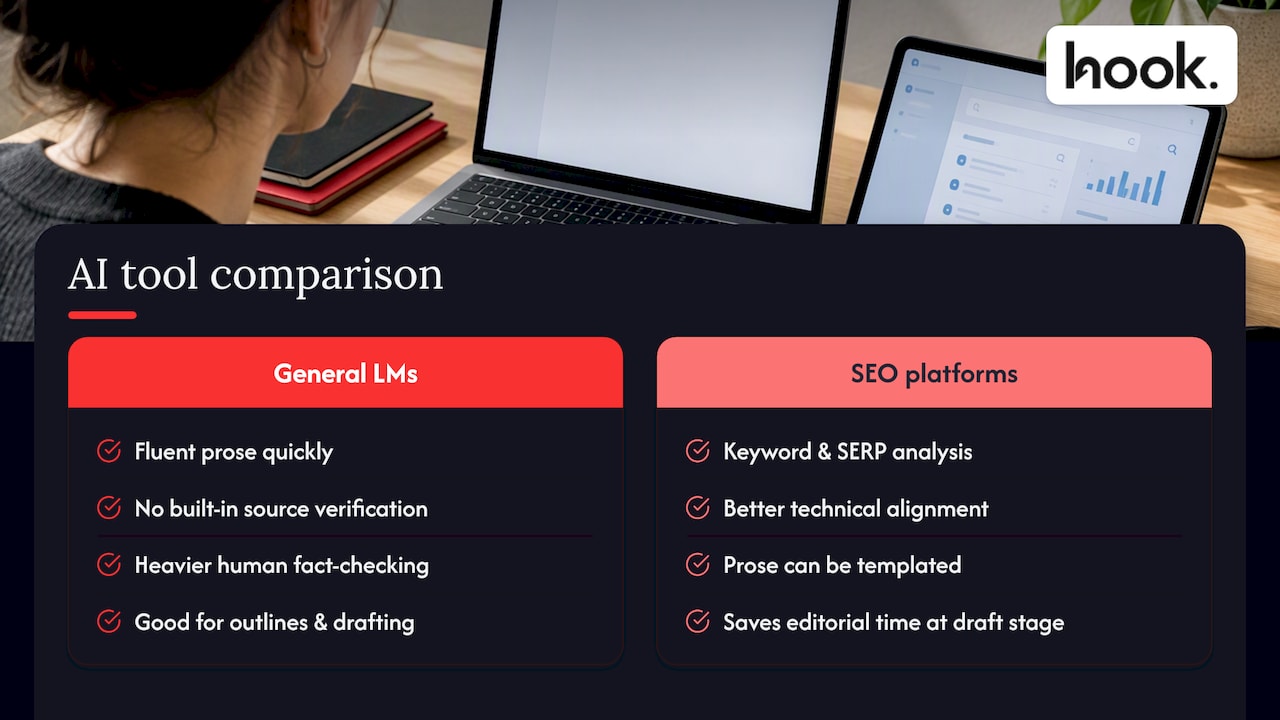
Most AI writing tools fall into two broad camps: general-purpose language models used for drafting, and SEO-specific platforms that layer keyword and SERP analysis on top of generation. General-purpose models tend to produce fluent prose quickly but need heavier human fact-checking, since they have no built-in mechanism for verifying claims against current sources. SEO-focused platforms often score better on technical alignment, suggesting keywords, headings and meta structures that match ranking competitors, but the prose they generate frequently needs a stronger editorial pass to avoid sounding templated.
Practitioner guidance generally recommends treating AI as a research and optimisation tool first, and a drafting assistant second: use it to surface competitor gaps, generate outlines, and draft meta tags, then rely on human editors for the final voice and fact-check. Editors who want a quick way to sanity-check a draft before publishing can also look at the common signs that reveal AI authorship, many of which overlap with the thin, generic phrasing that search engines also penalise.
No tool on the market removes the need for a human editor with subject knowledge. The platforms differ mainly in how much editorial work they save at the drafting stage, not in whether that editorial work is still required.
How we apply these principles day to day
We run technical SEO audits and hybrid editorial reviews as standard parts of client content programmes, because the two problems, indexing issues and thin content, usually show up together. Our 90 Minute Technical SEO Audit is built specifically to find what’s quietly blocking indexing before a content strategy even begins.
We also pair AI drafting tools with human creative input rather than letting either work alone, an approach we’ve written about in more depth when comparing human and AI-assisted output. Teams considering a pilot programme or a full content audit are welcome to start with a conversation about where their current workflow has gaps.
— Hook
How we help you build AI-safe SEO workflows
Running a hybrid content workflow well takes more than good intentions; it takes technical checks, editorial discipline and someone accountable for the whole process. We bring all of that under one roof rather than asking you to coordinate separate specialists for audits, content and design.
If you’re weighing up where AI fits into your content plan, a few starting points make sense:
- A technical SEO audit to confirm your site structure supports indexing and extraction.
- A content pilot that tests the hybrid workflow on a small batch of pages before wider rollout.
- Ongoing SEO and performance optimisation to monitor results and adjust as algorithms shift.
Get in touch through our full service marketing page to talk through what a pilot could look like for your content programme.
FAQ
Can I use AI content for SEO?
Yes, provided a human editor verifies facts, adds genuine expertise and takes editorial responsibility before publication. Google’s guidance rewards quality regardless of production method but penalises content created mainly to manipulate rankings.
What is the 30% rule for AI?
Definitions circulating online vary widely, so it’s safer to focus on verified editorial oversight and demonstrable expertise rather than any specific percentage of AI-generated text.
Is SEO still relevant with AI?
SEO remains relevant because generative search systems still rely on crawlable, well-structured content to generate answers and citations. Research shows AI overviews draw on a different, often broader set of sources than traditional organic results, which makes structure and credibility more important, not less.
Is there an AI that can do SEO?
AI tools can assist with keyword research, drafting, meta optimisation and schema generation, but none currently replace human judgement on strategy, fact-checking or editorial quality. Treating AI as a research and drafting aid within a human-led workflow tends to produce more reliable results than relying on it for end-to-end SEO decisions.
How do I know if my AI content is hurting my rankings?
Watch for fast indexing followed by stagnant or falling impressions, low dwell time, and no inbound citations after several months, all signs seen in a 16-month study of AI-only content performance. If those patterns appear, rewriting with added expertise or temporarily setting pages to noindex are the usual remediation steps.
Sources
- How generative AI disrupts search: An empirical study of Google Search, Gemini, and AI overviews
- Beyond the blue link: Empirical evaluation of generative engine optimisation in stochastic retrieval systems
- How AI-generated content performs in Google Search: A 16-month experiment
.png)


