


Instagram Reels Ideas for Your Business: 25 Formats

The best Instagram Reels ideas for a business are the ones that give people something: a quick lesson, a look behind the scenes, a transformation or a face they can get to know. This guide gives you 25 formats grouped by what you want a Reel to do, a simple hook formula, and a four-week plan, so you can stop staring at a blank screen and start filming.
TL;DR
- Reels that tend to work for businesses teach something, show how things are made, reveal a before and after, or put a real person on screen. Hard selling tends to do worse.
- The first one to two seconds decide whether anyone stays. Open with movement, bold text or a question, not a logo or a greeting.
- Pick three or four repeatable formats and turn them into a series, rather than hunting for a fresh idea every week.
- A phone is enough for most Reels. Spend professional budget on the footage you will reuse for months.
- Add UK detail, such as local places, the language your customers use and the questions they actually ask, so the Reel does not feel like it could be from anywhere.
Table of Contents
- What kind of Reels work for businesses
- Get the hook right first
- Reels ideas to introduce your business and your people
- Reels ideas that show your expertise
- Reels ideas that show your work and products
- Short video you already have, turned into Reels
- Using trends without looking generic
- Do you need a professional crew or a phone?
- A four-week plan you can start with
- Our view: consistency beats cleverness
- Where we can help
- FAQ
- Sources
What kind of Reels work for businesses
Across the guides we reviewed, the same four formats come up again and again for business accounts: educational content, behind-the-scenes process videos, before-and-after transformations and recreations of trending audio. Hootsuite’s 2026 guide describes them as shifting a brand from purely promotional posts to content that entertains or gives value.
The format itself matters too. Sprout Social’s UK trends report points to short video under 60 seconds as the dominant engagement format on Instagram in 2026, with a 52% interaction rate on the network and half of user time. You do not need to chase length. A Reel that makes its point in 15 to 30 seconds is usually easier to make, easier to finish and easier to watch twice.
One more finding is worth knowing before you plan. A study of 11,861 business Reels covering January to June 2026 found direct sales content got roughly a quarter fewer likes per view. It also found that asking people to comment a keyword increased comments but not views. Treat that as one data set, not a law, but it matches what most business owners see: people did not open Instagram to be sold to.
Get the hook right first
People often ask about the “three-second rule”. It is not an official Instagram rule. It is shorthand for a pattern: if the opening does not give a reason to stay, viewers scroll on. Practical guidance suggests skipping long introductions and using bold on-screen text, sudden movement or a provocative question in the first one to two seconds to stop the scroll.
Here are five opening lines you can adapt to almost any industry:
- The mistake: “Three things we see on every new website that cost you enquiries.”
- The result: Start on the finished product, then rewind to how it began.
- The question: “Would you pay £X for this? Here is what actually goes into it.”
- The myth: “You do not need a huge budget to do this.”
- The movement: Open mid-action, such as hands unwrapping a parcel, a door swinging open or a shutter lifting.
Two habits help every hook. Put the key words on screen as text, because many people watch with the sound off. And cut the first second of dead air before you speak: trim the clip so the first frame already has something happening.
Reels ideas to introduce your business and your people
If your account is new, or your audience does not know who is behind the business, start here. Trust is the first job. These formats are the ones small business guides, such as this set of Reel script ideas, recommend for introductions.
- The 20-second introduction. Who you are, who you help, and the one thing you want to be known for. Film it standing in your workplace, not at a desk.
- Meet the team. One person per Reel: their role, what they do in a normal week, and one personal detail such as a favourite biscuit or a first job.
- The origin story. Why you started, in three sentences. Use old photos as cutaways.
- A day in the life. Speed it up, caption the times (“7:45, first coffee”) and end on the thing you are proudest of that day.
- Staff achievements. A qualification passed, ten years in the job, a new apprentice’s first week. These are easy to film and make employers look like good places to work.
- Your values in action. Instead of saying you care about quality, show the moment you redo something because it was not right.
Reels ideas that show your expertise
This is where most businesses should spend most of their Reels. Expertise content is useful, so people save it and share it, and it answers the questions customers ask before they buy.
- One tip in 20 seconds. A single, practical tip. Not five.
- Myth versus reality. Pick a belief your customers hold that is wrong and correct it kindly.
- The FAQ Reel. Take the question you answer most often and answer it on camera. Use the question as the on-screen text.
- Mini tutorial. Show the steps to do one small task, such as setting up a profile, checking a document or caring for a product.
- Mistakes we see. Three common errors and how to avoid them. It works because people recognise themselves in it without feeling lectured.
- Reacting to a trend in your industry. A short, opinionated take on a change that affects your customers. Keep your opinion clear and your facts checked.
- Tool or kit tour. Show what you use and why. Specialist tools are fascinating to people outside the trade.
Reels ideas that show your work and products
Showing what you make or do is the easiest way to prove quality without writing a claim.
- Before and after. The classic. A cleared room, a redesigned logo, a rebuilt page, a repaired item. Keep the “before” short and the “after” the longest part.
- Behind the scenes of a project. Time-lapse the work, then cut to the finished result.
- Product spotlight. One product, one benefit, one detail people miss. Film it in use rather than on a plain background.
- Unboxing or packing an order. Satisfying to watch and shows you care about the details.
- Customer result. With permission, show what a customer achieved. A short quote on screen is enough.
- The making of. How long it takes, how many steps, what can go wrong. People value things more when they see the effort.
Short video you already have, turned into Reels
If you already own video, you are partway there. Many short video ideas can be adapted without reshooting from scratch:
- Cut-downs of a longer film. A three-minute brand film contains five or six 15-second moments. Our piece on corporate video types explains how one shoot can feed several channels.
- Testimonial clips. Pull the single best sentence from a customer interview and caption it.
- Event highlights. A trade show, open day or launch, cut to the beat of a track.
- Slideshow or carousel adaptation. Turn a popular carousel post into a Reel with one point per second or two, with on-screen text.
- Webinar or talk snippets. Use the 30 seconds where you made the clearest point.
- Photo sets in motion. A set of product or team photos with movement and music can work when you have no time for a video shoot.
The planning part matters here. If you know you will want Reels from a shoot, tell your videographer before the day, so they can film vertical, leave space for captions and capture a few extra seconds of movement at the start and end of each shot. Why a business benefits from professional videography covers the wider case.
Using trends without looking generic
Trends are a shortcut to reach, but copied trends make every business look the same. Three ways to avoid that:
- Add your own subject matter. The format is borrowed. The content should only be yours. A trending audio clip is more interesting when a plumber, an accountant or a florist uses it to show something real from their day.
- Make it local and British. UK-focused creator guidance suggests that references to British language and local topics, such as ISAs, pension rules, the NHS or the property market, can help content match what UK audiences are looking for, according to this UK Reels guide. For an Oxfordshire business the equivalent might be a local landmark, a market day, the commute or the term-time rush.
- Break your own routine. The 11,861-Reel study mentioned above notes that successful Reels often step outside an account’s usual pattern: filming outdoors, bringing in a guest or trying a new trend format. If your last ten posts were all product shots, film something different.
Humour is worth a mention. The same study found it in 27% of the most successful Reels and in 16% of typical ones, and acted skits were more common among hits. That is a pattern, not proof. If humour suits you and your customers, try it. If it does not, do not force it.
Do you need a professional crew or a phone?
For most Reels, a phone is enough. Guidance aimed at small businesses, such as this ideas list, suggests a smartphone can capture the raw, authentic style that suits the format better than polished commercial production.
A simple rule of thumb:
| Reel type | Phone is fine | Consider professional help |
|---|---|---|
| Quick tip, FAQ, team intro | Yes | Only if you want consistent branding |
| Behind the scenes, day in the life | Yes | Rarely |
| Product or commercial shots | Sometimes | When the product needs good lighting and detail |
| Brand film, testimonials, launch films | Rarely | Yes, especially if you will reuse them across channels |
| Team portraits and brand photography | No | Yes |
In practice, a blend works best: phone footage for the weekly rhythm, and a professional shoot once or twice a year for the assets you will reuse in Reels, on your website and in adverts.
A four-week plan you can start with
Series content is easier to produce and easier for followers to come back to. Sprout Social’s UK report notes that series-based content reduces creative fatigue for teams and builds “appointment viewing” habits, which supports long-term familiarity with the algorithm. If you want to understand how that works, our explainer on how social media algorithms work is a good place to start.
Here is a simple plan for one post a week:
| Week | Reel | Goal |
|---|---|---|
| 1 | Meet the team (one person) | Familiarity |
| 2 | FAQ: the question you hear most | Trust and saves |
| 3 | Behind the scenes of a current job | Proof of quality |
| 4 | Before and after | Enquiries |
Then repeat with new people, questions and projects. After four weeks, look at which Reel kept people watching and which got saved or sent to someone else, and make more like those. Plans like this sit inside a wider approach, which we cover in developing a social media strategy that works.
Our view: consistency beats cleverness
We work with Oxfordshire businesses on branding, video, photography, websites, social media and Google Ads, and the pattern we see is simple. Businesses rarely fail at Reels because they lack ideas. They fail because each Reel is a one-off, made in a rush, with no link to the rest of their marketing.
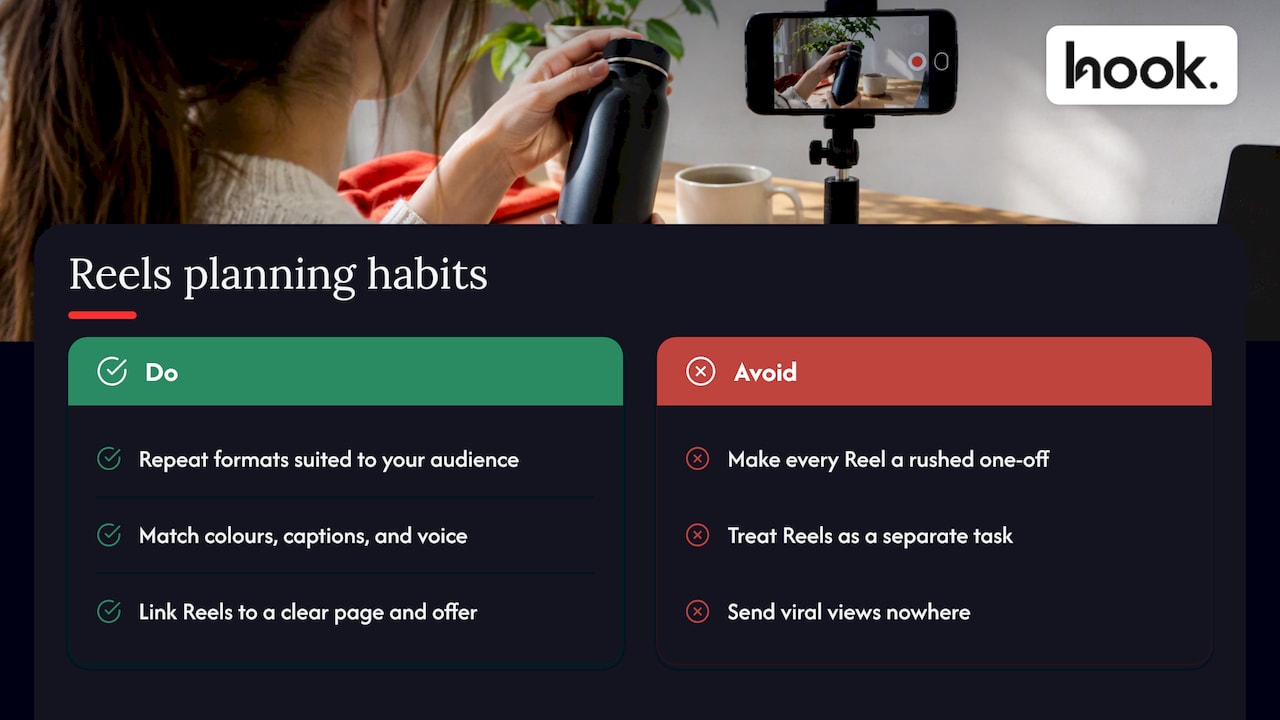
So we suggest three things. First, choose a small set of formats that suit your people and repeat them. Second, make the Reel match your brand, from colours and captions to the way you speak, so that someone who sees it next to your website recognises you. Third, treat Reels as one part of a joined-up plan, not a separate task. A Reel that points to a clear page, a tidy profile and a good offer does more than one that goes viral and sends people nowhere.
That is why we built Hook around the idea that you should only have to talk to one agency. When your video, design, website and social media are handled together, your Reels look like your business, and they are easier to plan because the assets already exist.
— Hook
Where we can help
If you would like Reels without the juggling, we can plan the formats, film or edit the footage and manage your posting as part of our social media and PPC service. If you want footage that works across Reels, your website and adverts, our video production team can plan one shoot to produce several pieces. And if you would like it all in one place, see full service marketing. Our scopes are tailored to your business, with no forced packages, and you can get in touch to talk through what you need.
FAQ
What kind of Reels do well on Instagram?
Educational tips, behind-the-scenes process videos, before-and-after transformations and trend-based formats are the ones most business guides point to. What they share is that they give the viewer something, such as knowledge, entertainment or a satisfying result. Direct sales pitches tend to get fewer likes per view.
What is the 3-second rule on Instagram?
It is an informal guideline, not an Instagram rule. It means your Reel needs a reason to keep watching almost immediately, so you open with movement, bold text or a question rather than an introduction. Aim to make the first frame interesting and trim any silence at the start.
How long should a business Reel be?
There is no perfect length, but short video under 60 seconds is described as the dominant engagement format on Instagram in 2026. For most business ideas, 15 to 30 seconds is enough. Make the point, then stop.
How often should my business post Reels?
Choose a rhythm you can keep up, even if that is one a week. A regular series you can sustain is more useful than a burst of daily posts that fades after a fortnight.
Sources
- Instagram Reels for business in 2026: Best practices (Hootsuite)
- UK Instagram trends 2026 (Sprout Social)
- Instagram Reels Study 2026: 11,861 business Reels (Cadenus)
- Instagram Reel script ideas for small businesses
- Instagram Reels UK guide for creators 2026
- 10 best Instagram Reels ideas for business growth


