



UGC Strategy: How to Build One That Works for Your Business

A UGC strategy is a plan for getting your customers to create content about your business, and for using that content on purpose. It covers what you ask for, how you collect it, how you secure permission to reuse it, where it appears, and how you measure it. Without those five things, UGC is just luck: the occasional tagged photo that you may or may not be allowed to repost.
This guide is written for business owners and marketing managers in the UK who want UGC to do a job, whether that is more enquiries, better conversion or lower acquisition costs. It is not a list of viral stunts. It is a working method.
TL;DR
- UGC is any content (photos, videos, reviews, posts) made by customers rather than by you. A strategy decides how you ask for it, approve it, reuse it and measure it.
- UK shoppers trust peer content over influencer endorsements, so it is worth the effort, but only if it looks real.
- Photos and video of identifiable people are personal data under UK GDPR. Get written, specific permission for every use and keep a record.
- Blend UGC with professional assets. Polished content that fakes a casual look tends to backfire with British audiences.
- Start small: one clear ask, a handful of seed creators, and one or two KPIs you can actually track.
Table of Contents
- What a UGC strategy actually is
- Why UGC is worth the effort in the UK
- Step 1: Choose a goal and one or two KPIs
- Step 2: Make the ask tiny
- Step 3: Sort out rights and consent first
- Step 4: Blend UGC with professional work
- Step 5: Put UGC where buyers decide
- UGC campaign ideas that suit UK businesses
- A 90-day plan to get started
- Our perspective
- How Hook can help
- FAQ
- Sources
What a UGC strategy actually is
User-generated content covers photos, videos, reviews, testimonials, forum posts and social posts created by customers, not by your team. A strategy turns those one-off moments into a repeatable system.
It helps to think of it as three jobs:
- Set goals and guardrails. Decide what UGC is for (trust on product pages, cheaper ad creative, social proof for a long B2B sales cycle) and what you will not post.
- Collect and tag. Make it easy for people to contribute, and log where each piece came from.
- Redistribute. Place the best content where it helps a buyer decide: your website, emails, social and paid ads.
That three-step shape appears again and again in campaign breakdowns of what successful programmes share. Note that there is no official “3-3-3 rule” in UGC. If you see one quoted, treat it as someone’s personal framework.
If you are planning a campaign around a launch or event, a clear week-by-week marketing timeline is a useful companion, because UGC works best when the ask is scheduled, not improvised.
Why UGC is worth the effort in the UK
The case rests on trust. Research from Akeneo found that 65% of UK shoppers say reviews and peer-created content influence their purchases, against 58% for social media endorsements. The same release reports that the influence of influencer endorsements on British shoppers fell from 54% in 2023 to 50% in 2025.
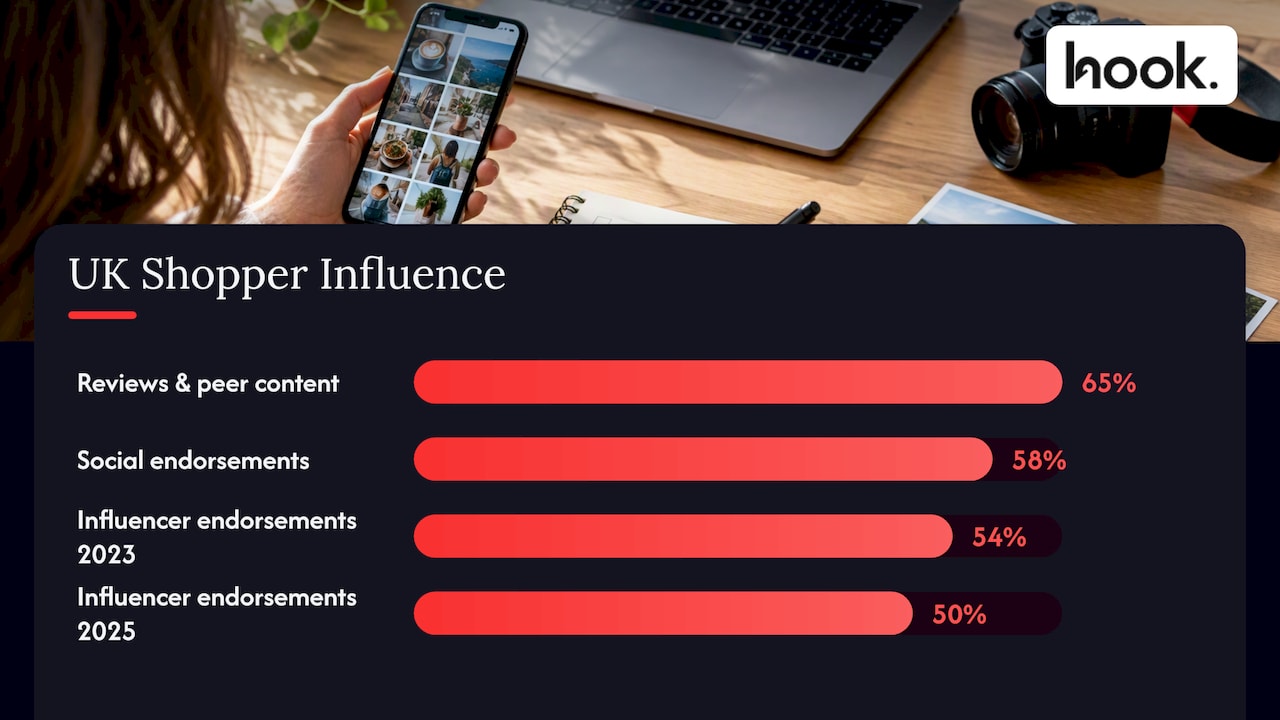
Analysts also describe UGC as social proof that lowers the perceived risk of buying. A customer’s photo says something your own copy cannot: someone else already did this and was happy.
It is also commercially sensible. Adobe’s guidance frames UGC as a way to de-risk content investment and tie assets to KPIs, such as conversion lift or lower customer acquisition cost. For a marketing manager asked to justify spend, that framing matters more than the “authenticity” talk.
One caution. Trust cuts both ways. When brands moderate badly, or when UGC contradicts the brand’s own messaging, credibility drops for both. That is why the guardrails come first.
Step 1: Choose a goal and one or two KPIs
Pick the job before the tactic. Common goals, and the number that shows whether they are working:
| Goal | Where the UGC goes | KPI to watch |
|---|---|---|
| Increase website conversion | Product or service pages, case study pages | Conversion rate on pages with UGC versus without |
| Lower ad costs | Paid social and retargeting creative | Cost per lead or cost per acquisition |
| Build credibility before a sales call | Website, proposals, email | Enquiry quality, win rate |
| Grow organic reach | Your social channels | Shares, saves, tagged posts |
Keep it to one or two. If you run ads as part of the mix, make sure placement results are tied to revenue, not just clicks. A guide to matching ad activity with profit-level metrics shows the kind of thinking involved, even though it is written for marketplace sellers.
Before any UGC reaches paid ads, check that your conversion tracking is sound. Our walkthrough on enabling enhanced conversions in Google Ads covers the common gaps.
Step 2: Make the ask tiny
The biggest reason UGC programmes stall is that the request is too big. “Share your story with us” asks for effort. “Send us one photo of it on your desk” asks for ten seconds.
A simple recipe, drawn from practical UGC how-to guidance:
- Define one action. One photo, one short review, one clip.
- Show an example. People copy what they can see.
- Give a reason. Recognition, a feature on your channels, a small reward or simply a thank-you.
- Ask at the right moment. Build the request into the post-purchase journey: the confirmation email, the follow-up after delivery, the end of a project.
That last point is what separates a repeatable engine from hoping for posts. If collection only happens when someone remembers, it will not happen.
Seed it before you scale it
Do not launch to an empty stage. Successful campaigns often seed content with 5 to 20 early creators so that the wider community has examples to follow. For a B2B or local business, that might be your five most enthusiastic clients, asked personally.
Step 3: Sort out rights and consent first
This is the step most businesses skip, and the one that can cause real trouble. Reposting a customer’s photo because they tagged you is not the same as having permission to use it in an advert.
Under UK GDPR, photographs and identifiable video of people are personal data. As UCL’s social media legal guidance explains, you need to be able to show a lawful basis and handle copyright properly. In practice, for commercial reuse, that usually means consent. A practical guide from a privacy training firm adds the working rules: explain where the image will be used, record consent, and let people withdraw it easily.
A workable rights process:
- Ask in writing, by direct message, email or a simple form, naming the specific use: website, newsletter, organic social, paid ads.
- Record who said yes, when, and to what. A spreadsheet is fine to start. Keep a screenshot of the original post and the reply.
- Credit the creator unless they ask you not to.
- Honour withdrawals promptly, and remove the content from future use.
- Do not stretch the permission. Consent for a Facebook repost is not consent for a paid ad or a billboard.
If you have any doubt about a particular use, especially involving children, employees of other companies or health-related images, speak to a solicitor or your data protection adviser before publishing.
Advertising rules still apply
If a customer posts about you and you did not pay them or give them anything, that is one thing. If you gave a freebie, a discount or any incentive, or the person has a commercial link to you, the ASA says the content must be obviously identifiable as advertising. The CAP Code also covers some of the content on a company’s own social channels. So if your ask includes a reward, plan how the resulting posts will be labelled.
Step 4: Blend UGC with professional work
There is a temptation, once you see UGC working, to produce a slick imitation of it. In the UK that tends to go badly. Research reported by Travel Weekly found that 88% of UK adults see a mix of high-quality professional photography and authentic UGC as crucial for brand trust, and commentary on the findings points to scepticism towards content that tries too hard to look natural.
So the working approach is:
- Professional assets carry the brand. Hero images, brand video, team portraits and product shots set the standard.
- UGC carries the proof. Real customers, real settings, slightly imperfect lighting.
- Do not blur the two. Sprout Social’s UK ecommerce guidance recommends tagging systems that separate genuine community content from commissioned creator content on pages such as product listings.
This is also why consistency matters. UGC will look different from your own work, so your core identity needs to be strong enough to hold it together. We cover that in why consistent branding builds trust.
Step 5: Put UGC where buyers decide
Collecting content is half the job. Placement is where it earns its keep.
- Website. Add customer photos and quotes to service and product pages, not just a testimonials page nobody visits. Your site is the centre of your marketing, as we explain in why your website is the heart of your marketing strategy.
- Email. One customer story in a newsletter often outperforms a paragraph of your own copy. Keep the same consent rules in mind for email, since regulators including the ICO and ASA do pay attention to email marketing.
- Organic social. Reshare with credit and add your own comment, so it feels like a conversation. Our guide to developing a social media strategy that works shows where this fits in a wider plan.
- Paid social and retargeting. Approved UGC can make strong ad creative, because it looks like content people already scroll through. Always check your consent covers paid use first.
The broader shift towards content people share, save and send in DMs makes customer-made content more valuable, not less: it is the kind of thing people send to a friend.
UGC campaign ideas that suit UK businesses
You do not need a hashtag challenge with a six-figure prize. These formats work at modest budgets and fit most business types:
- “Show us it in the wild.” Ask customers for one photo of your product or finished project in use. Works for retail, hospitality and manufacturing.
- Review prompts with a face. Ask for a 20-second video review instead of a star rating. Short, easy, and far more persuasive on a service page.
- Behind-the-project posts. For service businesses, invite clients to share a photo from the day a project went live, such as a new shopfront, a new site or a finished event.
- Customer of the month. A simple recurring feature that gives clients recognition and gives you a steady stream of content.
- Community Q&A. Collect customer questions and answers in posts, then reuse the best as FAQs on your site.
Campaign roundups such as this collection of 21 UGC campaigns grouped by format can spark more ideas, but adapt them to your audience rather than copying them.
A 90-day plan to get started
Days 1 to 30: foundations
- Choose one goal and one or two KPIs.
- Write a one-page policy: what you will repost, what you will not, who approves.
- Build a simple consent form and a tracking sheet.
- Identify your 5 to 20 seed contributors.
Days 31 to 60: collect
- Add the ask to your post-purchase email or end-of-project process.
- Invite seed contributors personally with a clear example.
- Review and tag everything that comes in, noting permitted uses.
Days 61 to 90: place and measure
- Add approved content to your top three pages and one email.
- Test one UGC-led ad against your current best creative.
- Compare results to your baseline and decide what to keep, change or drop.
Our perspective
Most of the businesses we speak to in Oxfordshire do not have a UGC problem. They have a joining-up problem. A client posts a lovely photo, nobody sees it, nobody asks permission, and it never reaches the website or an ad. The content exists, but the system does not.
We think UGC works best when it sits inside the rest of your marketing, not beside it. The brand identity gives it a frame. Professional photography and video set the quality bar so that customer content reads as proof, not as a cheap substitute. The website gives it a home. Social and paid campaigns give it reach. When those pieces are handled by different suppliers, the UGC falls into the gaps between them.
That is why we built Hook as one team. You talk to one agency, scopes are tailored rather than forced into packages, and our client portal keeps requests and updates in one place. We would rather start you with a small, well-governed UGC programme than a big campaign that creates rights headaches.
— Hook
How Hook can help
If you would like UGC to be part of a joined-up plan, our full service marketing team can cover the strategy, the professional photography and video that sit alongside customer content, and the social media and PPC that put it in front of buyers. Look at our pricing page to see how we scope work, or get in touch through our website.
FAQ
Is UGC still worth doing in 2026?
Yes, with a caveat. UK research shows peer content and reviews influence more shoppers than influencer endorsements. But audiences are quick to spot anything staged, so the value comes from real customer content, properly approved and placed well.
How do I start UGC as a beginner?
Pick one goal and one tiny ask, such as a single photo or short review. Show an example, give a reason to take part, and invite a handful of friendly customers first. Record their permission as you go, and add the best content to one page on your website before you scale up.
Do I need permission to repost a customer’s photo?
Yes, in most cases. Photos and video of identifiable people are personal data under UK GDPR, so you need a lawful basis, and for commercial use that usually means clear, recorded consent for the specific use. If the use is unusual or involves children, take legal advice first.
What is the difference between UGC and influencer content?
UGC comes from customers, usually unpaid and unscripted. Influencer content is commissioned or incentivised, so under ASA rules it must be clearly identifiable as advertising. Many brands use both, but label them differently on their own pages.
How do I measure a UGC strategy?
Tie each placement to a KPI before you launch: conversion rate on pages with UGC, cost per lead on UGC-led ads, or enquiry quality. Compare against a baseline from before you started. Avoid counting likes alone, as they rarely show commercial impact.
Sources
- Akeneo: Word of mouth beats paid influence
- Viral Manager: User-generated content examples
- Adobe: User-generated content guide
- SoPost: UGC, the new measure of authenticity
- Travel Weekly: Tui and consumer scepticism
- Sprout Social: UGC for UK ecommerce
- UCL: Social media best practice and legal resources
- Privacy Culture: Guide to photos, videos and social media
- ASA: Remit, social media
- Stay Legal: Legal guide to running a UK newsletter


